
Viperidae
African Bush Viper
VenomousAtheris squamigera
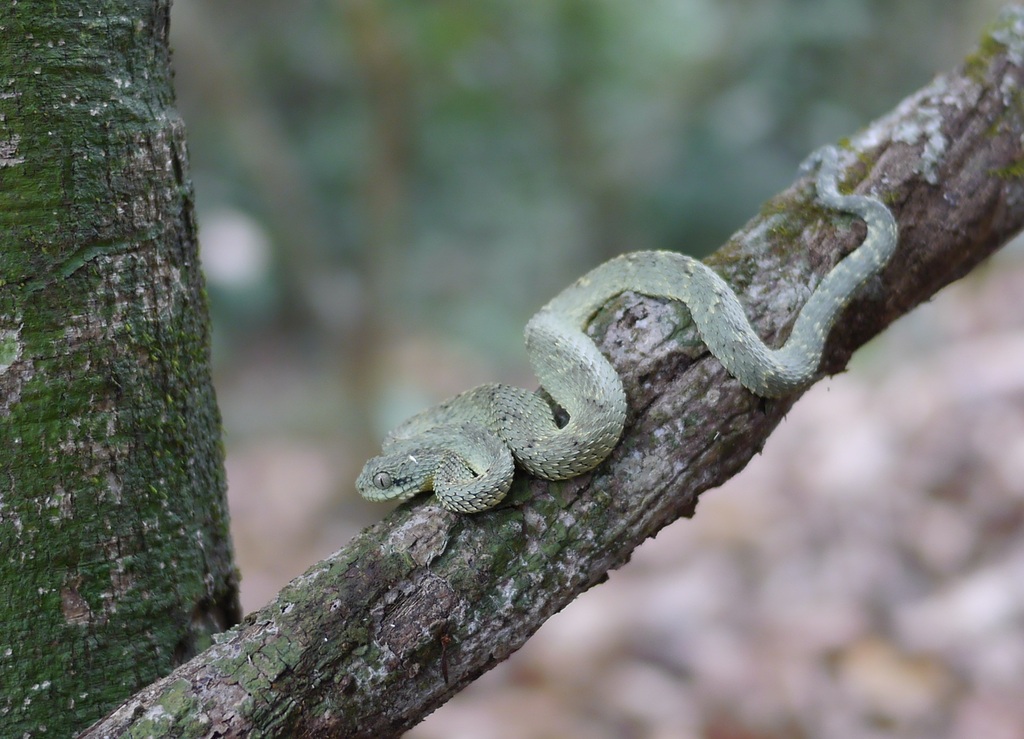
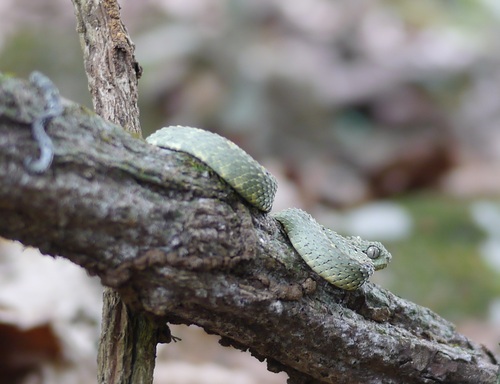
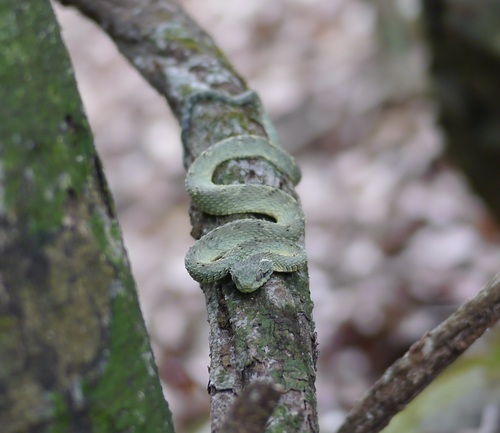
3 photographs of the African Bush Viper. © Matt Muir.
The African Bush Viper (Atheris squamigera) is a venomous snake in the Viperidae family, recorded in 16 countries.
If you are bitten
This is a venomous snake. Treat any bite as a medical emergency: stay calm, keep the bitten limb still and roughly level with the heart, remove rings and tight clothing, and get to emergency care immediately. Do not apply a tourniquet, cut the wound, apply ice, or try to suck out venom. Call your local emergency number or poison center.
- Family
- Viperidae
- Danger
- high
About the African Bush Viper
Atheris squamigera (common names: green bush viper, variable bush viper, leaf viper, Hallowell's green tree viper, and others) is a venomous viper species endemic to west and central Africa. No subspecies are currently recognized.
Description
Atheris squamigera grows to an average total length (body + tail) of 46 to 60 cm (18 to 24 in), with a maximum total length that sometimes exceeds 78 cm (31 in). Females are usually larger than males.
The head is broad and flat, distinct from the neck. The mouth has a very large gape. The head is thickly covered with keeled, imbricate scales. The rostral scale is not visible from above. A very small scale just above the rostral is flanked by very large scales on either side. The nostrils are lateral. The eye and the nasal are separated by 2 scales. Across the top of the head, there are 7 to 9 interorbital scales. There are 10 to 18 circumorbital scales. There are 2 (rarely 1 or more than 2) rows of scales that separate the eyes from the labials. There are 9 to 12 supralabials and 9 to 12 sublabials. Of the latter, the anterior 2 or 3 touch the chin shields, of which there is only one small pair. The gular scales are keeled.
Midbody there are 15 to 23 rows of dorsal scales, 11 to 17 posteriorly. There are 152 to 175 ventral scales and 45 to 67 undivided subcaudals. It is possible that there is a variation in morphometric characters related to habitat:
The coloration is the same in some populations, but variable in others. The dorsal color varies from sage green or light green to green, dark green, bluish, olive or dark olive brown. Rare specimens may be found that are yellow, reddish or slate gray. The scales have light-colored keels and sometimes yellow tips that form a series of 30 or more light crossbands or chevrons. On the tail, there are 10 to 19 chevrons: not always clearly defined, but usually present. The ventral edge of the dorsum has light spots in pairs. An interstitial black color is visible only when the skin is stretched. The belly is yellow or dull to pale olive; it may be uniform in color, or heavily mottled with blackish spots. The throat is sometimes yellow. The tail has a conspicuous ivory white tip, 7 to 12 mm long, extending back over 10 subcaudals.
Neonates have a dark, olive coloration with wavy bars, paler olive or yellowish olive with fine dark olive margins, bars at 5 mm (0.20 in) intervals, and a belly that is paler greenish olive. The adult color pattern develops within 3 to 4 months.
Reproduction in the wild
In the wild Atheris squamigeras begin reproducing once they reach sexual maturity at 42 months for females, and at 24 months for males respectively. Reproduction takes place once annually, most often during the wet season. A. squamigera is viviparous, and a single successful pairing can produce up to 19 neonates, although the average is 7–9. The female A. squamigera carries her young internally during a gestation period of two months. Following birth, the neonates are abandoned by the mother as they are born venomous and entirely self sufficient.
Diet and hunting
Adapted from Wikipedia, available under CC BY-SA.
Local and regional names
The African Bush Viper is known by these names across the regions where it lives:
- English
- Rough-scaled Bush Viper, Variable Bush Viper
- French
- Vipère arboricole verte, Vipère rugeuse
- German
- Rankschuppige Buschviper
Frequently asked: African Bush Viper
- Is the African Bush Viper venomous?
- Yes. The African Bush Viper (Atheris squamigera) is venomous and belongs to the Viperidae family (viper). Its bite is considered high risk to people. Treat any bite as a medical emergency.
- Is the African Bush Viper poisonous?
- Snakes are venomous, not poisonous. "Poisonous" means harmful to eat or touch; "venomous" means injecting toxins through a bite. The African Bush Viper is venomous, delivering venom through a bite.
- Is the African Bush Viper dangerous?
- This is a venomous snake. Treat any bite as a medical emergency: stay calm, keep the bitten limb still and roughly level with the heart, remove rings and tight clothing, and get to emergency care immediately. Do not apply a tourniquet, cut the wound, apply ice, or try to suck out venom. Call your local emergency number or poison center.
- Where does the African Bush Viper live?
- The African Bush Viper has verified records in 16 countries, including Cameroon, Congo, Democratic Republic of the, Kenya. See the distribution section below for its full range.
- What does the African Bush Viper eat?
- The diet of Atheris squamigera consists primarily of small mammals, although cases of cannibalism within the species have been documented. A. squamigera is a nocturnal hunter and its coloring allows it to blend in with its environment and ambush the small prey it feeds on. It is equipped with two front hollow fangs through which it injects its prey with hemotoxic venom rendering it defenseless.
- Why is it called the African Bush Viper?
- Common names for Atheris squamigera include green bush viper, variable bush viper, leaf viper, common bush viper, bush viper, tree viper, Hallowell's green tree viper. and Yété in Mongo.
If you are bitten by the African Bush Viper
Do
- Get away from the snake and stay calm. Most bites worsen when people panic or try again to handle the snake.
- Call 911 or Poison Control (1-800-222-1222) right away. Antivenom works best when given early.
- Note the time of the bite and, from a safe distance, the snake's color and pattern, a phone photo is enough. Do not chase it.
- Keep the bitten limb still and at roughly heart level. Sit or lie down and limit movement.
- Remove rings, watches, and tight clothing near the bite before swelling starts.
- Gently wash the bite with soap and water and cover it with a clean, dry dressing.
Do not
- Do not cut the wound or try to suck out the venom.
- Do not apply a tourniquet or ice.
- Do not drink alcohol or caffeine.
- Do not take aspirin or ibuprofen, they can worsen bleeding. Acetaminophen is safer for pain.
- Do not try to catch or kill the snake. A dead snake can still bite by reflex.
First-aid guidance adapted from the U.S. Centers for Disease Control and Prevention (CDC NIOSH), Venomous Snakes. Educational only; always follow the instructions of emergency responders.
Where it is found
More Viperidae snakes
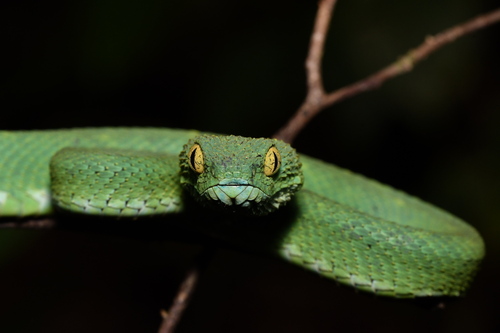 Green Bush ViperAtheris chlorechis
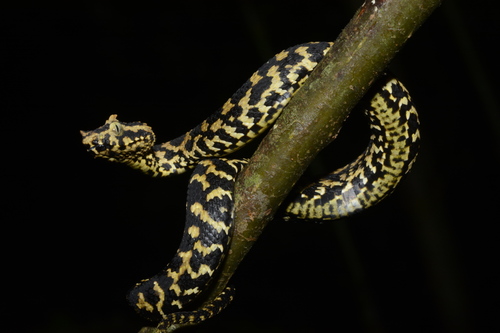
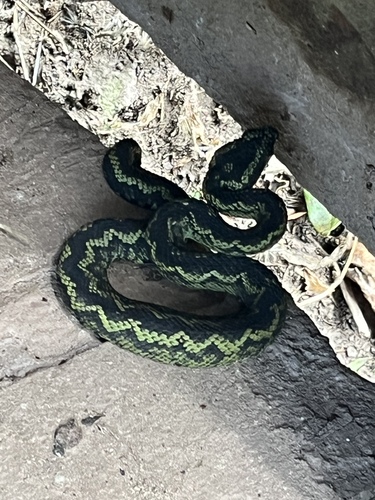 Great Lakes Bush ViperAtheris nitschei
 Usambara Eyelash ViperAtheris ceratophora
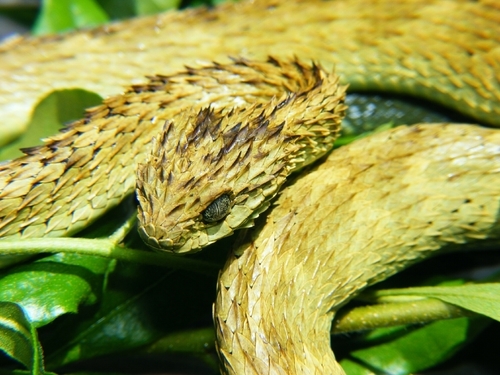 African Hairy Bush ViperAtheris hispida
 Mt Rungwe bush viperAtheris rungweensis
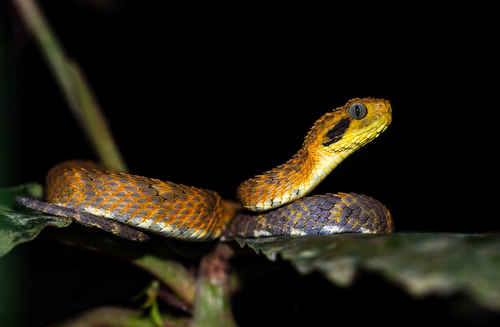 Cameroon bush viperAtheris broadleyi
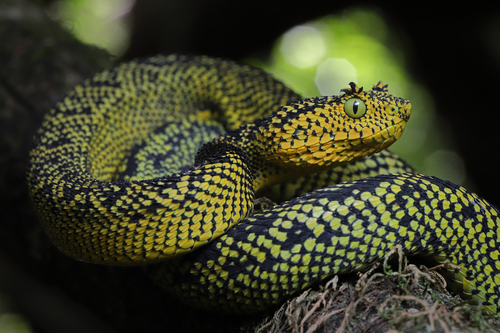 Matilda's horned viperAtheris matildae
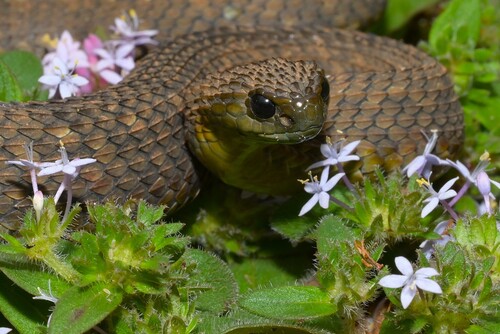 Uzungwe Mountain Bush ViperAtheris barbouri
Classification
How scientists group this snake, from the broadest category down to the exact species. Each step narrows to its closest relatives.
Keep learning
- Are Snakes Dangerous? The Real Risk, in PerspectiveMost snakes are harmless and avoid people. Here is the honest picture of snakebite risk worldwide and how to lower your own.
- Snakebite First Aid: What to Do (and What Never to Do)A clear, CDC-based guide to snakebite first aid: the steps that help, the popular myths that hurt, and how to tell a serious bite from a minor one.
- Venomous vs Nonvenomous: How to Tell the DifferenceThe folk rules for telling venomous snakes apart, where each one fails, and why location-based identification beats guessing by sight.
- What to Do If You Find a SnakeFound a snake at home or on a trail? Here is how to stay calm, give it space, identify it safely, and know when to call a professional.
Distribution from GBIF & iNaturalist. Venom status per CDC. Background: Wikipedia. Informational only. Never handle a snake to identify it.