
Viperidae
Great Lakes Bush Viper
VenomousAtheris nitschei
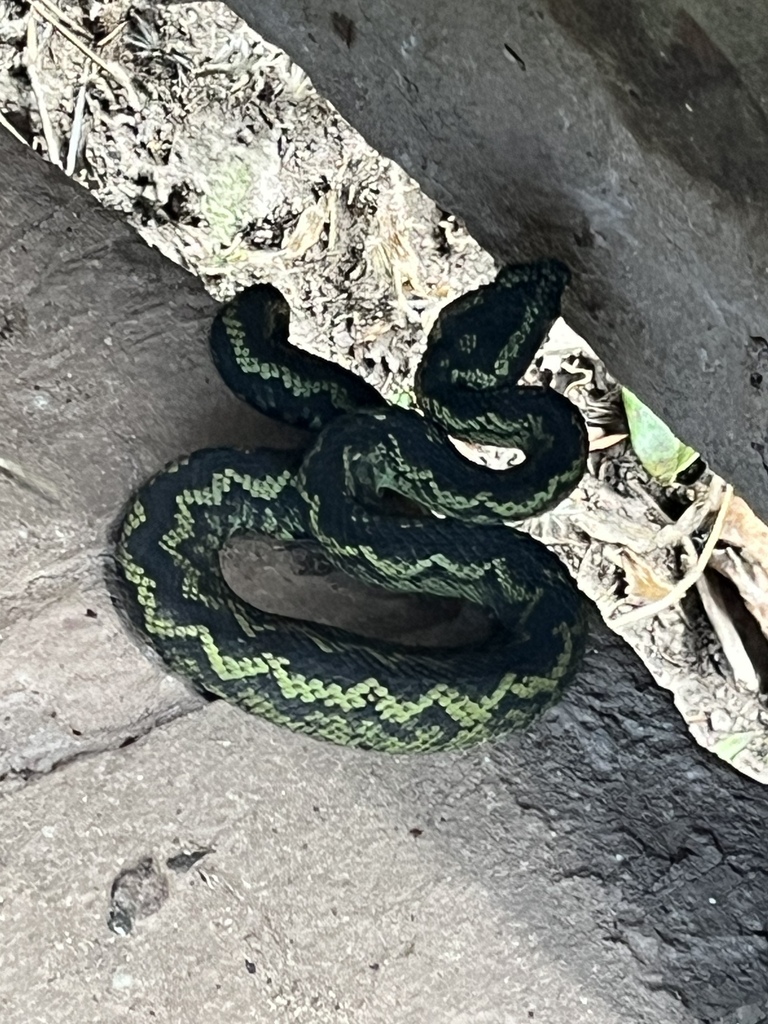
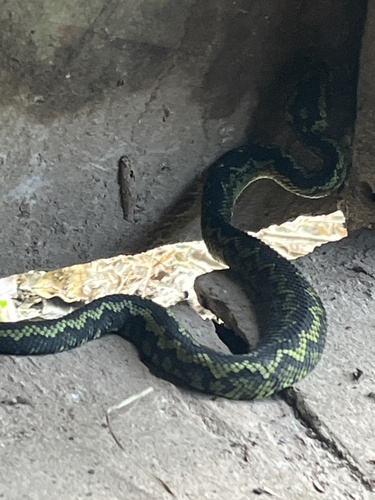
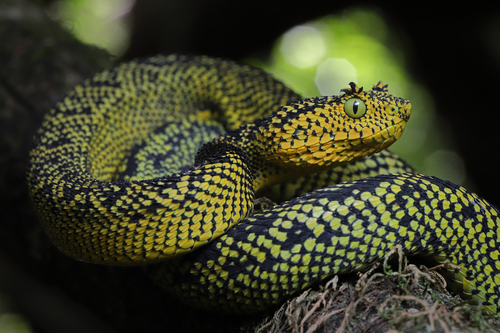
2 photographs of the Great Lakes Bush Viper. © Elliot Greiner.
The Great Lakes Bush Viper (Atheris nitschei) is a venomous snake in the Viperidae family, recorded in 7 countries.
If you are bitten
This is a venomous snake. Treat any bite as a medical emergency: stay calm, keep the bitten limb still and roughly level with the heart, remove rings and tight clothing, and get to emergency care immediately. Do not apply a tourniquet, cut the wound, apply ice, or try to suck out venom. Call your local emergency number or poison center.
- Family
- Viperidae
- Danger
- high
About the Great Lakes Bush Viper
Common names: Great Lakes bush viper, Nitsche's bush viper, more.
Atheris nitschei is a species of venomous snake, a viper in the subfamily Viperinae of the family Viperidae. The species is native to Africa. There are no subspecies that are recognized as being valid.
Taxonomy
The former subspecies Atheris nitschei rungweensis from southwestern Tanzania, northeastern Zambia and northern Malawi was elevated to species rank as Atheris rungweensis.
Etymology
The specific name, nitschei, is in honor of German zoologist Hinrich Nitsche (1845–1902).
The 1906 junior synonym, A. woosnami, was in honor of Kenyan game ranger Richard Bowen Woosnam (1880–1915), who later fought in World War I and was killed in action at Gallipoli.
Description
Atheris nitschei is a relatively large and stout bush viper, growing to an average total length (tail included) of 60 cm (24 in) and a maximum total length of at least 80 cm (31 in). The males are smaller than the females.
Common names
Common names for Atheris nitschei include Great Lakes bush viper, Nitsche's bush viper, black and green bush viper, Nitsche's tree viper. sedge viper, green viper, bush viper.
Geographic distribution
Atheris nitschei is found in forests of the Central African Albertine Rift, in southern and eastern DR Congo, Uganda, western Tanzania, Rwanda, Burundi, and Zambia.
The type locality is listed as "Mpororosumpf, Deutsch-Ost-Afrika" [Mpororo swamp, Tanzania-Rwanda border].
Habitat
Preferred natural habitats of Atheris nitschei are wetland and meadow areas, and elephant grass marshes, along small streams, sometimes in scrub and bush in valleys at higher elevations, and in mountain forests up to the bamboo zone at 1,600–2,800 m (5,200–9,200 ft) altitude. It is common in papyrus reed around small lakes.
Venom
Atheris nitschei has highly toxic venom like other species in the genus Atheris. Not much is known about its venom but envenomation has caused severe bleeding and hemorrhaging.
Reproduction
Atheris nitschei is viviparous.
Adapted from Wikipedia, available under CC BY-SA.
Local and regional names
The Great Lakes Bush Viper is known by these names across the regions where it lives:
- Czech
- zmije Nitscheiova
- Danish
- Sort-grøn Træhugorm
- French
- Vipère arboricole des Grands Lacs
- German
- Schwarzgrüne Buschviper
- Russian
- Чёрно-зелёная лесная гадюка
Frequently asked: Great Lakes Bush Viper
- Is the Great Lakes Bush Viper venomous?
- Yes. The Great Lakes Bush Viper (Atheris nitschei) is venomous and belongs to the Viperidae family (viper). Its bite is considered high risk to people. Treat any bite as a medical emergency.
- Is the Great Lakes Bush Viper poisonous?
- Snakes are venomous, not poisonous. "Poisonous" means harmful to eat or touch; "venomous" means injecting toxins through a bite. The Great Lakes Bush Viper is venomous, delivering venom through a bite.
- Is the Great Lakes Bush Viper dangerous?
- This is a venomous snake. Treat any bite as a medical emergency: stay calm, keep the bitten limb still and roughly level with the heart, remove rings and tight clothing, and get to emergency care immediately. Do not apply a tourniquet, cut the wound, apply ice, or try to suck out venom. Call your local emergency number or poison center.
- Where does the Great Lakes Bush Viper live?
- The Great Lakes Bush Viper has verified records in 7 countries, including Congo, Democratic Republic of the, Uganda, Burundi. See the distribution section below for its full range.
- Why is it called the Great Lakes Bush Viper?
- The specific name, nitschei, is in honor of German zoologist Hinrich Nitsche (1845–1902). The 1906 junior synonym, A. woosnami, was in honor of Kenyan game ranger Richard Bowen Woosnam (1880–1915), who later fought in World War I and was killed in action at Gallipoli.
If you are bitten by the Great Lakes Bush Viper
Do
- Get away from the snake and stay calm. Most bites worsen when people panic or try again to handle the snake.
- Call 911 or Poison Control (1-800-222-1222) right away. Antivenom works best when given early.
- Note the time of the bite and, from a safe distance, the snake's color and pattern, a phone photo is enough. Do not chase it.
- Keep the bitten limb still and at roughly heart level. Sit or lie down and limit movement.
- Remove rings, watches, and tight clothing near the bite before swelling starts.
- Gently wash the bite with soap and water and cover it with a clean, dry dressing.
Do not
- Do not cut the wound or try to suck out the venom.
- Do not apply a tourniquet or ice.
- Do not drink alcohol or caffeine.
- Do not take aspirin or ibuprofen, they can worsen bleeding. Acetaminophen is safer for pain.
- Do not try to catch or kill the snake. A dead snake can still bite by reflex.
First-aid guidance adapted from the U.S. Centers for Disease Control and Prevention (CDC NIOSH), Venomous Snakes. Educational only; always follow the instructions of emergency responders.
Where it is found
More Viperidae snakes
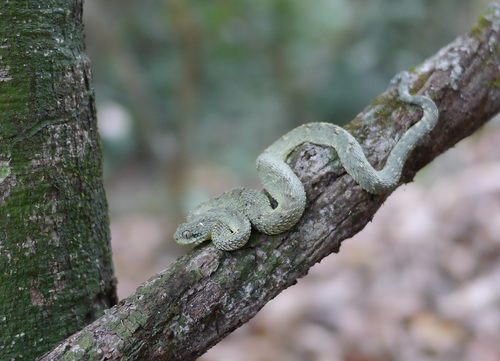 African Bush ViperAtheris squamigera
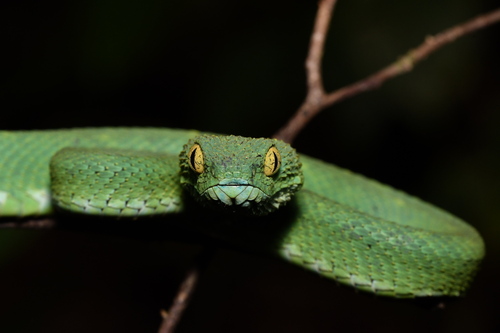 Green Bush ViperAtheris chlorechis
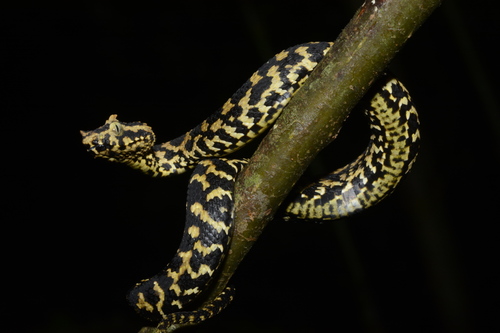 Usambara Eyelash ViperAtheris ceratophora
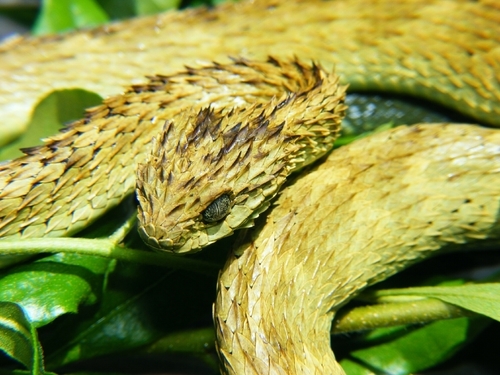 African Hairy Bush ViperAtheris hispida
 Mt Rungwe bush viperAtheris rungweensis
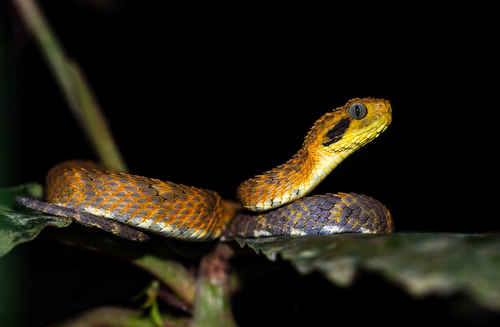 Cameroon bush viperAtheris broadleyi
 Matilda's horned viperAtheris matildae
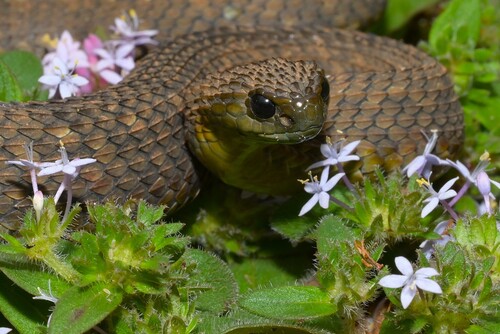 Uzungwe Mountain Bush ViperAtheris barbouri
Classification
How scientists group this snake, from the broadest category down to the exact species. Each step narrows to its closest relatives.
Keep learning
- Are Snakes Dangerous? The Real Risk, in PerspectiveMost snakes are harmless and avoid people. Here is the honest picture of snakebite risk worldwide and how to lower your own.
- Snakebite First Aid: What to Do (and What Never to Do)A clear, CDC-based guide to snakebite first aid: the steps that help, the popular myths that hurt, and how to tell a serious bite from a minor one.
- Venomous vs Nonvenomous: How to Tell the DifferenceThe folk rules for telling venomous snakes apart, where each one fails, and why location-based identification beats guessing by sight.
- What to Do If You Find a SnakeFound a snake at home or on a trail? Here is how to stay calm, give it space, identify it safely, and know when to call a professional.
Distribution from GBIF & iNaturalist. Venom status per CDC. Background: Wikipedia. Informational only. Never handle a snake to identify it.