
Pythonidae
Southern Green Python
HarmlessMorelia viridis
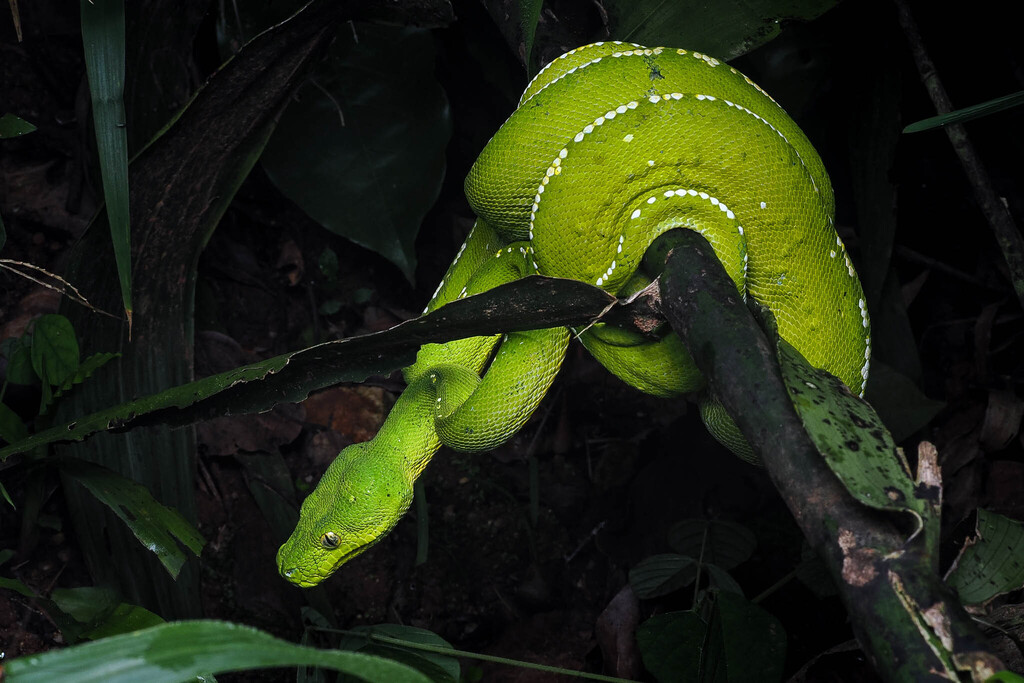
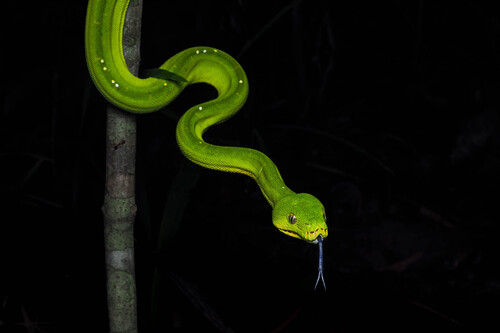
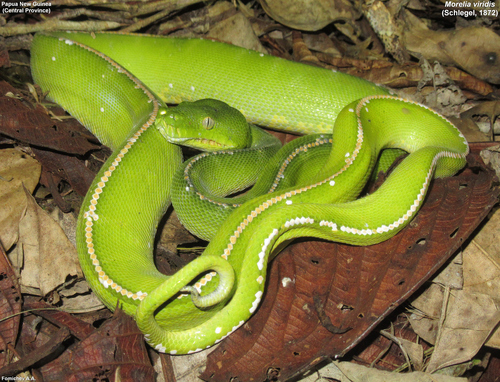
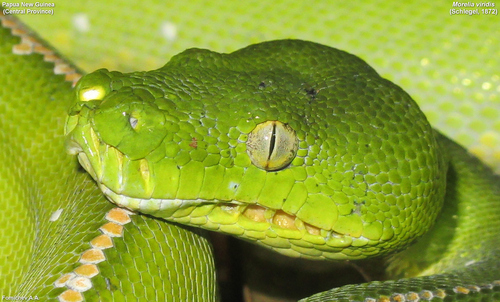
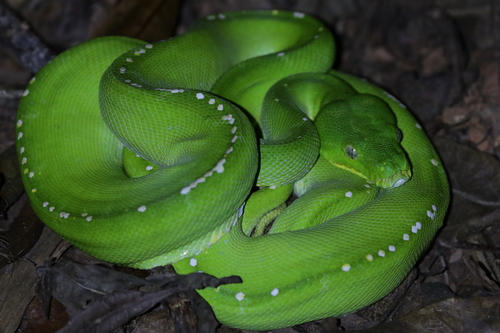
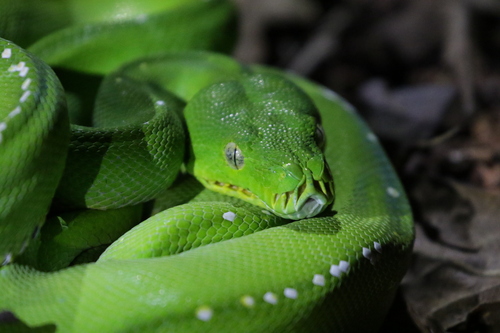
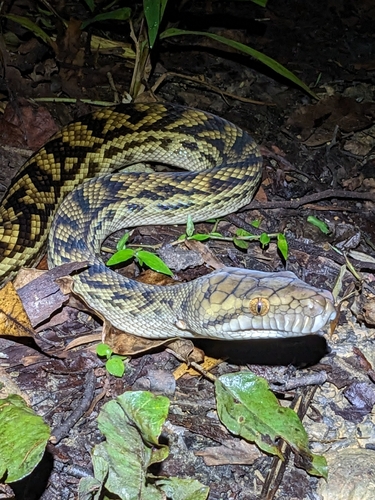
6 photographs of the Southern Green Python. © Ged Tranter.
The Southern Green Python (Morelia viridis) is a non-venomous snake in the Pythonidae family, recorded in 9 countries.
- Family
- Pythonidae
About the Southern Green Python
The green tree python (Morelia viridis), is a species of snake in the family Pythonidae. The species is native to New Guinea, some islands in Indonesia, and the Cape York Peninsula in Australia. First described by Hermann Schlegel in 1872, it was known for many years as Chondropython viridis. As its common name suggests, it is a bright green snake that can reach a total length (including tail) of 2 m (6.6 ft) and a weight of 1.6 kg (3.5 lb), with females slightly larger and heavier than males. Living generally in trees, the green tree python mainly hunts and eats small reptiles and mammals. It is a popular pet, and numbers in the wild have suffered with large-scale smuggling of wild-caught green tree pythons in Indonesia. Despite this, the green tree python is rated as least concern on the IUCN Red List of endangered species.
Taxonomy
German naturalist Hermann Schlegel described the green tree python in 1872 as Python viridis, from two specimens collected in the Aru Islands of Indonesia. His countryman Adolf Bernhard Meyer erected the genus Chondropython (though recognised similarity to Morelia) and described the green tree python as Chondropython azureus in 1874, from a specimen collected in "Kordo", later determined to be Korido on Biak Island. This was destroyed in World War II. French naturalist Henri Émile Sauvage described Chondropython pulcher from a specimen from Mansinam Island, Irian Jaya.
For many years, the green tree python was classified as the only species of the genus Chondropython, with the binomial name C. viridis. In 1993, Professor Arnold G. Kluge published a detailed phylogenetic analysis that found that the green tree python was nested within the genus Morelia and most closely related to the rough-scaled python (M. carinata). Hence, it became Morelia viridis. Two studies of mitochondrial and nuclear DNA published in 2013 and 2014 came up with differing results, one confirming the species in Morelia, the other placing it as an early offshoot with the Children's python genus Antaresia. This latter result was thought anomalous by later researchers.
Raymond Hoser described the Australian population as a separate subspecies Chondropython viridis shireenae, after his wife Shireen, noting that the taxon consistently had white markings along the backbone, whereas snakes from New Guinea and Indonesia only sometimes had this trait, and the molecular analysis would bear out the distinctness. A genetic study by Lesley Rawlings and Stephen Donnellan in 2003 of mitochondrial DNA of the green tree python found two distinct lineages: a southern lineage comprising populations of Australia, the Aru Islands, and New Guinea south of the central highlands, and a northern lineage of New Guinea north of the central highlands and the Vogelkop Peninsula, and Biak Island. The two likely diverged around 5 million years ago with the rising of the central mountain range in New Guinea. The authors suggested this might explain poor breeding success in Australia if people were unknowingly trying to breed the northern and southern green tree pythons, as they were not closely related. The two taxa are indistinguishable in appearance.
Description
Adapted from Wikipedia, available under CC BY-SA.
Frequently asked: Southern Green Python
- Is the Southern Green Python venomous?
- No. The Southern Green Python (Morelia viridis) is non-venomous and is not considered dangerous to humans. Like most snakes, it will retreat rather than bite when given the chance.
- Is the Southern Green Python poisonous?
- Snakes are venomous, not poisonous. "Poisonous" means harmful to eat or touch; "venomous" means injecting toxins through a bite. The Southern Green Python is neither poisonous nor venomous.
- Is the Southern Green Python dangerous?
- The Southern Green Python is not dangerous to humans. It has no medically significant venom and bites only defensively if cornered or handled.
- Where does the Southern Green Python live?
- The Southern Green Python has verified records in 9 countries, including Australia, Papua New Guinea, Indonesia. See the distribution section below for its full range.
- What does the Southern Green Python eat?
- The diet of green tree pythons consists mostly of small mammals, such as murid rodents (Melomys capensis, M. cervinipes, Mus domesticus, Rattus leucopus, other Rattus spp.), and sometimes reptiles, such as geckos and skinks (Carlia longipes), and insects. This snake, like the emerald tree boa, was previously thought to eat birds; however, Switak conducted field work on this issue. In examining stomach contents of more than 1,000 animals, he did not find any evidence of avian prey.
Where it is found
More Pythonidae snakes

Classification
How scientists group this snake, from the broadest category down to the exact species. Each step narrows to its closest relatives.
- OrderThe broad group of scaled reptiles: all snakes and lizards
- Squamata
- FamilyA group of related snakes that share key traits
- Pythonidae
- GenusA close-knit group of very similar species
- Morelia
- SpeciesThis exact snake, named in the two-part scientific name
- Morelia viridis
Keep learning
- What to Do If You Find a SnakeFound a snake at home or on a trail? Here is how to stay calm, give it space, identify it safely, and know when to call a professional.
- Venomous vs Nonvenomous: How to Tell the DifferenceThe folk rules for telling venomous snakes apart, where each one fails, and why location-based identification beats guessing by sight.
- What Is a Snake? Anatomy and the BasicsA clear overview of what makes a snake a snake: limbless body plan, anatomy, evolution from lizards, species diversity, and why they are ectothermic.
- How to Keep Snakes Out of Your Yard and HomeA practical guide to keeping snakes out of your yard and home using habitat changes that work, plus what to skip and what to do if one shows up.
Distribution from GBIF & iNaturalist. Venom status per CDC. Background: Wikipedia. Informational only. Never handle a snake to identify it.