
Pythonidae
Australian Scrub Python
HarmlessSimalia kinghorni
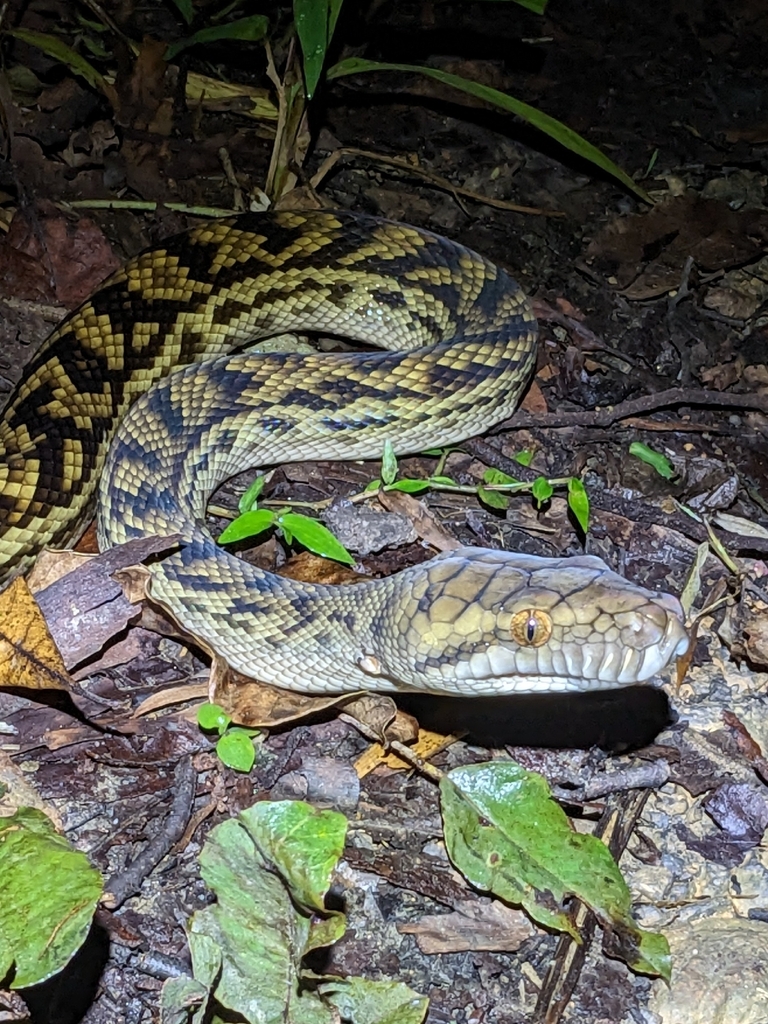
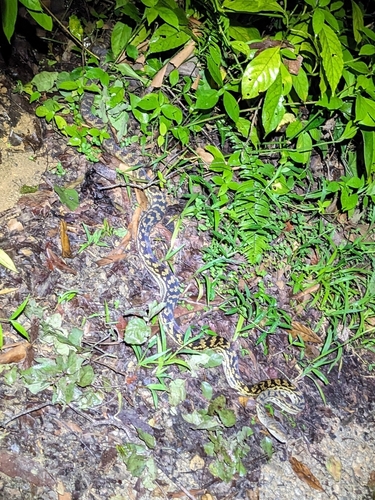
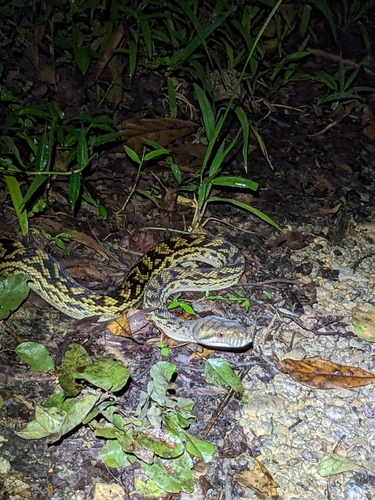
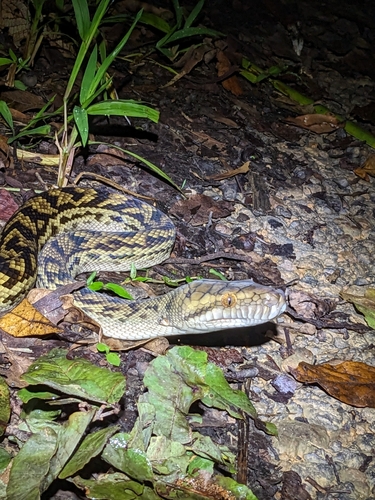
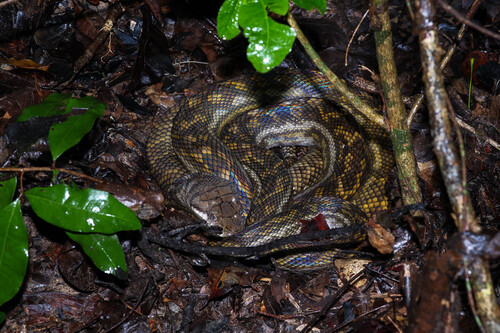
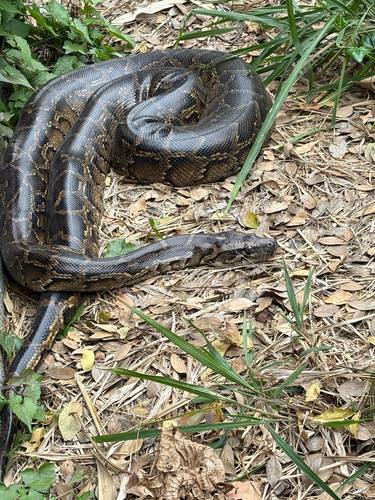
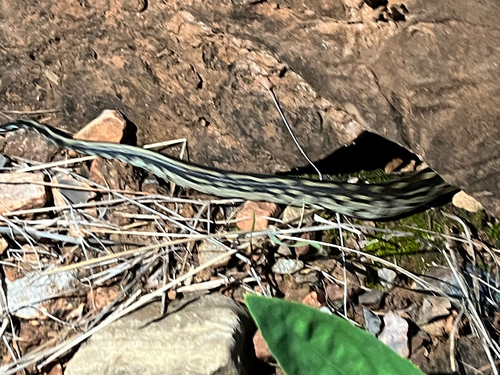
6 photographs of the Australian Scrub Python. © Matthew Borella.
The Australian Scrub Python (Simalia kinghorni) is a non-venomous snake in the Pythonidae family, recorded in 3 countries.
- Family
- Pythonidae
About the Australian Scrub Python
The Australian scrub python (Simalia kinghorni), also known commonly as Kinghorn's python and simply as the scrub python is a species of snake in the family Pythonidae. The species is indigenous to forests of northern Australia. It is one of the world's longest and largest snakes, and is the longest and largest in Australia. In 2014 it was reclassified to the genus Simalia from Morelia, alongside the rest of the scrub python species.
Taxonomy
American herpetologist Olive Griffith Stull described this taxon as Liasis amethistinus kinghorni in 1933 from a specimen at the Museum of Comparative Zoology which had been collected at Lake Barrine in north Queensland, classifying it as a subspecies of the amethystine python based on its larger number of scales. The specific name, kinghorni, is in honour of Australian herpetologist and ornithologist James Roy Kinghorn. It was first raised to species status by Wells and Wellington in 1984, and given the name Australiasis kinghorni. American biologist Michael Harvey and colleagues investigated the amethystine python complex and confirmed its classification as a separate species based on cladistic analysis of mitochondrial cytochrome b sequences and morphology. In 2014 cladistic analysis of nuclear and mitochondrial genes of pythons and boas, R. Graham Reynolds and colleagues concluded that the support for its distinctness was weak.
Description
The Australian scrub python is commonly considered arboreal or tree-dwelling, making it one of the world's largest and longest arboreal species of snakes. This snake has an ornate dorsal pattern consisting of browns and tans, with many different natural variations, and an iridescent sheen. Its belly is usually white, sometimes with some yellows. The top of the head is covered with large symmetrical shields, and there are heat-sensing pits on the rostral and some labials.
Size
S. kinghorni exhibits sexual dimorphism, with males usually growing a third longer and twice as heavy than females. Females reach sexual maturity with a snout-to-vent length (SVL) of about 2.27 m (7.4 ft) while males reach sexual maturity with an SVL of 1.34 m (4.4 ft). On the Tully River, a river about 140 km south of Cairns, 24 adult females were measured. They had an average SVL of 2.68 m (8.8 ft) and a mass of 3.4 kg (7.5 lb). In the same place, 80 adult males had an average SVL of 2.91 m (9.5 ft) and a weight of 5.1 kg (11 lb). Of these, the largest male had an SVL of 3.76 m (12.3 ft) and a weight of 11 kg (24 lb).
In the past, data on the lengths of individuals longer than 6 meters were repeatedly mentioned in the literature, and all of them today can no longer be verified and cause serious doubts, in particular, in Fearn & Sambono (2000). The most extreme information comes from Worell, who reported in 1954 second-hand about an animal allegedly 8.5 m (28 ft) long from Greenhill in Cairns, described it as 7.6 m (25 ft) in 1958 and repeatedly mentioned the same thing in 1963 under the first length. He leaves open the question of whether the reported length refers to a corpse or to skin stretched more than 3 m (9.8 ft). Dean also describes an extremely large specimen from Barron Falls in 1954 with a total length of 7.2 m (24 ft), which, however, consisted of an artificially stretched frame that decomposed in the tropics for more than two days, though it was considered reliable by the staff of the Guinness Book of World Records. The largest female Australian scrub python seriously measured to date was caught in Palm Cove near Cairns in 2000, had a total length (including tail) of 5.65 m (18.5 ft), a head length of 12 cm (4.7 in), a tail length of 75 cm (30 in), a circumference at midbody of 36 cm (14 in), and a weight of 24 kg (53 lb). The largest male seriously measured to date was discovered in Kuranda in 2002. Its length was 5.33 m (17.5 ft), of which the length of the head was 11 cm (4.3 in), the incomplete tail was 60 cm (24 in), and the weight was 19 kg (42 lb). However, heavier individuals have been measured, some weighing more than 27 kg (60 lb) with a length of more than 5 m (16 ft).
Distribution and habitat
Adapted from Wikipedia, available under CC BY-SA.
Frequently asked: Australian Scrub Python
- Is the Australian Scrub Python venomous?
- No. The Australian Scrub Python (Simalia kinghorni) is non-venomous and is not considered dangerous to humans. Like most snakes, it will retreat rather than bite when given the chance.
- Is the Australian Scrub Python poisonous?
- Snakes are venomous, not poisonous. "Poisonous" means harmful to eat or touch; "venomous" means injecting toxins through a bite. The Australian Scrub Python is neither poisonous nor venomous.
- Is the Australian Scrub Python dangerous?
- The Australian Scrub Python is not dangerous to humans. It has no medically significant venom and bites only defensively if cornered or handled.
- Where does the Australian Scrub Python live?
- The Australian Scrub Python has verified records in 3 countries, including Australia, Papua New Guinea, Indonesia. See the distribution section below for its full range.
- What does the Australian Scrub Python eat?
- S. kinghorni is one of the largest land predators in Australia, and depending on the habitat, age and size, the prey range can vary from small mammals, birds and reptiles to wallabies. The basis of the diet consists of birds and mammals. Among them, for example, rainbow bee-eaters (Merops ornatus), bush rats (Rattus fuscipes), northern quolls (Dasyurus hallucatus), spectacled flying fox (Pteropus conspicillatus), northern brown bandicoots (Isoodon macrourus), long-nosed bandicoots (Perameles nasuta) and striped possums (Dactylopsila trivirgata).
Where it is found
More Pythonidae snakes
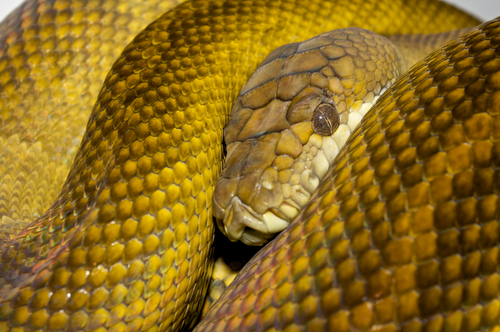
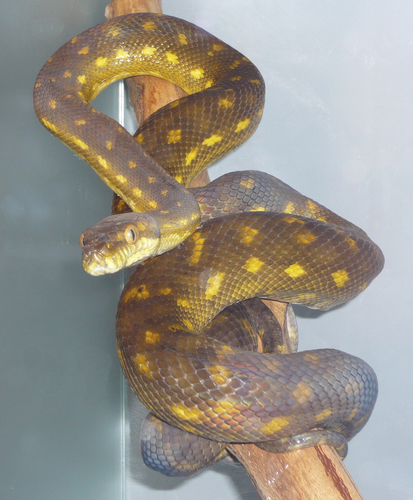
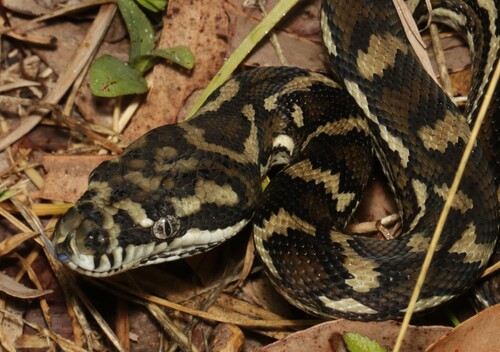
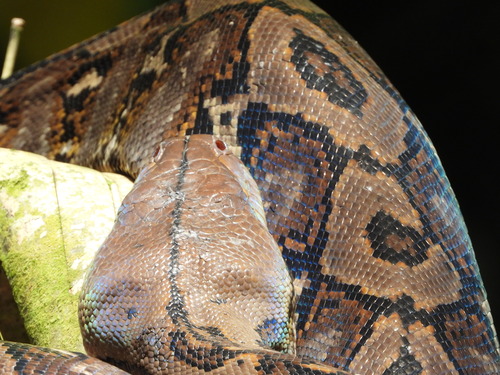
Classification
How scientists group this snake, from the broadest category down to the exact species. Each step narrows to its closest relatives.
- OrderThe broad group of scaled reptiles: all snakes and lizards
- Squamata
- FamilyA group of related snakes that share key traits
- Pythonidae
- GenusA close-knit group of very similar species
- Simalia
- SpeciesThis exact snake, named in the two-part scientific name
- Simalia kinghorni
Keep learning
- What to Do If You Find a SnakeFound a snake at home or on a trail? Here is how to stay calm, give it space, identify it safely, and know when to call a professional.
- Venomous vs Nonvenomous: How to Tell the DifferenceThe folk rules for telling venomous snakes apart, where each one fails, and why location-based identification beats guessing by sight.
- What Is a Snake? Anatomy and the BasicsA clear overview of what makes a snake a snake: limbless body plan, anatomy, evolution from lizards, species diversity, and why they are ectothermic.
- How to Keep Snakes Out of Your Yard and HomeA practical guide to keeping snakes out of your yard and home using habitat changes that work, plus what to skip and what to do if one shows up.
Distribution from GBIF & iNaturalist. Venom status per CDC. Background: Wikipedia. Informational only. Never handle a snake to identify it.