
Pythonidae
Rough-scaled Python
HarmlessMorelia carinata

The Rough-scaled Python (Morelia carinata) is a non-venomous snake in the Pythonidae family, recorded in 1 country.
- Family
- Pythonidae
About the Rough-scaled Python
The rough-scaled python (Morelia carinata) is a large-scaled python species endemic to Australia. No subspecies are currently recognized.
Description
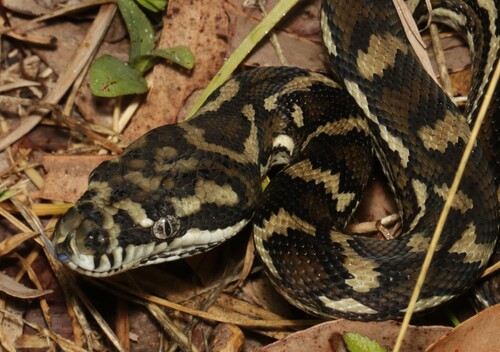
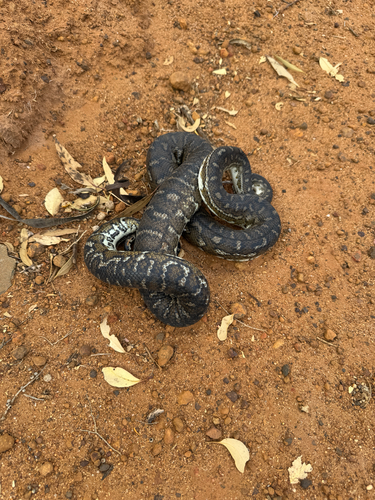
The rough-scaled python is able to grow to around 2 m (6.6 ft) in total length. It has a triangular-shaped head with a conspicuous constriction at the neck area. M. carinata is distinguished by the presence of a large parietal scale and by having distinct keeled dorsal scales. The body is slim and muscular. The color pattern is light honey-tan with darker reddish-brown markings or dark brown with pale brown blotches. The blotches become larger toward the tail, so the pattern appears to be reversed. The belly is white, possibly with black spots. The markings are thought to assist in providing camouflage. The wrinkled to corrugated scales also assist the snake in climbing up sandstone and crevices.
The species was first formally identified by biologist L.A. Smith in 1981 as part of the work A revision of the python genera Aspidites and Python (Serpentes: Boidae) in Western Australia as published in the Records of the Western Australian Museum.
Captivity
They are now available to private owners, originating from a few wild-caught specimens, as they were found to breed readily in captivity.
Three males and two females were collected and transferred to the Australian Reptile Park in 2000 and had produced 71 offspring by 2012. These, in turn, had produced another offspring.
Distribution and habitat
These snakes are found in Australia, in northwestern Western Australia in the lower sections of the Mitchell and Hunter Rivers, just inland from the coast. The type locality given is "Mitchell River Falls, Western Australia (14°50'S, 125°42'E)" [Australia].
They are found in rocky valleys of Kimberley region in far northern Western Australia, where they climb on low trees and shrubs of monsoon rainforest. The species has one of the smallest distributions of any snake. They are present in the Charnley River–Artesian Range Wildlife Sanctuary in the Kimberley region.
The species is often associated with fruit-bearing trees, possibly indicating a preference of ambush sites for herbivorous animals, and also close to permanent fresh water.
Behavior
So far, they are reported to be strictly crepuscular. Their temperament is quite docile with rarely any attempts to bite.
Reproduction
This species is confirmed to be an egg-layer (oviparous) like other pythons. The mating season is between July and August, after which the female will typically find a vacant mammal or reptile burrow (or an otherwise dark, secluded location) to occupy for a number of weeks, effectively converting the space into a nursery. Females usually lay around ten semi-soft, leathery, oval-shaped eggs, which they then incubate with their body heat for several weeks, abstaining from all food or water, not wishing to deprive any essential warmth to the developing eggs until they hatch. Once the eggs do begin cracking, and the young pythons finally take their first breaths of air, the likely starving and parched mother leaves her offspring in-search of nourishment, never to return. She does not take care of the babies, which are instead born with a hunter's instinct. The snakelets begin their lives by hunting larger insects, such as beetles or large crickets, before gradually moving-on to mammalian prey.
Media
Adapted from Wikipedia, available under CC BY-SA.
Frequently asked: Rough-scaled Python
- Is the Rough-scaled Python venomous?
- No. The Rough-scaled Python (Morelia carinata) is non-venomous and is not considered dangerous to humans. Like most snakes, it will retreat rather than bite when given the chance.
- Is the Rough-scaled Python poisonous?
- Snakes are venomous, not poisonous. "Poisonous" means harmful to eat or touch; "venomous" means injecting toxins through a bite. The Rough-scaled Python is neither poisonous nor venomous.
- Is the Rough-scaled Python dangerous?
- The Rough-scaled Python is not dangerous to humans. It has no medically significant venom and bites only defensively if cornered or handled.
- Where does the Rough-scaled Python live?
- The Rough-scaled Python has verified records in 1 country, including Australia. See the distribution section below for its full range.
Where it is found
More Pythonidae snakes
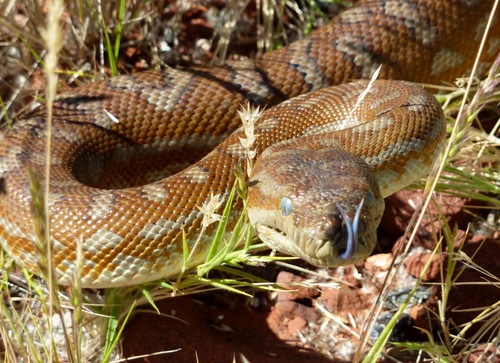
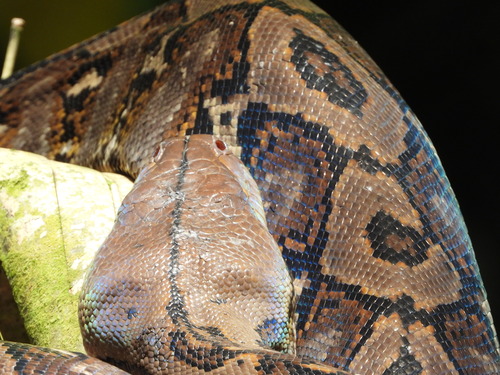
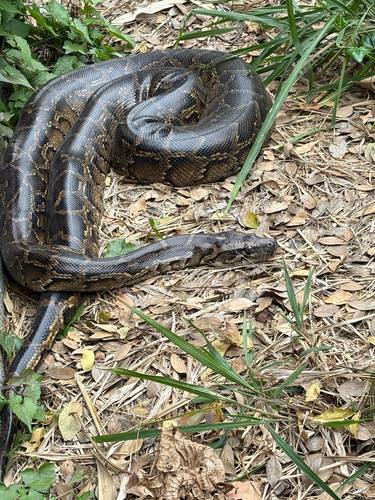
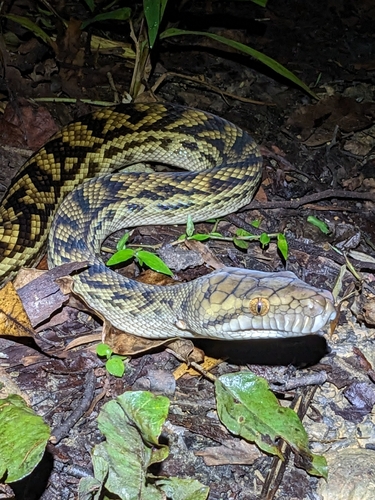
Classification
How scientists group this snake, from the broadest category down to the exact species. Each step narrows to its closest relatives.
- OrderThe broad group of scaled reptiles: all snakes and lizards
- Squamata
- FamilyA group of related snakes that share key traits
- Pythonidae
- GenusA close-knit group of very similar species
- Morelia
- SpeciesThis exact snake, named in the two-part scientific name
- Morelia carinata
Keep learning
- What to Do If You Find a SnakeFound a snake at home or on a trail? Here is how to stay calm, give it space, identify it safely, and know when to call a professional.
- Venomous vs Nonvenomous: How to Tell the DifferenceThe folk rules for telling venomous snakes apart, where each one fails, and why location-based identification beats guessing by sight.
- What Is a Snake? Anatomy and the BasicsA clear overview of what makes a snake a snake: limbless body plan, anatomy, evolution from lizards, species diversity, and why they are ectothermic.
- How to Keep Snakes Out of Your Yard and HomeA practical guide to keeping snakes out of your yard and home using habitat changes that work, plus what to skip and what to do if one shows up.
Distribution from GBIF & iNaturalist. Venom status per CDC. Background: Wikipedia. Informational only. Never handle a snake to identify it.