
Pythonidae
Carpet Python
HarmlessMorelia spilota
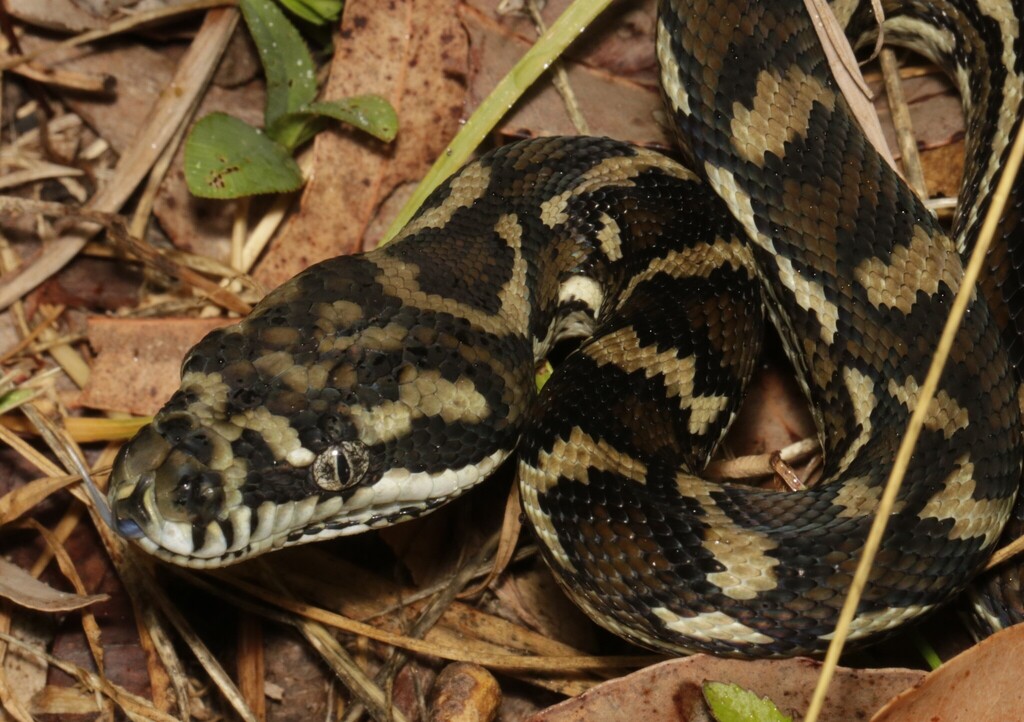
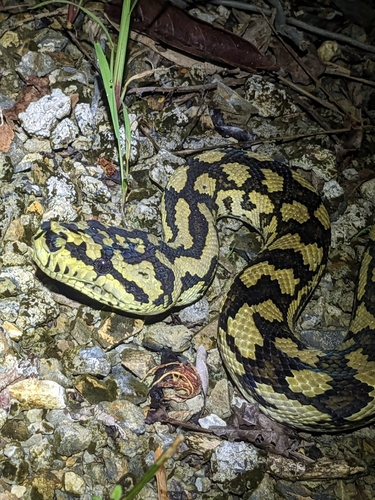
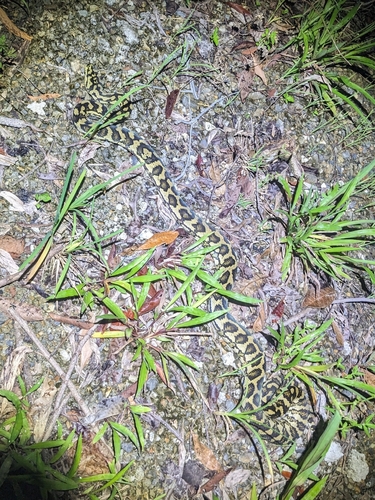
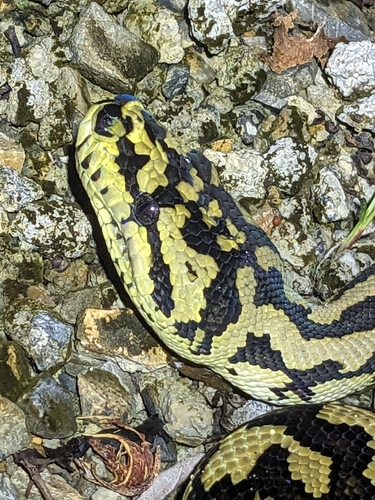
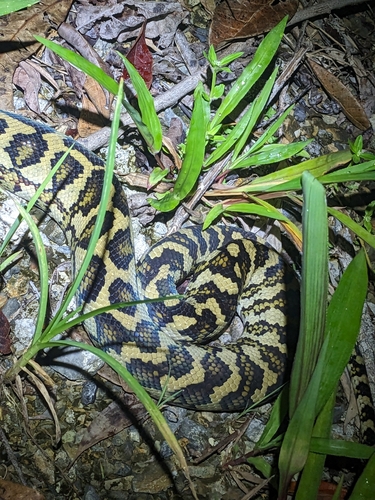
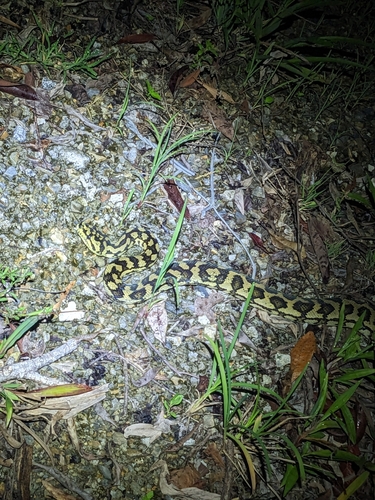
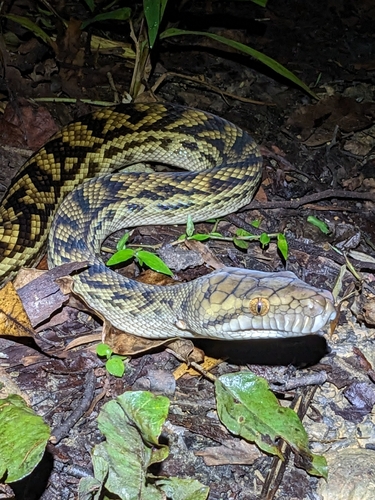
6 photographs of the Carpet Python. © Ryan van Huyssteen.
The Carpet Python (Morelia spilota) is a non-venomous snake in the Pythonidae family, recorded in 8 countries.
- Family
- Pythonidae
About the Carpet Python
Morelia spilota, commonly known as the carpet python, is a large snake of the family Pythonidae found in Australia, New Guinea (Indonesia and Papua New Guinea), Bismarck Archipelago, and the northern Solomon Islands. Many subspecies are recognised; ITIS lists six, the Reptile Database six, and the IUCN eight.
Description
M. spilota is a large species of python in the genus, reaching between 2 and 4 m (6.6 and 13.1 ft) in length and weighing up to 15 kg (33 lb). M. s. mcdowelli is the largest subspecies, regularly attaining lengths of 2.7–3.0 m (8.9–9.8 ft). M. s. variegata is the smallest subspecies, typically 120–180 cm (3.9–5.9 ft) in length. The average adult length is roughly 2 m (6.6 ft). However, one 3-year-old captive male M. s. mcdowelli, measured in Ireland, was found to exceed 396 cm (12.99 ft). Males are typically smaller than females; in some regions, females are up to four times heavier. The head is triangular with a conspicuous row of thermoreceptive labial pits.
The colouring of M. spilota is highly variable, ranging from olive to black with white or cream and gold markings. The patterning may be roughly diamond-shaped or have intricate markings made up of light and dark bands on a background of grey or a version of brown.
Reproduction
The species is oviparous, with females laying 10–50 eggs at a time. Afterward, females coil around the eggs to protect them and keep them warm through using muscular contractions to generate heat. This type of maternal care, which is typical for pythons, ceases once the hatchlings have emerged.
Behaviour
Differences in activity are noted throughout various subspecies; as a whole, the species is generally active during both daytime and nighttime, although the subspecies M. s. variegata is noted to be primarily nocturnal. Carpet pythons favor arboreal living conditions, although they can also be found on the ground, and they commonly use open spaces to bask.
Seasonal activity
In the northern Australian city of Darwin, carpet pythons are significantly more likely to be encountered in suburban areas during the dry season months of May–July. This is indicative of shifts in snake behaviour or movement across the year, with snakes likely moving out of natural forest areas in the later dry season to the more productive suburban areas in search of prey or mates.
Diet
Carpet pythons kill prey by constriction. Their diet consists mainly of small mammals, birds, and lizards. Incidents of carpet pythons devouring domestic cats and small dogs have been reported.
Distribution and habitat
The species is found throughout mainland Australia, with the exception of the arid centre and the western regions. It is widely distributed throughout the forest regions of Southwest Australia. It is also found in Indonesia (southern Western New Guinea in Merauke Regency), Papua New Guinea (southern Western Province, the Port Moresby area of Central Province), and on Yule Island. The type locality given is "Nouvelle-Hollande" [Australia].
Adapted from Wikipedia, available under CC BY-SA.
Frequently asked: Carpet Python
- Is the Carpet Python venomous?
- No. The Carpet Python (Morelia spilota) is non-venomous and is not considered dangerous to humans. Like most snakes, it will retreat rather than bite when given the chance.
- Is the Carpet Python poisonous?
- Snakes are venomous, not poisonous. "Poisonous" means harmful to eat or touch; "venomous" means injecting toxins through a bite. The Carpet Python is neither poisonous nor venomous.
- Is the Carpet Python dangerous?
- The Carpet Python is not dangerous to humans. It has no medically significant venom and bites only defensively if cornered or handled.
- Where does the Carpet Python live?
- The Carpet Python has verified records in 8 countries, including Australia, Papua New Guinea, Indonesia. See the distribution section below for its full range.
- What does the Carpet Python eat?
- Carpet pythons kill prey by constriction. Their diet consists mainly of small mammals, birds, and lizards. Incidents of carpet pythons devouring domestic cats and small dogs have been reported.
- Why is it called the Carpet Python?
- The first description of M. spilota was by Lacépède (1804), who placed it in the genus Coluber as Coluber spilotus. The species has since been described by various authors as containing a number of subspecies and hybrids; these have also been known by various informal names. The attempted arrangement of taxa in this, and other, Australasian Pythonidae has produced numerous synonyms. The discreet and roaming habits of this species have produced a low number of recorded specimens, giving inadequate sample numbers to support descriptions of a taxon's morphology.
Where it is found
By U.S. state
More Pythonidae snakes
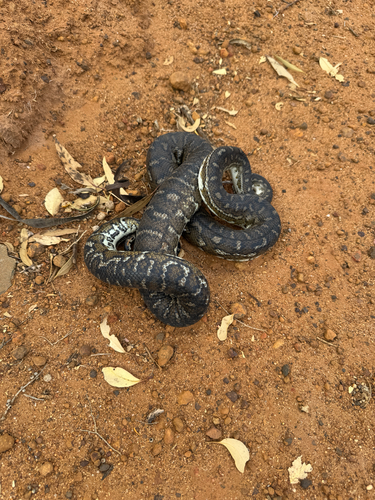 Southwestern Carpet PythonMorelia imbricata
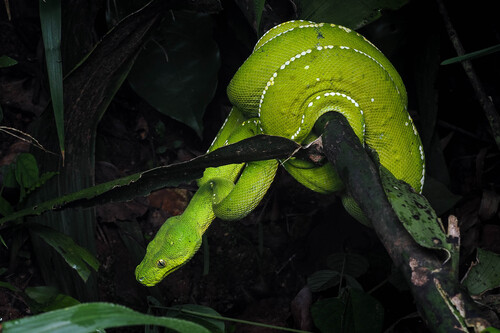 Southern Green PythonMorelia viridis
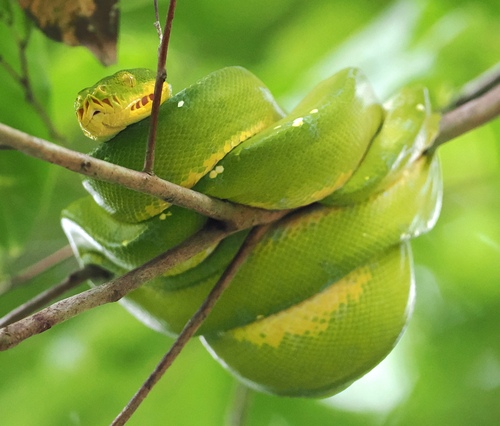 Northern Green PythonMorelia azurea
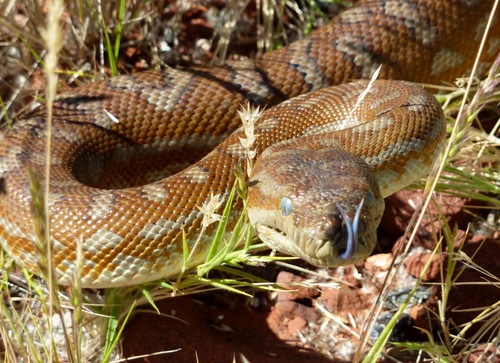 Centralian Carpet PythonMorelia bredli
 Rough-scaled PythonMorelia carinata
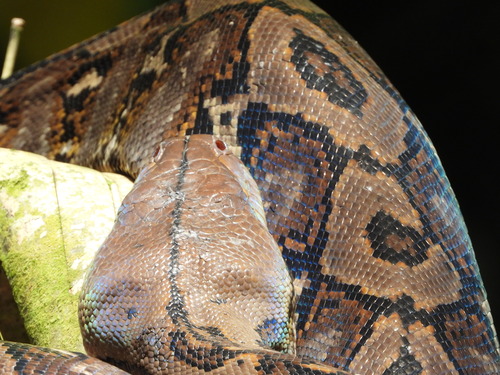 Reticulated PythonMalayopython reticulatus
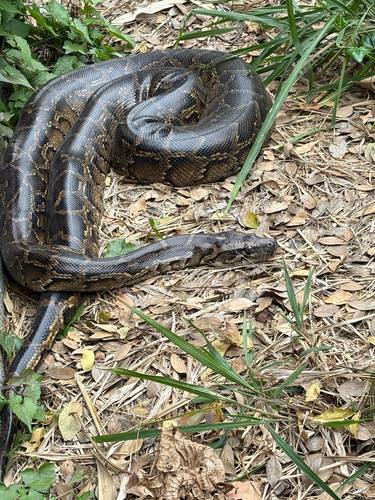 Burmese PythonPython bivittatus
 Australian Scrub PythonSimalia kinghorni
Classification
How scientists group this snake, from the broadest category down to the exact species. Each step narrows to its closest relatives.
- OrderThe broad group of scaled reptiles: all snakes and lizards
- Squamata
- FamilyA group of related snakes that share key traits
- Pythonidae
- GenusA close-knit group of very similar species
- Morelia
- SpeciesThis exact snake, named in the two-part scientific name
- Morelia spilota
Keep learning
- What to Do If You Find a SnakeFound a snake at home or on a trail? Here is how to stay calm, give it space, identify it safely, and know when to call a professional.
- Venomous vs Nonvenomous: How to Tell the DifferenceThe folk rules for telling venomous snakes apart, where each one fails, and why location-based identification beats guessing by sight.
- What Is a Snake? Anatomy and the BasicsA clear overview of what makes a snake a snake: limbless body plan, anatomy, evolution from lizards, species diversity, and why they are ectothermic.
- How to Keep Snakes Out of Your Yard and HomeA practical guide to keeping snakes out of your yard and home using habitat changes that work, plus what to skip and what to do if one shows up.
Distribution from GBIF & iNaturalist. Venom status per CDC. Background: Wikipedia. Informational only. Never handle a snake to identify it.