
Genus · Colubridae
Diadophis
The genus Diadophis contains a single species. It is not considered dangerous to humans.
About ring-necked snakes
Small, secretive woodland snakes named for the bright collar that rings the neck.
Diadophis is a genus in Colubridae, the largest snake family and the group that holds most of the common, non-front-fanged snakes people meet in North America. The genus is best known for a single widely recognized species, the Ring-necked Snake (Diadophis punctatus), which ranges across much of the United States, into southern Canada, and down into parts of Mexico. Within Colubridae, ring-necked snakes sit among the small, ground-dwelling, semi-fossorial snakes that spend much of their lives under cover rather than out in the open.
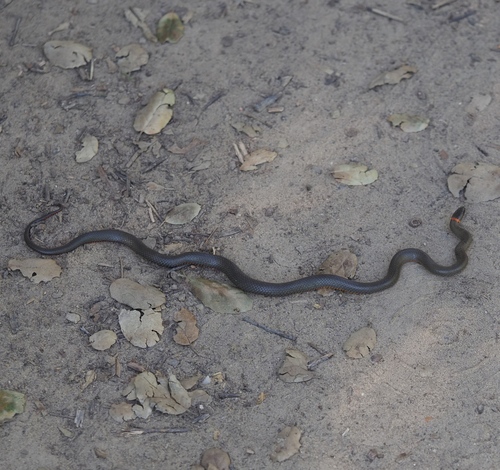
Members are easy to recognize in general terms. They are slender and small, usually under 15 inches, with a smooth, often slate-gray to olive or blackish back and a distinct yellow, orange, or cream collar just behind the head. The belly is typically yellow to orange, sometimes reddening toward the tail, and some populations curl the tail to flash that bright underside as a defense. The contrast between the dark back and the bright ring and belly is the signature look, though collar width and belly color vary across the wide range.
Ring-necked snakes are harmless to people. They are technically rear-fanged with a mild saliva that helps subdue small prey, but they are not considered dangerous to humans and are not a medical threat. They are shy and rarely bite. They hide under rocks, logs, and leaf litter, often in moist woodland and rocky hillsides, and are frequently found in loose colonies. Their diet is mostly earthworms, slugs, salamanders, small frogs, and other tiny prey, and they lay small clutches of eggs in summer. If anyone is ever bitten by a snake they cannot identify, or has a serious reaction, treat it as an emergency and contact US Poison Control at 1-800-222-1222 or local emergency services rather than relying on field identification.
Diadophis belongs to the Colubridae family (Colubrids). The largest snake family, and the one most snakes you meet belong to. Typically round pupils, a head only slightly wider than the neck, and no heat-sensing facial pit or rattle. Scales may be smooth and glossy or keeled and matte depending on the species.
Danger: Almost all colubrids are harmless. A small number are rear-fanged with medically significant venom, the boomslang and the twig (vine) snakes of Africa being the dangerous exceptions. Most colubrids will flee or bluff rather than bite.
All species (1)
Keep learning
- What Is a Snake? Anatomy and the BasicsA clear overview of what makes a snake a snake: limbless body plan, anatomy, evolution from lizards, species diversity, and why they are ectothermic.
- How Snakes Move, Hunt, and EatHow snakes move without legs, hunt as ambushers or active foragers, kill by constriction or venom, and swallow prey wider than their head.
- What Do Snakes Eat?All snakes are carnivores. Learn what snakes eat, how diet changes with size and age, how often they feed, and how they hunt and swallow prey.
- Venomous vs Nonvenomous: How to Tell the DifferenceThe folk rules for telling venomous snakes apart, where each one fails, and why location-based identification beats guessing by sight.