
Colubridae
Ring-Headed Dwarf Snake
HarmlessEirenis modestus
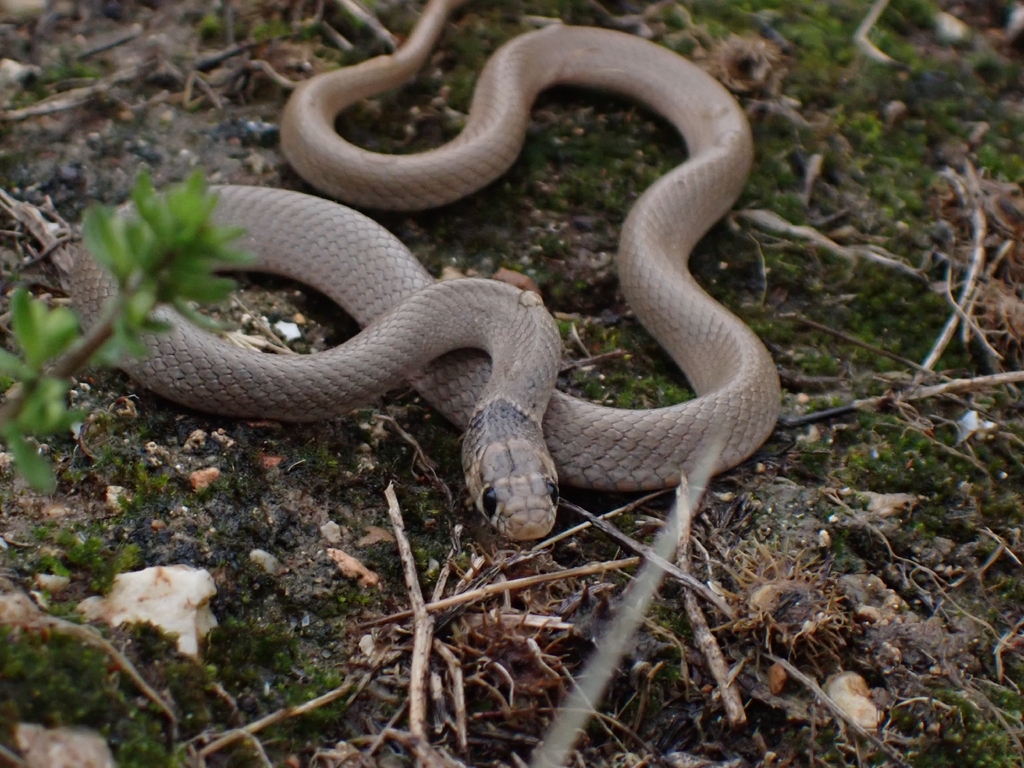
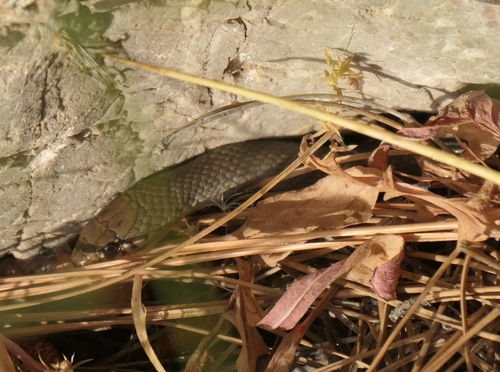
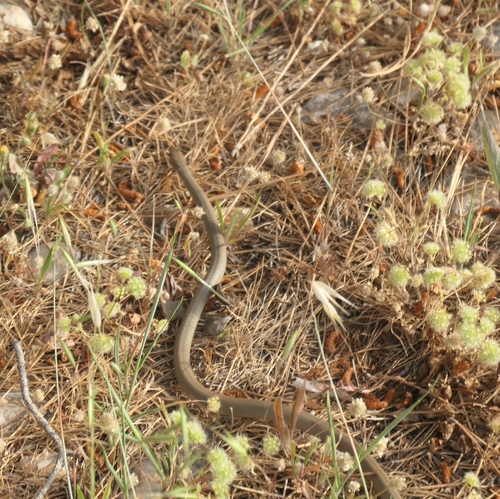
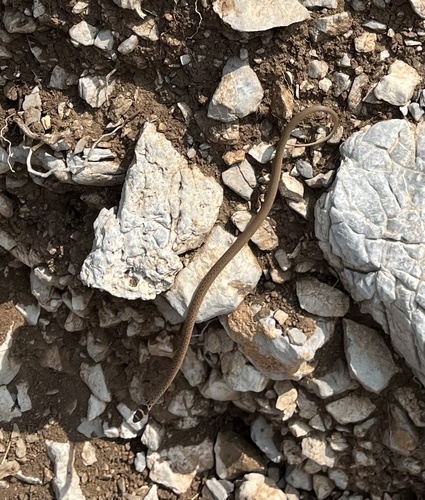
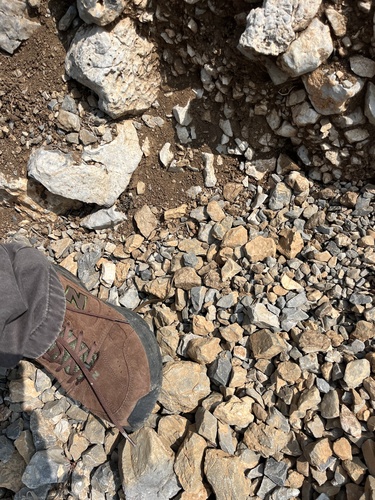
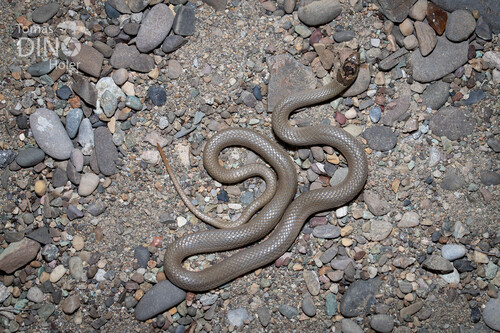
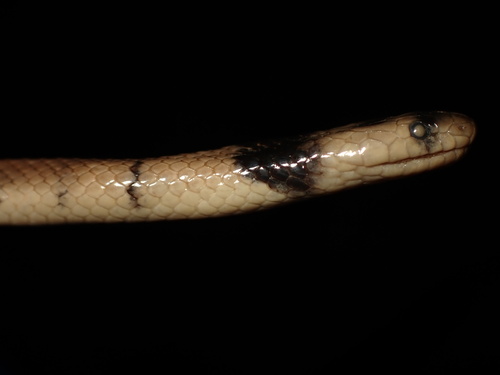
6 photographs of the Ring-Headed Dwarf Snake. © Oscar Hopgood.
The Ring-Headed Dwarf Snake (Eirenis modestus) is a non-venomous snake in the Colubridae family, recorded in 13 countries.
- Family
- Colubridae
About the Ring-Headed Dwarf Snake
Eirenis modestus, commonly known as ring-headed dwarf snake or simply the Asia Minor dwarf racer, is a non-venomous species of snake in the Colubridae family. It is native to several Greek islands, Turkey, Syria, Armenia, Azerbaijan, Israel, Georgia and southwestern parts of the Russian Federation.
Description
The ring-headed dwarf snake is a pencil-thin species that grows to a maximum length of 60 cm (24 in) but most adults are considerably smaller than this. The skin is smooth and the edges of the scales are slightly darker than the centres. The upper surface of the body is a uniform yellowish-brown, greyish-brown or reddish-brown colour and the underparts are glossy white. The top of the head has a large black blotch inside which are either two whitish spots or a pale W-shaped mark. Round the neck is a crescent-shaped band of dark blotches separated from the head by a pale band.
Subspecies
Currently, three subspecies are recognized, namely Eirenis modestus modestus (Martin 1838), E. m. semimaculatus (Boettger 1876) from central and western Turkey (Anatolia), and E. m. cilicius (Schmidtler 1993) from southern Turkey.
Distribution and habitat
The ring-headed dwarf snake is native to the Greek Mediterranean islands of Lesbos, Chios, Samos, Fournoi, Kasos, Karpathos, Kalymnos, Leros, Symi and Megisti and most of Turkey. Its range extends eastwards into the Caucasus Mountains, eastern Georgia, Armenia and Azerbaijan. Its natural habitats are dry shrubby vegetation, cultivated fields, fallow areas and dry open woodland.
Behaviour
During the day the ring-headed dwarf snake shelters under stones or in crevices, and several snakes may share the same hiding place. It emerges at twilight to hunt for spiders, insects, centipedes, scorpions and small lizards. Breeding takes place in summer when the female lays a clutch of three to eight relatively large eggs. The hatchlings are up to about 12 cm (4.7 in) long.
Status
The ring-headed dwarf snake has a wide range and is presumed to have a large total population. It seems to be an adaptable species able to tolerate a range of different habitat types, and no particular threats have been identified and for these reasons, the IUCN has listed it as being of "Least Concern".
Adapted from Wikipedia, available under CC BY-SA.
Frequently asked: Ring-Headed Dwarf Snake
- Is the Ring-Headed Dwarf Snake venomous?
- No. The Ring-Headed Dwarf Snake (Eirenis modestus) is non-venomous and is not considered dangerous to humans. Like most snakes, it will retreat rather than bite when given the chance.
- Is the Ring-Headed Dwarf Snake poisonous?
- Snakes are venomous, not poisonous. "Poisonous" means harmful to eat or touch; "venomous" means injecting toxins through a bite. The Ring-Headed Dwarf Snake is neither poisonous nor venomous.
- Is the Ring-Headed Dwarf Snake dangerous?
- The Ring-Headed Dwarf Snake is not dangerous to humans. It has no medically significant venom and bites only defensively if cornered or handled.
- Where does the Ring-Headed Dwarf Snake live?
- The Ring-Headed Dwarf Snake has verified records in 13 countries, including Türkiye, Greece, Georgia. See the distribution section below for its full range.
Where it is found
More Colubridae snakes
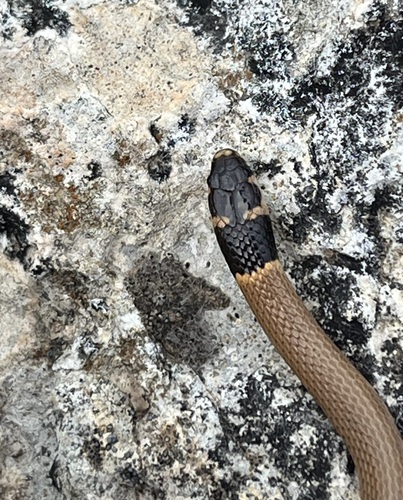 Roth's Dwarf SnakeEirenis rothii
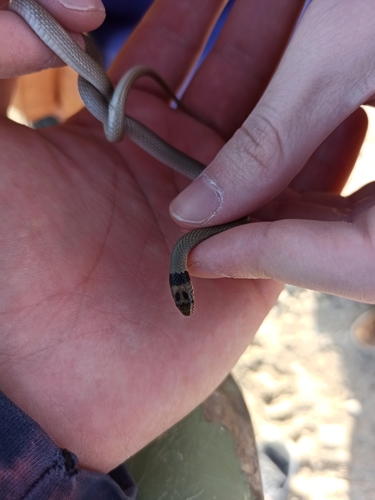 Collared Dwarf SnakeEirenis collaris
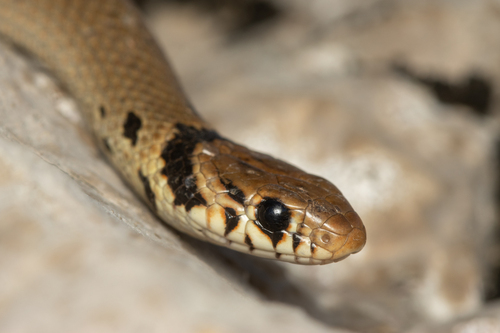 Levantine Dwarf SnakeEirenis levantinus
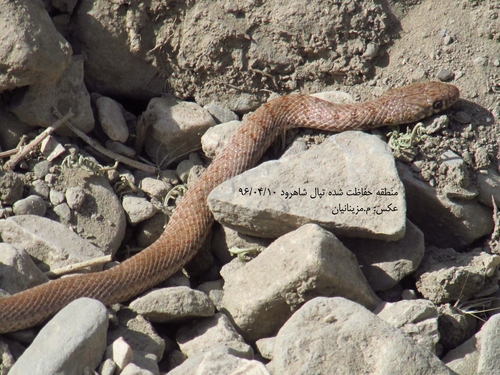 Dotted Dwarf SnakeEirenis punctatolineatus
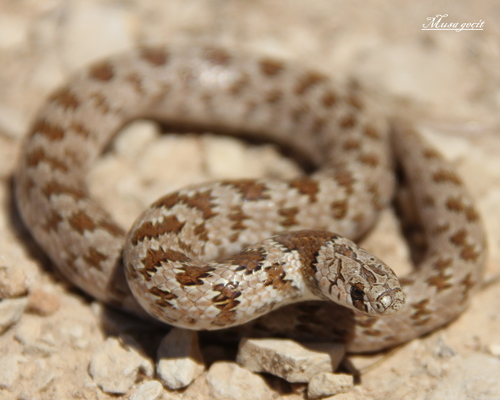 Spotted Line Dwarf SnakeEirenis lineomaculatus
 Narrow-striped Dwarf SnakeEirenis decemlineatus
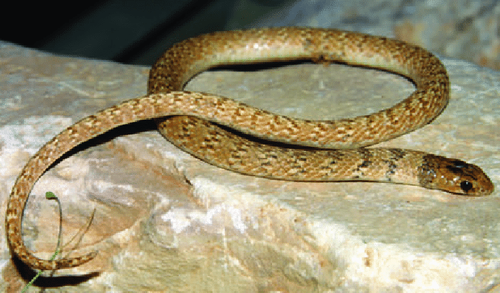 Crowned Dwarf RacerEirenis coronella
 Dark-headed Dwarf RacerEirenis persicus
Classification
How scientists group this snake, from the broadest category down to the exact species. Each step narrows to its closest relatives.
- OrderThe broad group of scaled reptiles: all snakes and lizards
- Squamata
- FamilyA group of related snakes that share key traits
- Colubridae
- GenusA close-knit group of very similar species
- Eirenis
- SpeciesThis exact snake, named in the two-part scientific name
- Eirenis modestus
Keep learning
- What to Do If You Find a SnakeFound a snake at home or on a trail? Here is how to stay calm, give it space, identify it safely, and know when to call a professional.
- Venomous vs Nonvenomous: How to Tell the DifferenceThe folk rules for telling venomous snakes apart, where each one fails, and why location-based identification beats guessing by sight.
- What Is a Snake? Anatomy and the BasicsA clear overview of what makes a snake a snake: limbless body plan, anatomy, evolution from lizards, species diversity, and why they are ectothermic.
- How to Keep Snakes Out of Your Yard and HomeA practical guide to keeping snakes out of your yard and home using habitat changes that work, plus what to skip and what to do if one shows up.
Distribution from GBIF & iNaturalist. Venom status per CDC. Background: Wikipedia. Informational only. Never handle a snake to identify it.