
Genus · Colubridae
Types of dwarf snakes
10+ species make up the genus Eirenis, the snakes commonly called dwarf snakes. None are considered dangerous to humans.
About dwarf snakes
Small, secretive ground snakes of the Old World that spend most of their lives hidden under rocks and rarely reach the length of a pencil.
Eirenis is a genus of small snakes in the family Colubridae, the largest snake family and the one that holds the bulk of the world's harmless and mildly venomous non-front-fanged species. Members of the genus are commonly called dwarf snakes, a name earned by their size. Most stay well under 60 cm and many are far shorter, with a slender body, a small head that is barely distinct from the neck, and smooth scales that give them a polished look.
The genus is centered on the eastern Mediterranean, the Middle East, and Central Asia. Dwarf snakes range across parts of southeastern Europe, Turkey, the Caucasus, the Levant, Iran, and into Central Asia, with the database holding 10+ species. Typical habitat is dry, rocky, and warm: stony hillsides, scrub, open woodland edges, and arid grassland. They are strongly secretive and are most often found by lifting flat stones, under which they shelter from heat and predators.
Recognizing a dwarf snake comes down to a combination of small size and head pattern rather than any single bold marking. Many species carry a dark collar, cap, or band across the head and neck, which shows up in the common names of members in the database such as the Ring-Headed Dwarf Snake, the Collared Dwarf Snake, and the Levantine Dwarf Snake. Roth's Dwarf Snake is another representative member. Body color is usually a plain tan, gray, olive, or brown that blends with rocky ground. Because several species look alike, exact identification often relies on scale counts and locality.
On safety: dwarf snakes are not considered dangerous to people. They are small, non-aggressive, and tend to flee or hide rather than bite. Some colubrids in this part of the world are technically rear-fanged, meaning they have enlarged grooved teeth at the back of the jaw and produce mild secretions used to subdue small prey, and any such mild effect would be limited to tiny animals, not humans. Even so, no wild snake should be picked up or handled, and a person should not rely on a field identification to decide a snake is harmless. If a bite occurs or the snake cannot be confidently identified, treat it seriously and contact emergency care: in the US, Poison Control at 1-800-222-1222, or local emergency services elsewhere.
Ecologically, dwarf snakes are small predators of small prey. Their diet leans toward invertebrates and small vertebrates such as insects, spiders, scorpions, centipedes, and lizards, which suits their modest jaw size. They are egg-laying snakes that produce small clutches, and they are generally shy, ground-dwelling, and active in warmer months while sheltering under cover during heat and cold. Their quiet, stone-loving habits mean they are easy to overlook, which is part of why a group this widespread stays so little known to most people.
Eirenis belongs to the Colubridae family (Colubrids). The largest snake family, and the one most snakes you meet belong to. Typically round pupils, a head only slightly wider than the neck, and no heat-sensing facial pit or rattle. Scales may be smooth and glossy or keeled and matte depending on the species.
Danger: Almost all colubrids are harmless. A small number are rear-fanged with medically significant venom, the boomslang and the twig (vine) snakes of Africa being the dangerous exceptions. Most colubrids will flee or bluff rather than bite.
All species (15)
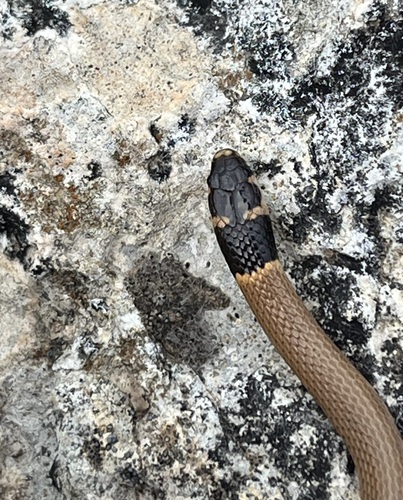 Roth's Dwarf SnakeEirenis rothiiHarmless
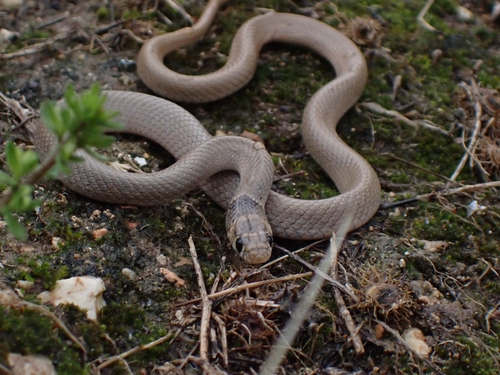 Ring-Headed Dwarf SnakeEirenis modestusHarmless
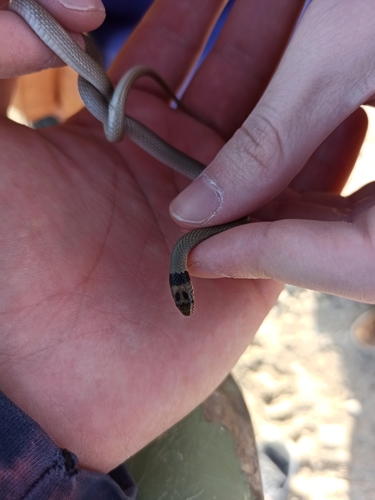 Collared Dwarf SnakeEirenis collarisHarmless
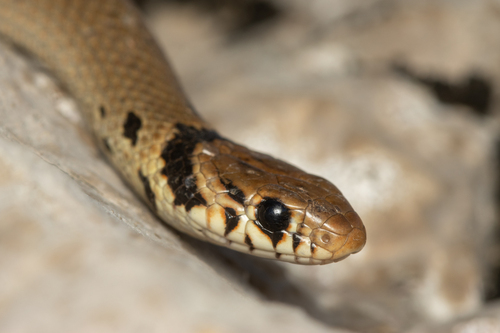 Levantine Dwarf SnakeEirenis levantinusHarmless
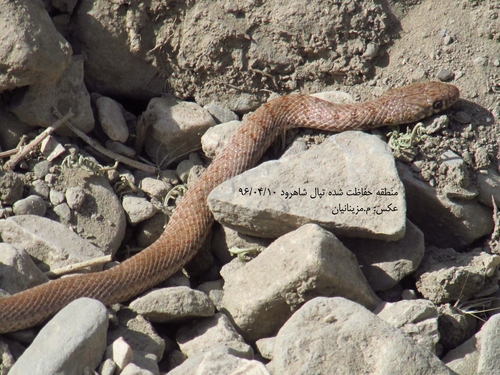 Dotted Dwarf SnakeEirenis punctatolineatusHarmless
 Narrow-striped Dwarf SnakeEirenis decemlineatusHarmless
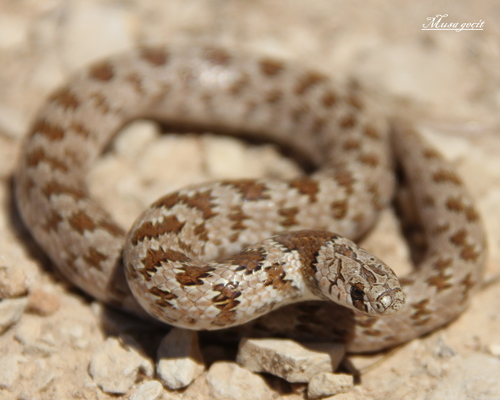 Spotted Line Dwarf SnakeEirenis lineomaculatusHarmless
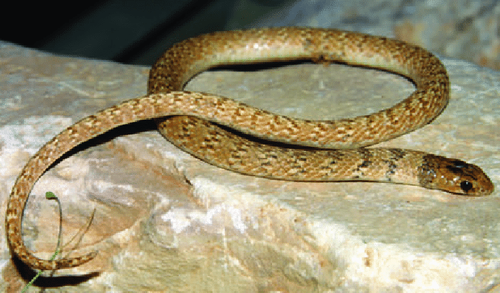 Crowned Dwarf RacerEirenis coronellaHarmless
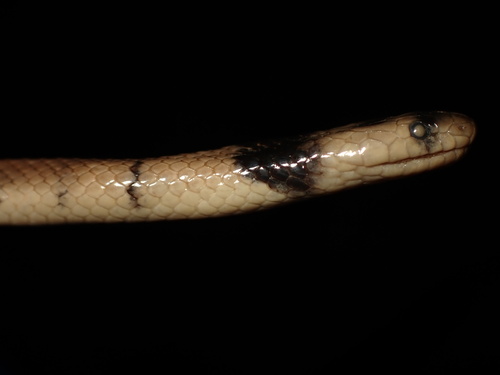 Dark-headed Dwarf RacerEirenis persicusHarmless
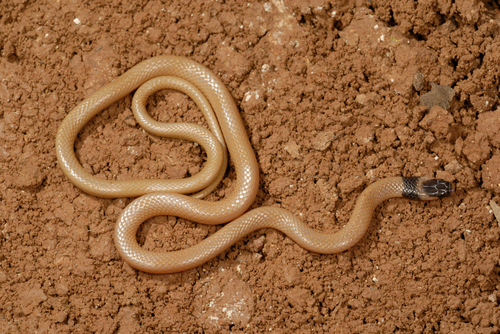 Western Dwarf RacerEirenis occidentalisHarmless
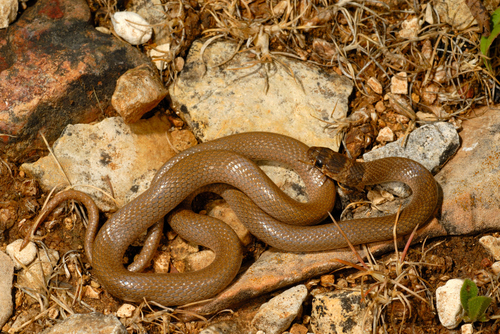 Eiselt's Dwarf RacerEirenis eiseltiHarmless
 Ashkhabad Dwarf RacerEirenis medusHarmless
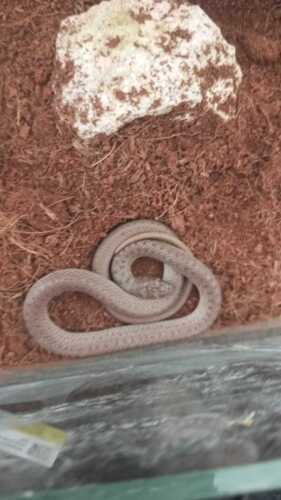 Baran Dwarf RacerEirenis baraniHarmless
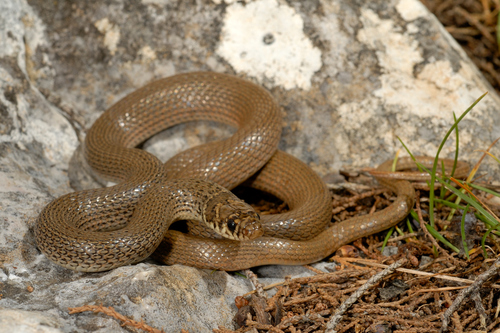 Golden-striped Dwarf SnakeEirenis aurolineatusHarmless
- No photoEirenis nigrofasciatusHarmless
Keep learning
- What Is a Snake? Anatomy and the BasicsA clear overview of what makes a snake a snake: limbless body plan, anatomy, evolution from lizards, species diversity, and why they are ectothermic.
- How Snakes Move, Hunt, and EatHow snakes move without legs, hunt as ambushers or active foragers, kill by constriction or venom, and swallow prey wider than their head.
- What Do Snakes Eat?All snakes are carnivores. Learn what snakes eat, how diet changes with size and age, how often they feed, and how they hunt and swallow prey.
- Venomous vs Nonvenomous: How to Tell the DifferenceThe folk rules for telling venomous snakes apart, where each one fails, and why location-based identification beats guessing by sight.