
Pythonidae
Macklot's Python
HarmlessLiasis mackloti

The Macklot's Python (Liasis mackloti) is a non-venomous snake in the Pythonidae family, recorded in 5 countries.
- Family
- Pythonidae
About the Macklot's Python
Liasis mackloti, commonly known as Macklot's python or the freckled python, is a species of python, a non-venomous snake in the family Pythonidae. The species is native to Indonesia, Timor-Leste, Papua New Guinea, and coastal northern Australia. Three subspecies are recognized, including the nominate subspecies described here.
Etymology
The specific name, mackloti, is in honor of naturalist and taxidermist Heinrich Christian Macklot.
The subspecific name, dunni, is in honor of American herpetologist Emmett Reid Dunn.
Description
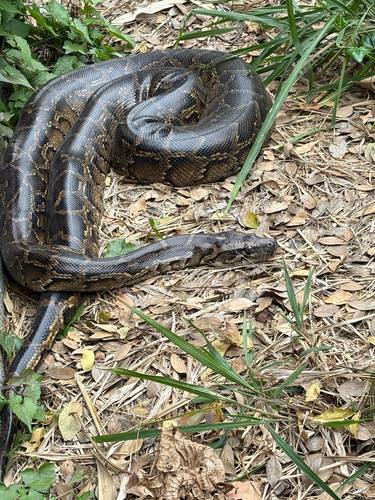
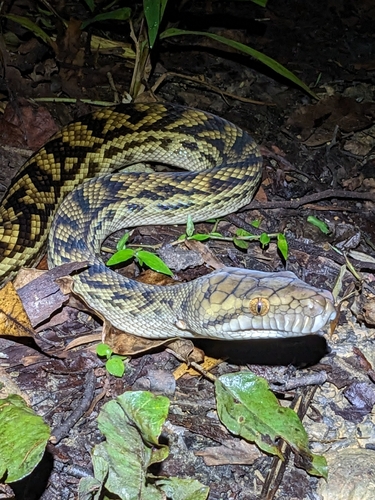
Attaining 7 ft (2.13 m) or more in total length (tail included), Macklot's python is large and if not treated properly can be a poor-tempered snake. Its coloration consists of a blackish-brown to green base color, with yellow to ochre sides, and a white belly that is patterned with small and dispersed yellow spots or black speckles, while the labial scales are pale in color.
Reproduction
Liasis mackloti is known to breed easily in captivity. It is oviparous.
Geographic range
Liasis mackloti is found in Indonesia in the Lesser Sunda Islands of Savu, Roti, Samao, Timor and Wetar, in East Timor, Papua New Guinea, and coastal northern Australia. The type locality given is "les îles de Timor et de Samao ". Brongersma (1968) restricted the type locality to "Timor" by lectotype designation.
Subspecies
Exotic trade and captive care
Liasis mackloti is a snake that is known and sold in the live exotic animal trade, bringing it far beyond its native range, to as far as the United Kingdom, and North America, where it is sold and kept in captivity from pet stores, speciality shops, and conventions.
Adapted from Wikipedia, available under CC BY-SA.
Frequently asked: Macklot's Python
- Is the Macklot's Python venomous?
- No. The Macklot's Python (Liasis mackloti) is non-venomous and is not considered dangerous to humans. Like most snakes, it will retreat rather than bite when given the chance.
- Is the Macklot's Python poisonous?
- Snakes are venomous, not poisonous. "Poisonous" means harmful to eat or touch; "venomous" means injecting toxins through a bite. The Macklot's Python is neither poisonous nor venomous.
- Is the Macklot's Python dangerous?
- The Macklot's Python is not dangerous to humans. It has no medically significant venom and bites only defensively if cornered or handled.
- Where does the Macklot's Python live?
- The Macklot's Python has verified records in 5 countries, including Indonesia, Timor-Leste, Australia. See the distribution section below for its full range.
- Why is it called the Macklot's Python?
- The specific name, mackloti, is in honor of naturalist and taxidermist Heinrich Christian Macklot. The subspecific name, dunni, is in honor of American herpetologist Emmett Reid Dunn.
Where it is found
More Pythonidae snakes
Classification
How scientists group this snake, from the broadest category down to the exact species. Each step narrows to its closest relatives.
- OrderThe broad group of scaled reptiles: all snakes and lizards
- Squamata
- FamilyA group of related snakes that share key traits
- Pythonidae
- GenusA close-knit group of very similar species
- Liasis
- SpeciesThis exact snake, named in the two-part scientific name
- Liasis mackloti
Keep learning
- What to Do If You Find a SnakeFound a snake at home or on a trail? Here is how to stay calm, give it space, identify it safely, and know when to call a professional.
- Venomous vs Nonvenomous: How to Tell the DifferenceThe folk rules for telling venomous snakes apart, where each one fails, and why location-based identification beats guessing by sight.
- What Is a Snake? Anatomy and the BasicsA clear overview of what makes a snake a snake: limbless body plan, anatomy, evolution from lizards, species diversity, and why they are ectothermic.
- How to Keep Snakes Out of Your Yard and HomeA practical guide to keeping snakes out of your yard and home using habitat changes that work, plus what to skip and what to do if one shows up.
Distribution from GBIF & iNaturalist. Venom status per CDC. Background: Wikipedia. Informational only. Never handle a snake to identify it.