
Genus · Pythonidae
Types of pythons
3 species make up the genus Liasis, the snakes commonly called pythons. None are considered dangerous to humans.
About water pythons
Liasis is a small genus of nonvenomous, water-loving pythons from Australia, New Guinea, and nearby islands.
Liasis is a genus in the python family, Pythonidae, the group of nonvenomous constricting snakes native to Africa, Asia, and Australasia. The genus sits within the Australo-Papuan radiation of pythons and currently holds a handful of recognized species, including the Water Python, the Olive Python, and Macklot's Python. As pythons, these snakes kill prey by constriction rather than venom, and they share the family traits of heat-sensing pits along the lips, a coat of small smooth or lightly glossed scales, and the paired pelvic spurs seen near the vent in many members of the family.
The genus is centered on Australia and New Guinea, with species reaching into the islands of Indonesia and the surrounding region. True to the common name, several members favor habitats near water such as floodplains, swamps, billabongs, river edges, and seasonally wet lowlands, though some range into drier savanna and rocky country. They are generally ground-dwelling and are competent swimmers, often hunting along the margins where water meets land.
Recognizing a Liasis python in general terms means looking for a medium to large, heavy-bodied snake with smooth scales that can carry an iridescent sheen in good light. Coloration tends toward plain or subtly patterned browns, olives, and dark tones rather than the bold blotching of some other pythons. The head is distinct from the neck, and the labial scales bear the small heat-sensing pits typical of the family. Exact size varies by species, with the larger members among the more substantial Australian pythons.
These snakes are nonvenomous and are not a venom threat to people. They are not safe to handle when encountered in the wild, however. A large python can deliver a powerful defensive bite that causes lacerations and risks infection, and large constrictors should be treated with respect and given distance. Do not attempt to capture or move a wild snake. If a bite breaks the skin or you are unsure of the snake's identity, clean the wound and seek medical care, and in the United States you can reach Poison Control at 1-800-222-1222 or contact local emergency services.
Ecologically, Liasis pythons are ambush and active foragers that prey on mammals, birds, and reptiles, with diet shifting by species and habitat; waterside members often take aquatic and floodplain prey. Like other pythons they are egg-layers, and females of many species coil around the clutch and may shiver to generate warmth during incubation. Behavior is generally secretive and most activity falls in the cooler parts of the day in warm climates, with these snakes playing a role as mid-sized predators that help regulate rodent and small-vertebrate populations.
Liasis belongs to the Pythonidae family (Pythons). Old-World egg-laying constrictors, including the longest snakes on Earth. Large and heavy-bodied with blotched or banded patterns, smooth scales, and heat-sensing pits along the lips. No rattle or fangs.
Danger: Non-venomous. Only the very largest species could be a physical danger, and bites are defensive, not venomous.
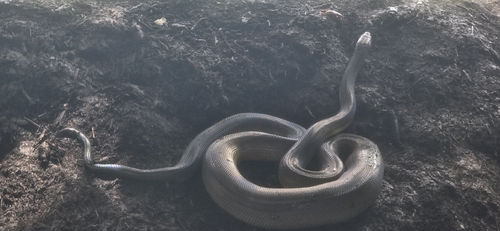
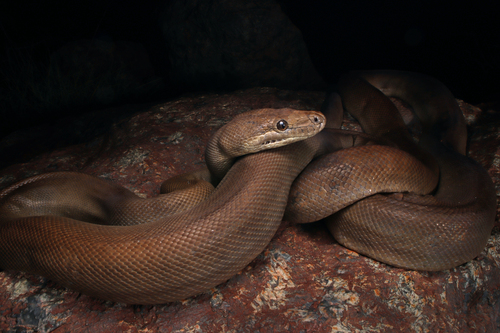
All species (3)

Keep learning
- What Is a Snake? Anatomy and the BasicsA clear overview of what makes a snake a snake: limbless body plan, anatomy, evolution from lizards, species diversity, and why they are ectothermic.
- How Snakes Move, Hunt, and EatHow snakes move without legs, hunt as ambushers or active foragers, kill by constriction or venom, and swallow prey wider than their head.
- What Do Snakes Eat?All snakes are carnivores. Learn what snakes eat, how diet changes with size and age, how often they feed, and how they hunt and swallow prey.
- Venomous vs Nonvenomous: How to Tell the DifferenceThe folk rules for telling venomous snakes apart, where each one fails, and why location-based identification beats guessing by sight.