
Xenopeltidae
Asian Sunbeam Snake
HarmlessXenopeltis unicolor
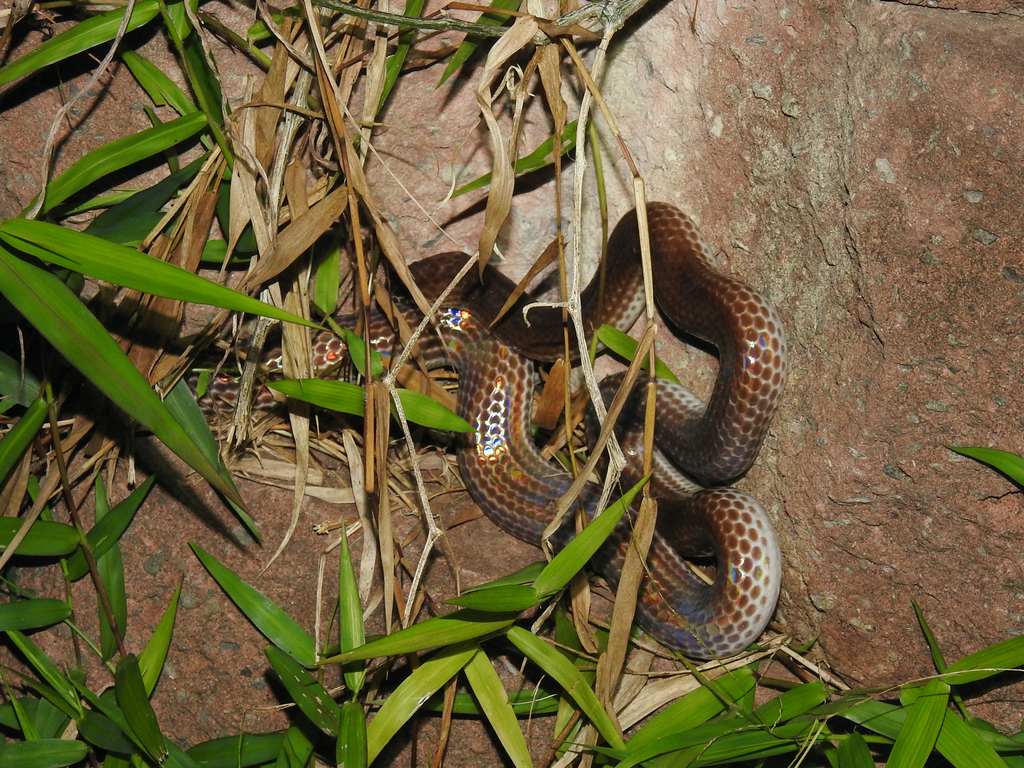
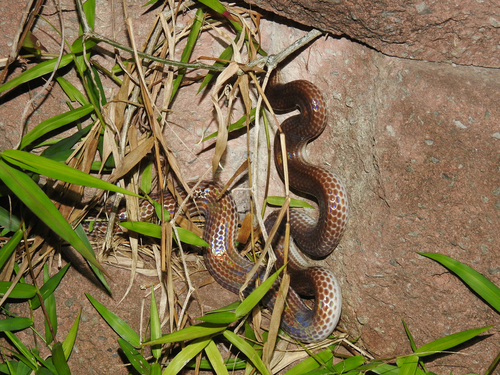
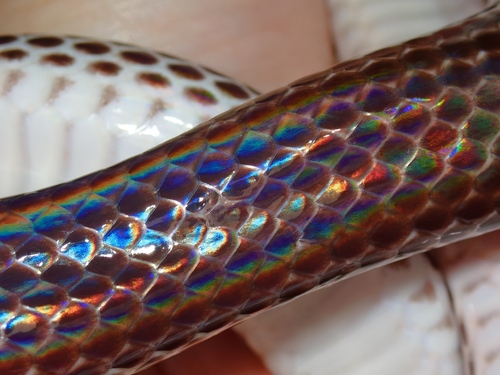
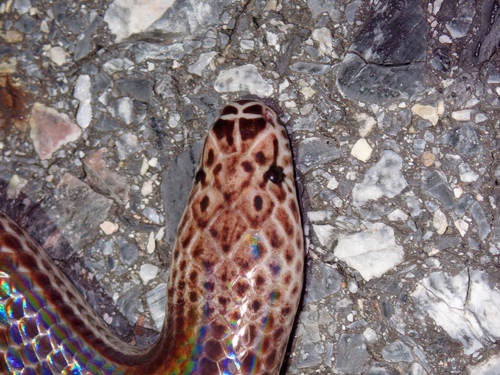
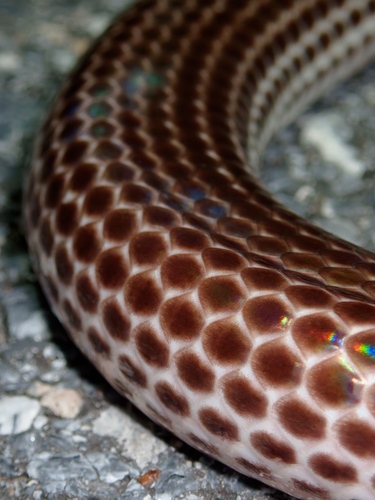
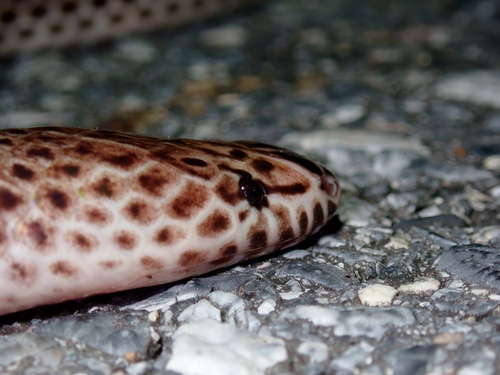
6 photographs of the Asian Sunbeam Snake. © Kseniia Marianna Prondzynska.
The Asian Sunbeam Snake (Xenopeltis unicolor) is a non-venomous snake in the Xenopeltidae family, recorded in 14 countries.
- Family
- Xenopeltidae
About the Asian Sunbeam Snake
Xenopeltis unicolor, commonly known as the sunbeam snake, common sunbeam snake or iridescent snake, is a non-venomous sunbeam snake species found in Southeast Asia and some regions of Indonesia. This is a primitive snake known for both its highly iridescent scales and its ability to reproduce quickly, as it is oviparous and as such can lay up to 10 eggs at a time. No subspecies are currently recognized.
Description
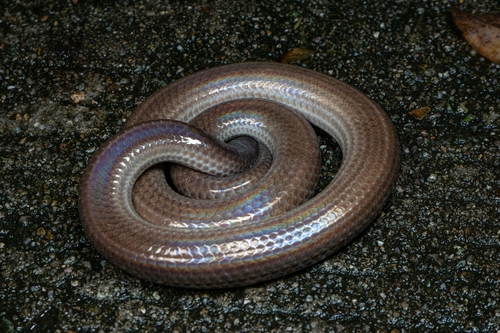
Grows to an average of about 1 m (3 ft 3 in). The color is reddish brown, brown or blackish with an unpatterned withish-grey venter. A fossorial species, the head is wedge-shaped and narrow with little neck delineation, which makes it easy to push through the soil. Its most defining characteristic is its iridescent, highly polished scales that give this snake its common name. They have a layer of dark pigmentation just below the surface on each scale that enhances the iridescence. The young look very similar to the adults, except that they have a strong white "collar" of scales evident just below the head. This coloration fades within the first year. They have two cone opsins allowing for the potential of dichromatic color vision.
Xenopeltis unicolor has two postocular scales, supralabial formula 3-2-3, 181 – 196 ventrals, and 26 – 31 pairs of subcaudals.
This is a primitive form of snake with both boid and python characteristics; which family it belongs to is still a matter of debate.
Geographic range
Found in China (Guangdong and Yunnan), Myanmar, the Andaman and Nicobar Islands, Vietnam, Laos, Cambodia, Thailand, West Malaysia, Penang Island, Singapore Island, East Malaysia (Sarawak), Indonesia (the Riau Archipelago, Bangka, Billiton, Sumatra, We, Simalur, Nias, the Mentawai Islands (Siberut), Borneo, Java and Sulawesi) and the Philippines (Balabac, Bongao, Jolo and Palawan). The type locality given is "Java".
Habitat
Tends to live in open areas such as forest clearings, gardens and parks. Often encountered in rice paddies.
These snakes are found in monsoon and rain forests, on the rice fields and gardens adjacent to residential houses; prefer the sites of the forests in the valleys of mountain streams with outcrops of the rocks and numerous hollows under the piles of stones.
Behaviour
These snake are constrictors, killing their prey by suffocation in their muscular coils. They are fossorial and spend most of their time below ground. They may bite readily if handled roughly, but mostly just try to escape if picked up. They are also observed to vibrate their tails in a rattlesnake-like fashion when they feel threatened.
Feeding
The diet is varied, consisting primarily of frogs, reptiles, including other snakes, and small mammals.
Reproduction
Adapted from Wikipedia, available under CC BY-SA.
Frequently asked: Asian Sunbeam Snake
- Is the Asian Sunbeam Snake venomous?
- No. The Asian Sunbeam Snake (Xenopeltis unicolor) is non-venomous and is not considered dangerous to humans. Like most snakes, it will retreat rather than bite when given the chance.
- Is the Asian Sunbeam Snake poisonous?
- Snakes are venomous, not poisonous. "Poisonous" means harmful to eat or touch; "venomous" means injecting toxins through a bite. The Asian Sunbeam Snake is neither poisonous nor venomous.
- Is the Asian Sunbeam Snake dangerous?
- The Asian Sunbeam Snake is not dangerous to humans. It has no medically significant venom and bites only defensively if cornered or handled.
- Where does the Asian Sunbeam Snake live?
- The Asian Sunbeam Snake has verified records in 14 countries, including Thailand, Indonesia, Viet Nam. See the distribution section below for its full range.
- What does the Asian Sunbeam Snake eat?
- The diet is varied, consisting primarily of frogs, reptiles, including other snakes, and small mammals.
Where it is found
By U.S. state
More Xenopeltidae snakes
Classification
How scientists group this snake, from the broadest category down to the exact species. Each step narrows to its closest relatives.
- OrderThe broad group of scaled reptiles: all snakes and lizards
- Squamata
- FamilyA group of related snakes that share key traits
- Xenopeltidae
- GenusA close-knit group of very similar species
- Xenopeltis
- SpeciesThis exact snake, named in the two-part scientific name
- Xenopeltis unicolor
Keep learning
- What to Do If You Find a SnakeFound a snake at home or on a trail? Here is how to stay calm, give it space, identify it safely, and know when to call a professional.
- Venomous vs Nonvenomous: How to Tell the DifferenceThe folk rules for telling venomous snakes apart, where each one fails, and why location-based identification beats guessing by sight.
- What Is a Snake? Anatomy and the BasicsA clear overview of what makes a snake a snake: limbless body plan, anatomy, evolution from lizards, species diversity, and why they are ectothermic.
- How to Keep Snakes Out of Your Yard and HomeA practical guide to keeping snakes out of your yard and home using habitat changes that work, plus what to skip and what to do if one shows up.
Distribution from GBIF & iNaturalist. Venom status per CDC. Background: Wikipedia. Informational only. Never handle a snake to identify it.