
Xenopeltidae
Hainan Sunbeam Snake
HarmlessXenopeltis hainanensis
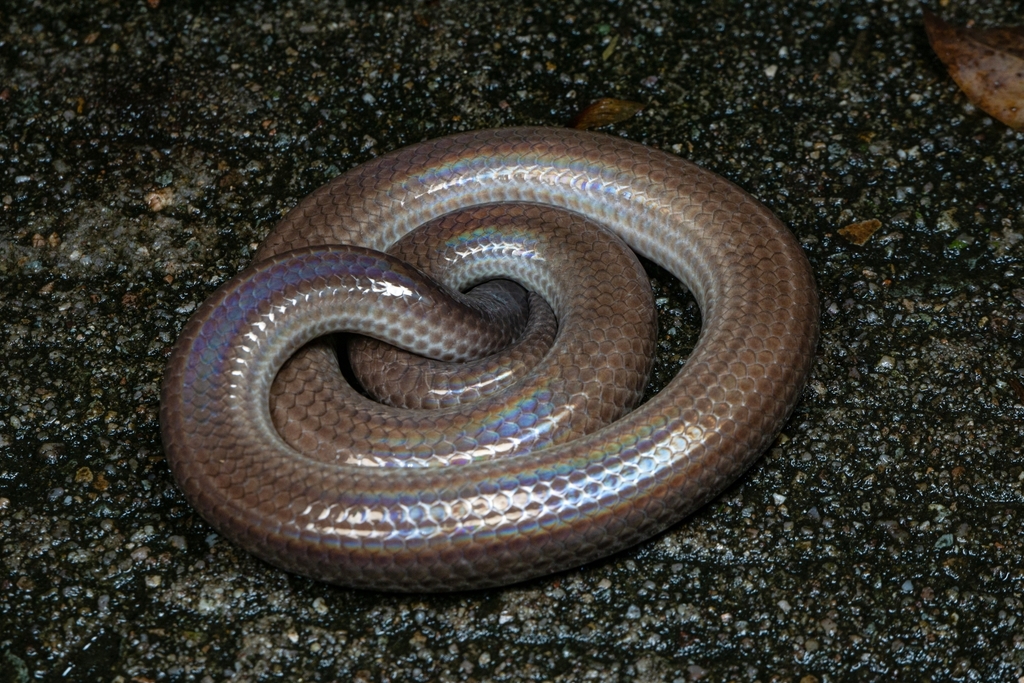
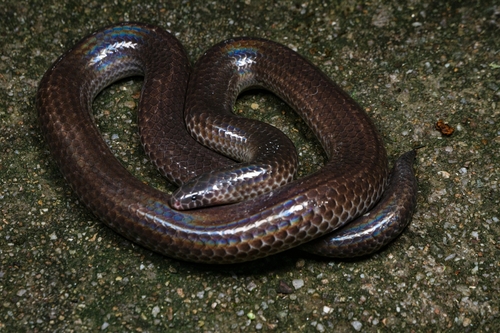
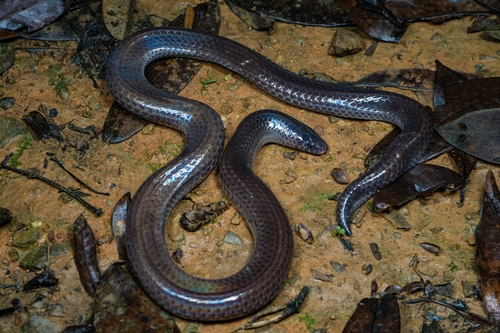
3 photographs of the Hainan Sunbeam Snake. (c) liushi, some rights reserved (CC BY-NC).
The Hainan Sunbeam Snake (Xenopeltis hainanensis) is a non-venomous snake in the Xenopeltidae family, recorded in 2 countries.
- Family
- Xenopeltidae
About the Hainan Sunbeam Snake
Xenopeltis hainanensis is a non-venomous sunbeam snake species found in China and Vietnam. This is a primitive snake known for its highly iridescent scales. No subspecies are recognized.
Description
This snake grows to an average of about .5 to 1 m. A fossorial species, the head is wedge-shaped and narrow with little neck delineation, which makes it easy to push through the soil. Its most defining characteristic is its iridescent, highly polished scales that give this snake its common name (sunbeam snake). The dorsal scales a layer of dark (indigo-brown) pigmentation just below the surface on each scale that enhances the iridescence. The ventral scales are greyish-white.
This species differs from its sister taxon Xenopeltis unicolor in several ways. It has a singular postocular scale rather than two, fewer ventral, supralabial, and infralabial scales, a shorter tail, and fewer maxillary teeth.
The holotype of the species is Chengdu Institute of Biology specimen CIB 64III6016, a male collected in 1964. The paratype, CIB 64III6650, is a female collected the same year.
Both species together form the family Xenopeltidae, a primitive group of snakes with both boid and pythonid characteristics.
Geographic range
Xenopeltis hainanensis is found in "isolated pockets" of southeastern China (from Guangxi east to Zhejiang and south to Hainan) and northern Vietnam. The type locality given is Dali village, Diaoluo Shan (Mount Diaoluo) on Hainan island, China.
Habitat
This snake tends to live on forest slopes, at heights between 900 and 1100 metres above sea level.
Behavior
These snakes are not venomous, but are constrictors, killing their prey by suffocation in their muscular coils. They are fossorial and spend most of their time below ground.
Feeding
The diet is varied, consisting primarily of frogs, reptiles, including other snakes, and small mammals. The young look very similar to the adults, except that they have a strong white "collar" of scales evident just below the head. This coloration fades within the first year.
Reproduction
This species of snake is oviparous, with females laying up to 10 eggs at a time.
Adapted from Wikipedia, available under CC BY-SA.
Frequently asked: Hainan Sunbeam Snake
- Is the Hainan Sunbeam Snake venomous?
- No. The Hainan Sunbeam Snake (Xenopeltis hainanensis) is non-venomous and is not considered dangerous to humans. Like most snakes, it will retreat rather than bite when given the chance.
- Is the Hainan Sunbeam Snake poisonous?
- Snakes are venomous, not poisonous. "Poisonous" means harmful to eat or touch; "venomous" means injecting toxins through a bite. The Hainan Sunbeam Snake is neither poisonous nor venomous.
- Is the Hainan Sunbeam Snake dangerous?
- The Hainan Sunbeam Snake is not dangerous to humans. It has no medically significant venom and bites only defensively if cornered or handled.
- Where does the Hainan Sunbeam Snake live?
- The Hainan Sunbeam Snake has verified records in 2 countries, including China, Viet Nam. See the distribution section below for its full range.
- What does the Hainan Sunbeam Snake eat?
- The diet is varied, consisting primarily of frogs, reptiles, including other snakes, and small mammals. The young look very similar to the adults, except that they have a strong white "collar" of scales evident just below the head. This coloration fades within the first year.
Where it is found
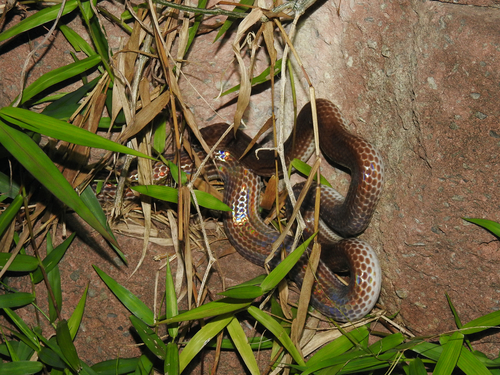
More Xenopeltidae snakes
Classification
How scientists group this snake, from the broadest category down to the exact species. Each step narrows to its closest relatives.
- OrderThe broad group of scaled reptiles: all snakes and lizards
- Squamata
- FamilyA group of related snakes that share key traits
- Xenopeltidae
- GenusA close-knit group of very similar species
- Xenopeltis
- SpeciesThis exact snake, named in the two-part scientific name
- Xenopeltis hainanensis
Keep learning
- What to Do If You Find a SnakeFound a snake at home or on a trail? Here is how to stay calm, give it space, identify it safely, and know when to call a professional.
- Venomous vs Nonvenomous: How to Tell the DifferenceThe folk rules for telling venomous snakes apart, where each one fails, and why location-based identification beats guessing by sight.
- What Is a Snake? Anatomy and the BasicsA clear overview of what makes a snake a snake: limbless body plan, anatomy, evolution from lizards, species diversity, and why they are ectothermic.
- How to Keep Snakes Out of Your Yard and HomeA practical guide to keeping snakes out of your yard and home using habitat changes that work, plus what to skip and what to do if one shows up.
Distribution from GBIF & iNaturalist. Venom status per CDC. Background: Wikipedia. Informational only. Never handle a snake to identify it.