
Genus · Xenopeltidae
Types of sunbeam snakes
2 species make up the genus Xenopeltis, the snakes commonly called sunbeam snakes. None are considered dangerous to humans.
About sunbeam snakes
Smooth-bodied burrowers from Southeast Asia whose iridescent scales scatter light into rainbow sheens.
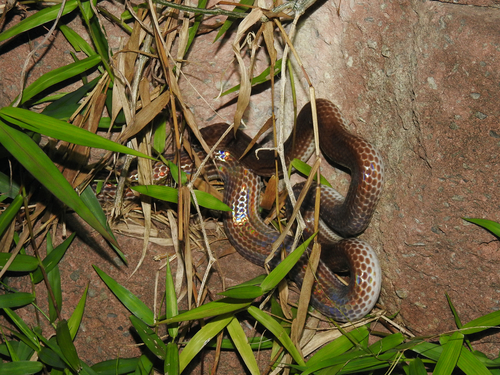
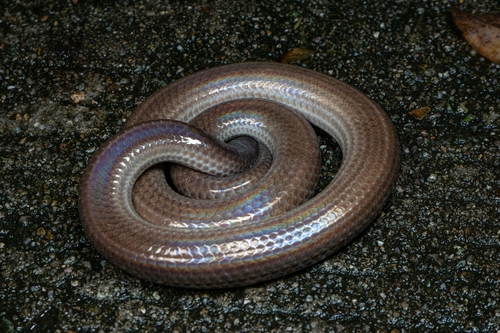
Xenopeltis is the only genus in the family Xenopeltidae, a small and ancient lineage of nonvenomous, primitive snakes native to Southeast Asia. It holds just two recognized species: the wide-ranging Asian Sunbeam Snake (Xenopeltis unicolor) and the more localized Hainan Sunbeam Snake (Xenopeltis hainanensis). The family sits among the basal, fossorial snakes and is best known for the spectacular iridescence of its members, a structural effect produced by the microscopic surface of their highly polished scales rather than by any pigment. The genus ranges across mainland and island Southeast Asia, with the Asian Sunbeam Snake found from southern China and Myanmar through Thailand, the Indochinese peninsula, and into Indonesia and the Philippines, while the Hainan Sunbeam Snake occupies southern China and northern Vietnam. Typical habitats are lowland forests, agricultural land, gardens, and other moist soils where the snakes spend most of their lives underground or under leaf litter and debris.
Sunbeam snakes are easy to recognize as a group. They are stout, cylindrical snakes with a wedge-shaped, slightly flattened head that is barely distinct from the neck, small eyes, and smooth scales that give the body a glossy, almost wet look. In good light the dark brownish or blackish dorsal surface throws off a strong rainbow iridescence, while the underside is typically pale. They are nonvenomous and harmless to people. They lack the long fangs and venom apparatus of dangerous snakes and rely on a constricting, gripping bite to subdue prey. There is no medical danger from these animals, though as with any wild snake the sensible practice is to observe rather than handle and to let the animal move on.
Ecologically, Xenopeltis are nocturnal, secretive burrowers that hunt soft-bodied prey such as frogs, smaller snakes, lizards, and small mammals, overpowering them by constriction. They are egg-layers, producing clutches that hatch into miniature versions of the adults. Their fossorial habits mean they are far more often turned up by digging or plowing than seen moving in the open, and when disturbed they may vibrate the tail and release a musky odor. Because they are inoffensive and feed on rodents and other small animals, they are a benign presence in the gardens and farmland they share with people across the region.
Xenopeltis belongs to the Xenopeltidae family (Sunbeam snakes). Burrowing snakes famous for brilliantly iridescent scales. Glossy dark body with striking iridescence and a wedge-shaped head.
Danger: Harmless. Non-venomous.
All species (2)
Keep learning
- What Is a Snake? Anatomy and the BasicsA clear overview of what makes a snake a snake: limbless body plan, anatomy, evolution from lizards, species diversity, and why they are ectothermic.
- How Snakes Move, Hunt, and EatHow snakes move without legs, hunt as ambushers or active foragers, kill by constriction or venom, and swallow prey wider than their head.
- What Do Snakes Eat?All snakes are carnivores. Learn what snakes eat, how diet changes with size and age, how often they feed, and how they hunt and swallow prey.
- Venomous vs Nonvenomous: How to Tell the DifferenceThe folk rules for telling venomous snakes apart, where each one fails, and why location-based identification beats guessing by sight.