
Elapidae
Sinomicrurus annularis
VenomousThis species has no widely used English common name.
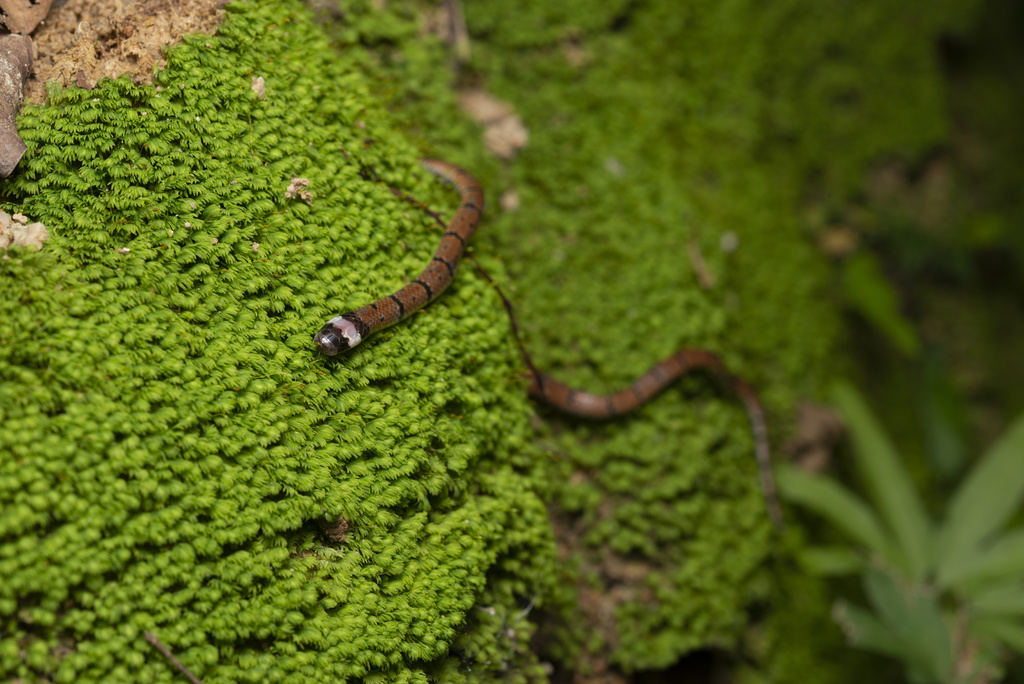
Sinomicrurus annularis is a venomous snake in the Elapidae family, recorded in 12 countries.
If you are bitten
This is a venomous snake. Treat any bite as a medical emergency: stay calm, keep the bitten limb still and roughly level with the heart, remove rings and tight clothing, and get to emergency care immediately. Do not apply a tourniquet, cut the wound, apply ice, or try to suck out venom. Call your local emergency number or poison center.
- Family
- Elapidae
- Danger
- high
About the Sinomicrurus annularis
Sinomicrurus annularis is a species of Asian coral snake. This snake is relatively unknown, although it is a member of the venomous elapid family.
Morphology
This snake is under three feet in length (32 inches, or 80 centimeters). This snake is a dull red with black crossbands, with a white underside. The pattern of the stripes can vary within this species.
Taxonomic history
The species was originally described as Callophis annularis by Albert Günther in 1864. It was synonymized with Callophis maclellandi in 1891 and resurrected from synonymy as Sinomicrurus annularis in 2021. As a result, almost all of the pertinent literature refers to this species as either Calliophis macclellandi (late 1800s and 1900s) or Sinomicrurus macclellandi (early 2000s).
Common names
The most widely used common name for this species of snake is MacClelland's coral snake, which is a source of confusion since this is also the common name of Sinomicrurus macclellandi.
Geographic range
Although S. macclellandi is widespread in central Asia south of the Himalayas (northern India, Nepal, Bhutan, Bangladesh, Myanmar, Thailand, Laos, Cambodia, western Vietnam, and parts of China), S. annularis is restricted to northeastern Vietnam and southeastern China (including Hainan and Hong Kong). Because many observations from the zone of contact have not been examined in detail, it is difficult to say exactly where the species boundary occurs.
The MacClelland's coral snake prefers to live in areas with high elevation, despite foraging in detritus.
Similar species
Sinomicrurus annularis can be differentiated from other closely related species of Sinomicrurus (S. macclellandi, S. peinani, S. swinhoei and S. iwasakii) by a combination of absent mid-dorsal and lateral stripes, a temporal scale arrangement of 1+1, 13 dorsal scale rows at midbody, a black rostral band spilling into the frontal scale, a straight anterior edge of the black nuchal band (in dorsal profile) beginning at the parietal scales, and a complete pale parietal band.
Feeding
MacClelland's coral snake produces venom, which is used to subdue its prey. This venom functions by impacting the nervous system of its prey. Very few human deaths have been reported, although the exact number is unknown. However, the venom is capable of altering breathing and heart function of humans.
This snake is nocturnal and is usually reluctant to bite. They generally hide or attempt to startle predators by twitching its body or showing its bottom scales to prevent predators from attacking its head.
This snake species has been documented to feed on other reptiles, such as lizards and even different species of snakes. However, in 2022, a paper was published that recorded a MacClelland's coral snake engaging in cannibalism.
Reproduction
Adapted from Wikipedia, available under CC BY-SA.
Frequently asked: Sinomicrurus annularis
- Is the Sinomicrurus annularis venomous?
- Yes. The Sinomicrurus annularis is venomous and belongs to the Elapidae family (cobra, mamba, coral or sea snake). Its bite is considered high risk to people. Treat any bite as a medical emergency.
- Is the Sinomicrurus annularis poisonous?
- Snakes are venomous, not poisonous. "Poisonous" means harmful to eat or touch; "venomous" means injecting toxins through a bite. The Sinomicrurus annularis is venomous, delivering venom through a bite.
- Is the Sinomicrurus annularis dangerous?
- This is a venomous snake. Treat any bite as a medical emergency: stay calm, keep the bitten limb still and roughly level with the heart, remove rings and tight clothing, and get to emergency care immediately. Do not apply a tourniquet, cut the wound, apply ice, or try to suck out venom. Call your local emergency number or poison center.
- Where does the Sinomicrurus annularis live?
- The Sinomicrurus annularis has verified records in 12 countries, including Chinese Taipei, Japan, China. See the distribution section below for its full range.
- What does the Sinomicrurus annularis eat?
- MacClelland's coral snake produces venom, which is used to subdue its prey. This venom functions by impacting the nervous system of its prey. Very few human deaths have been reported, although the exact number is unknown. However, the venom is capable of altering breathing and heart function of humans. This snake is nocturnal and is usually reluctant to bite. They generally hide or attempt to startle predators by twitching its body or showing its bottom scales to prevent predators from attacking its head.
If you are bitten by the Sinomicrurus annularis
Do
- Get away from the snake and stay calm. Most bites worsen when people panic or try again to handle the snake.
- Call 911 or Poison Control (1-800-222-1222) right away. Antivenom works best when given early.
- Note the time of the bite and, from a safe distance, the snake's color and pattern, a phone photo is enough. Do not chase it.
- Keep the bitten limb still and at roughly heart level. Sit or lie down and limit movement.
- Remove rings, watches, and tight clothing near the bite before swelling starts.
- Gently wash the bite with soap and water and cover it with a clean, dry dressing.
Do not
- Do not cut the wound or try to suck out the venom.
- Do not apply a tourniquet or ice.
- Do not drink alcohol or caffeine.
- Do not take aspirin or ibuprofen, they can worsen bleeding. Acetaminophen is safer for pain.
- Do not try to catch or kill the snake. A dead snake can still bite by reflex.
First-aid guidance adapted from the U.S. Centers for Disease Control and Prevention (CDC NIOSH), Venomous Snakes. Educational only; always follow the instructions of emergency responders.
Where it is found
More Elapidae snakes
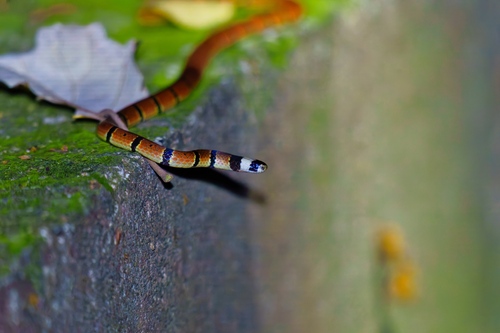 Swinhoe's Temperate Asian CoralsnakeSinomicrurus swinhoei
 Taiwan Coral SnakeSinomicrurus sauteri
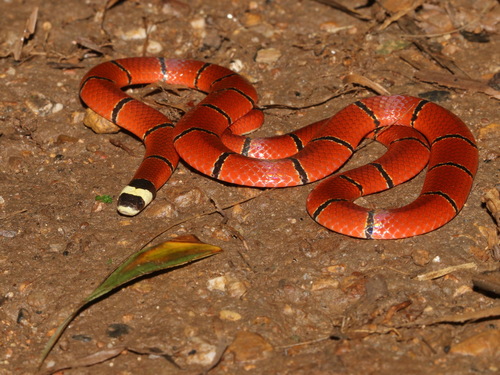 MacClelland’s Coral SnakeSinomicrurus macclellandi
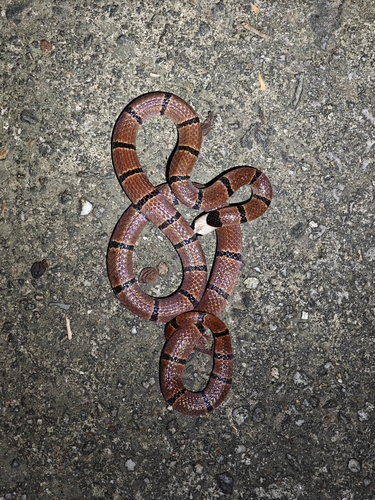 Guangxi Coral SnakeSinomicrurus peinani
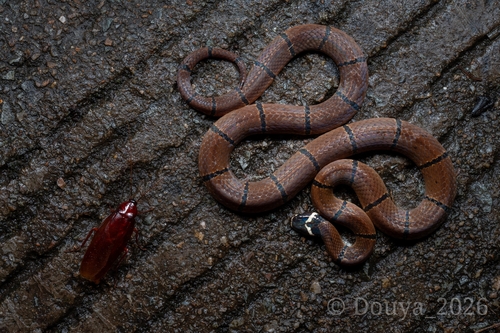 Kellogg's Coral SnakeSinomicrurus kelloggi
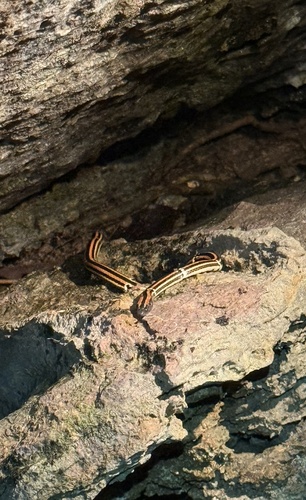 Hai Coral SnakeSinomicrurus boettgeri
 Japanese Coral SnakeSinomicrurus japonicus
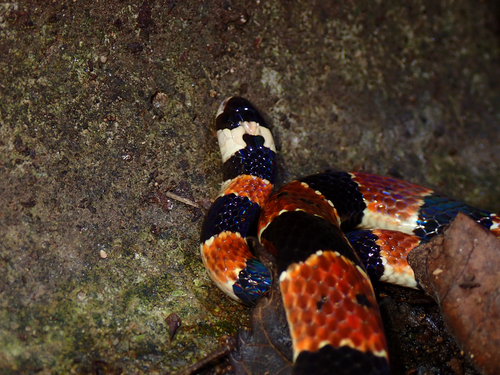 Sinomicrurus iwasakiiSinomicrurus iwasakii
Classification
How scientists group this snake, from the broadest category down to the exact species. Each step narrows to its closest relatives.
- OrderThe broad group of scaled reptiles: all snakes and lizards
- Squamata
- FamilyA group of related snakes that share key traits
- Elapidae
- GenusA close-knit group of very similar species
- Sinomicrurus
- SpeciesThis exact snake, named in the two-part scientific name
- Sinomicrurus annularis
Keep learning
- Are Snakes Dangerous? The Real Risk, in PerspectiveMost snakes are harmless and avoid people. Here is the honest picture of snakebite risk worldwide and how to lower your own.
- Snakebite First Aid: What to Do (and What Never to Do)A clear, CDC-based guide to snakebite first aid: the steps that help, the popular myths that hurt, and how to tell a serious bite from a minor one.
- Venomous vs Nonvenomous: How to Tell the DifferenceThe folk rules for telling venomous snakes apart, where each one fails, and why location-based identification beats guessing by sight.
- What to Do If You Find a SnakeFound a snake at home or on a trail? Here is how to stay calm, give it space, identify it safely, and know when to call a professional.
Distribution from GBIF & iNaturalist. Venom status per CDC. Background: Wikipedia. Informational only. Never handle a snake to identify it.