
Viperidae
Pope’s Tree Viper
VenomousTrimeresurus popeiorum
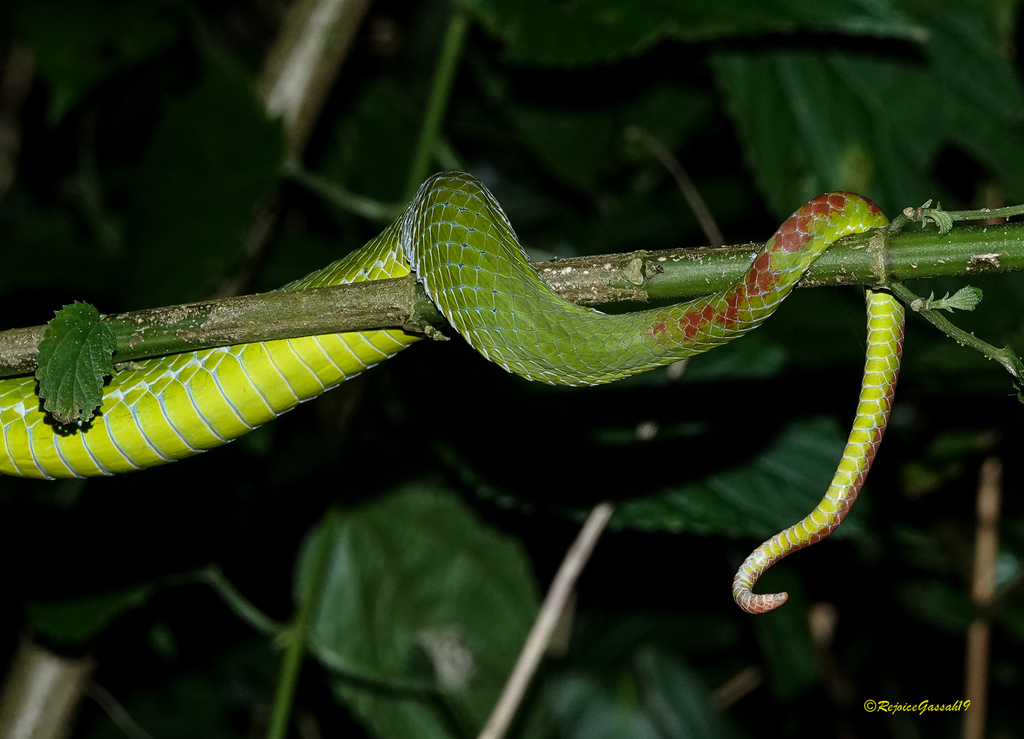
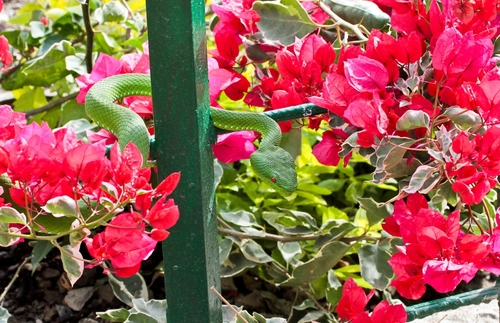
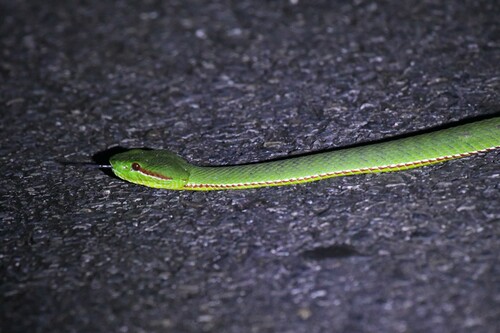
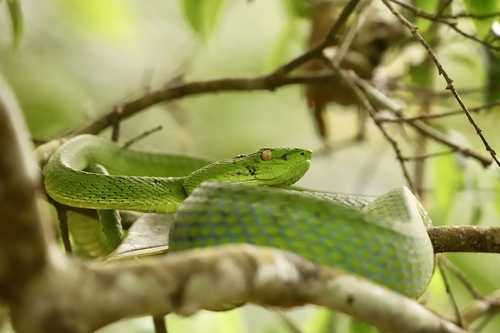
2 photographs of the Pope’s Tree Viper. (c) Rejoice Gassah, some rights reserved (CC BY).
The Pope’s Tree Viper (Trimeresurus popeiorum) is a venomous snake in the Viperidae family, recorded in 13 countries.
If you are bitten
This is a venomous snake. Treat any bite as a medical emergency: stay calm, keep the bitten limb still and roughly level with the heart, remove rings and tight clothing, and get to emergency care immediately. Do not apply a tourniquet, cut the wound, apply ice, or try to suck out venom. Call your local emergency number or poison center.
- Family
- Viperidae
- Danger
- high
About the Pope’s Tree Viper
Trimeresurus popeiorum is a species of venomous pit viper in the family Viperidae. The species is native to northern and northeastern parts of India and Southeast Asia. Common names include: Pope's pit viper, Pope's green pit viper, Pope's tree viper and Pope's bamboo pitviper.
Description
Trimeresurus popeiorum may grow to a total length of 770 mm (30 in), which includes a tail length 170 mm (6.7 in).
Above green, below pale green to whitish, the two separated by a bright bicolored orange or brown (below) and white (above) (males) or white (females) ventrolateral stripe, which occupies the whole of the outermost scale row and a portion of the second row.
Dorsal scales in 21 (rarely 23) longitudinal rows at midbody; 9–11 upper labials, first upper labials separated from nasals by a distinct suture; a single supraocular. Ventrals 155–169; subcaudals 52–76, in males the base of the tail enlarged to the level of subcaudals 20–25; hemipenes long and slender, smooth, without spines.
This species is most often confused with T. s. stejnegeri (q.v.); the two have quite distinct hemipenes, which does not make identification of individuals in the field or in the laboratory any easier without recourse to (a) male individuals and (b) an examination of the hemipenes. However, the two species are not known to have overlapping distributions, at least based on available materials. Also, closely allied to T. popeiorum is Trimeresurus yunnanensis (q.v.); ordinarily, the two are more easily told apart by the number of midbody dorsal scale rows, 21 in T. popeiorum, 19 in T. yunnanensis.
Geographic range
Trimeresurus popeiorum is found in Northeastern India (Meghalaya, Arunachal Pradesh, Mizoram, Darjiling), northern Myanmar, Thailand, and Laos. It probably also occurs in Nepal and Yunnan (China), but there are no reliable records from those areas.
The type locality, designated by lectotype, is listed as "Khasi Hills, Assam" (India).
Taxonomy and etymology
The specific name, popeiorum (Latin, genitive, plural), is in honor of two American herpetologists, Clifford H. Pope and Sarah H. Pope, his wife.
There are differences in opinion as to the correct spelling of the specific epithet. The following is from David and Vogel (1996):
This species was named in honour to Clifford H. Pope and Sarah H. Pope. The original spelling of the specific epithet, popeiorum, was corrected into popeorum by Smith (1943:518) on the basis that it was indeed a clerical error. Unfortunately, according to the Art. 32 (c, ii) of the Code (ICZN, 1985), such a change does not fall into the category of a "correction of an incorrect original spelling." According to the Art. 33 (d), the use of a termination -orum in a subsequent spelling of a species-group name that is a genitive based upon a personal name in which the correct original spelling terminates with -iorum, is an incorrect subsequent spelling, even if the change is deliberate. The original spelling, popeiorum, must therefore be conserved.
Habitat
Adapted from Wikipedia, available under CC BY-SA.
Local and regional names
The Pope’s Tree Viper is known by these names across the regions where it lives:
- Chinese
- Yíng jiāng zhú yè qīng, 坡普竹叶青蛇
- English
- Pope's Bamboo Pit Viper, Pope's Green Pit Viper, Pope's Pit Viper, Pope's Tree Viper, Yingjiang green pitviper
- German
- Popes Bambusotter, Popes Lanzenotter
Frequently asked: Pope’s Tree Viper
- Is the Pope’s Tree Viper venomous?
- Yes. The Pope’s Tree Viper (Trimeresurus popeiorum) is venomous and belongs to the Viperidae family (viper). Its bite is considered high risk to people. Treat any bite as a medical emergency.
- Is the Pope’s Tree Viper poisonous?
- Snakes are venomous, not poisonous. "Poisonous" means harmful to eat or touch; "venomous" means injecting toxins through a bite. The Pope’s Tree Viper is venomous, delivering venom through a bite.
- Is the Pope’s Tree Viper dangerous?
- This is a venomous snake. Treat any bite as a medical emergency: stay calm, keep the bitten limb still and roughly level with the heart, remove rings and tight clothing, and get to emergency care immediately. Do not apply a tourniquet, cut the wound, apply ice, or try to suck out venom. Call your local emergency number or poison center.
- Where does the Pope’s Tree Viper live?
- The Pope’s Tree Viper has verified records in 13 countries, including Thailand, India, Malaysia. See the distribution section below for its full range.
- What does the Pope’s Tree Viper eat?
- Trimeresurus popeiorum preys upon frogs, lizards, birds, and rodents (especially rats and squirrels).
- Why is it called the Pope’s Tree Viper?
- The specific name, popeiorum (Latin, genitive, plural), is in honor of two American herpetologists, Clifford H. Pope and Sarah H. Pope, his wife. There are differences in opinion as to the correct spelling of the specific epithet. The following is from David and Vogel (1996): This species was named in honour to Clifford H. Pope and Sarah H. Pope. The original spelling of the specific epithet, popeiorum, was corrected into popeorum by Smith (1943:518) on the basis that it was indeed a clerical error. Unfortunately, according to the Art.
If you are bitten by the Pope’s Tree Viper
Do
- Get away from the snake and stay calm. Most bites worsen when people panic or try again to handle the snake.
- Call 911 or Poison Control (1-800-222-1222) right away. Antivenom works best when given early.
- Note the time of the bite and, from a safe distance, the snake's color and pattern, a phone photo is enough. Do not chase it.
- Keep the bitten limb still and at roughly heart level. Sit or lie down and limit movement.
- Remove rings, watches, and tight clothing near the bite before swelling starts.
- Gently wash the bite with soap and water and cover it with a clean, dry dressing.
Do not
- Do not cut the wound or try to suck out the venom.
- Do not apply a tourniquet or ice.
- Do not drink alcohol or caffeine.
- Do not take aspirin or ibuprofen, they can worsen bleeding. Acetaminophen is safer for pain.
- Do not try to catch or kill the snake. A dead snake can still bite by reflex.
First-aid guidance adapted from the U.S. Centers for Disease Control and Prevention (CDC NIOSH), Venomous Snakes. Educational only; always follow the instructions of emergency responders.
Where it is found
More Viperidae snakes
 Chinese Green Tree ViperTrimeresurus stejnegeri
 White-lipped Pit ViperTrimeresurus albolabris
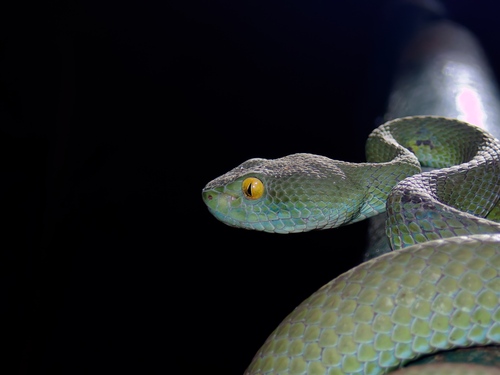 Kramer's Pit ViperTrimeresurus macrops
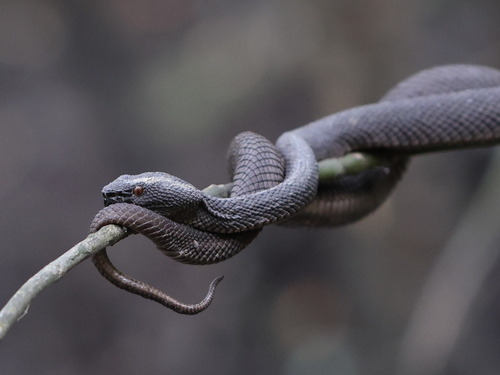 Mangrove ViperTrimeresurus purpureomaculatus
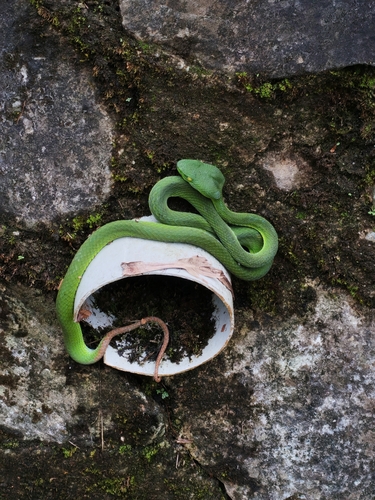 Sabah Bamboo PitviperTrimeresurus sabahi
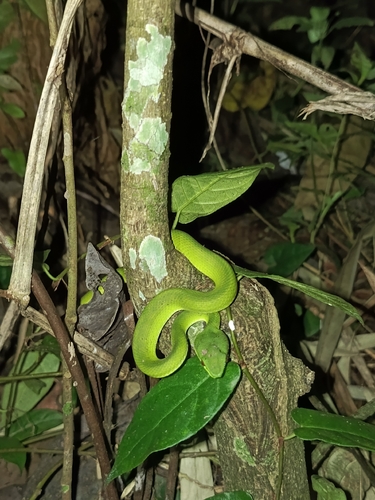 White-lipped Island PitviperTrimeresurus insularis
 Lanna Green PitviperTrimeresurus lanna
 Vogel’s Pit ViperTrimeresurus vogeli
Classification
How scientists group this snake, from the broadest category down to the exact species. Each step narrows to its closest relatives.
- OrderThe broad group of scaled reptiles: all snakes and lizards
- Squamata
- FamilyA group of related snakes that share key traits
- Viperidae
- GenusA close-knit group of very similar species
- Trimeresurus
- SpeciesThis exact snake, named in the two-part scientific name
- Trimeresurus popeiorum
Keep learning
- Are Snakes Dangerous? The Real Risk, in PerspectiveMost snakes are harmless and avoid people. Here is the honest picture of snakebite risk worldwide and how to lower your own.
- Snakebite First Aid: What to Do (and What Never to Do)A clear, CDC-based guide to snakebite first aid: the steps that help, the popular myths that hurt, and how to tell a serious bite from a minor one.
- Venomous vs Nonvenomous: How to Tell the DifferenceThe folk rules for telling venomous snakes apart, where each one fails, and why location-based identification beats guessing by sight.
- What to Do If You Find a SnakeFound a snake at home or on a trail? Here is how to stay calm, give it space, identify it safely, and know when to call a professional.
Distribution from GBIF & iNaturalist. Venom status per CDC. Background: Wikipedia. Informational only. Never handle a snake to identify it.