
Greensnake
Smooth Greensnake
HarmlessOpheodrys vernalis
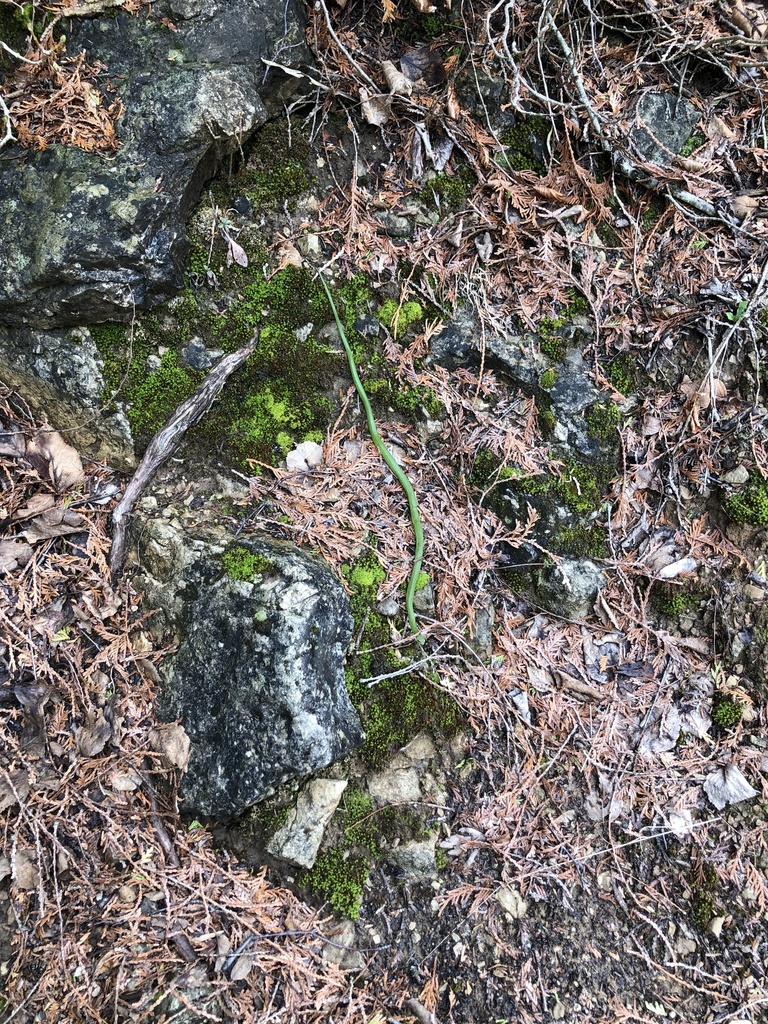
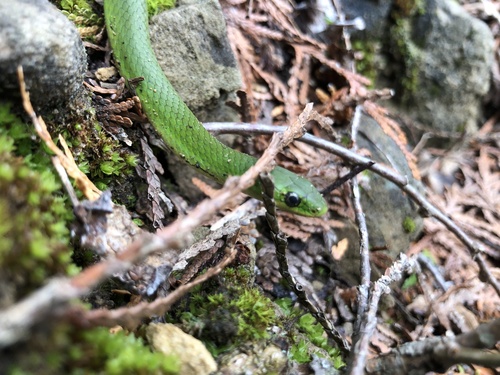
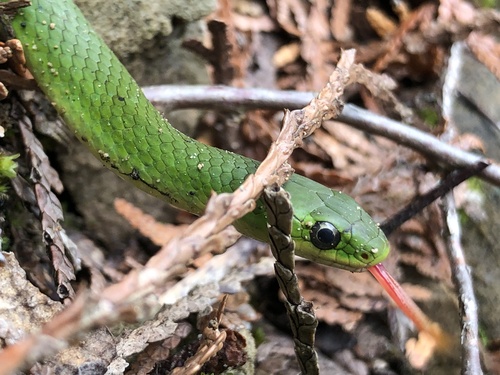
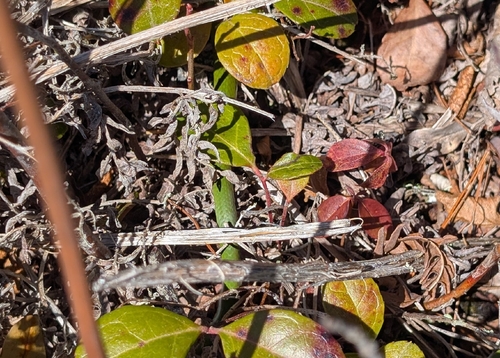
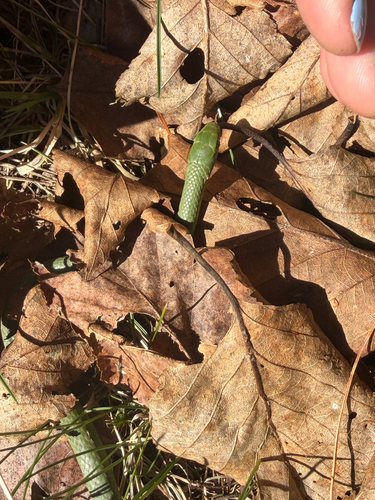
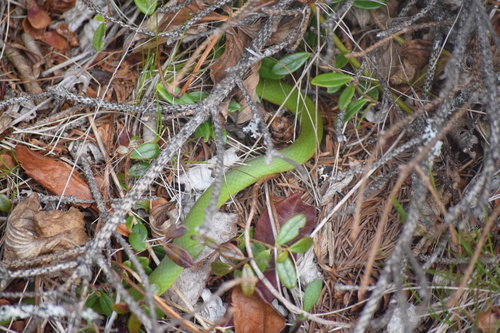
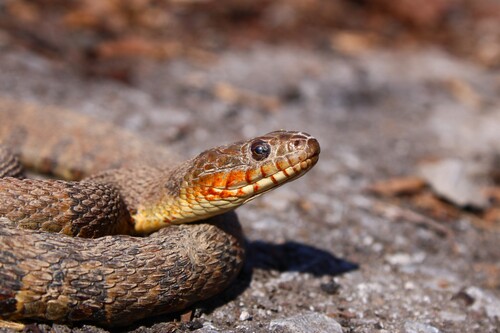
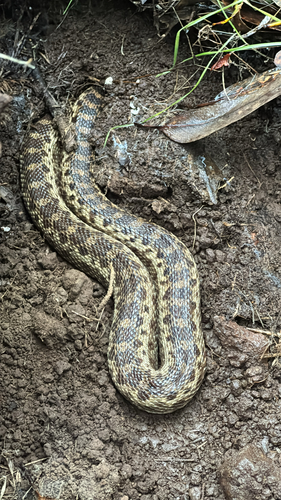
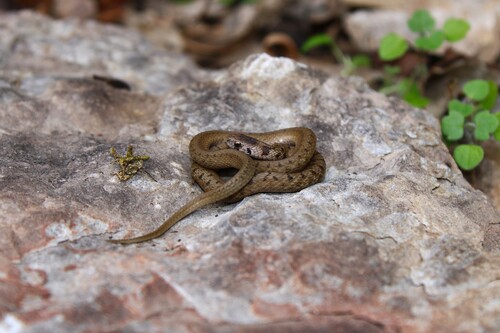
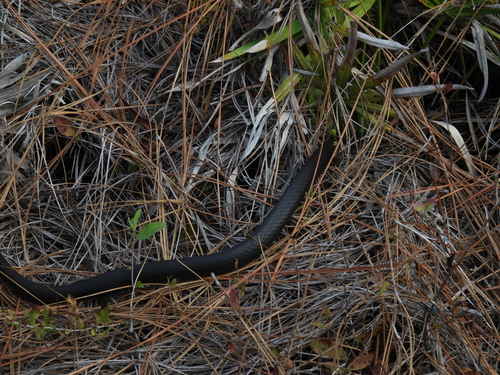
6 photographs of the Smooth Greensnake. © byron murray.
The Smooth Greensnake (Opheodrys vernalis) is a non-venomous snake in the Colubridae family, recorded in 5 countries.
- Also called
- Greensnake
- Family
- Colubridae
- Size
- Slender, 1.5–3 ft.
- Habitat
- Meadows, shrubs, and vine tangles.
- Behavior
- Day-active insect-eaters; superbly camouflaged.
- Identify
- Bright green above with a plain pale belly.
About the Smooth Greensnake
The smooth green snake (Opheodrys vernalis) is a species of North American nonvenomous snake in the family Colubridae. The species is also referred to as the grass snake. It is a slender, "small medium" snake that measures 36–51 cm (14–20 in) as an adult. It gets its common name from its smooth dorsal scales, as opposed to the rough green snake, which has keeled dorsal scales. The smooth green snake is found in marshes, meadows, open woods, and along stream edges, and is native to regions of Canada, the United States, and northern Mexico. A non-aggressive snake, it seldom bites and usually flees when threatened. It mates in late spring to summer, and females lay their eggs from June to September. The smooth green snake will often bob its head in order to mimic vegetation blowing in the wind.
Description
The smooth green snake is slender. In size, it is classified as a "small medium" snake, reaching to 36–51 cm (14–20 in) in total length (including tail) as an adult. The longest smooth green snake was measured as being 66 cm (26 in) in total length. The tail makes up about 1/4 to 1/2 the total length of the snake; males have longer tails than females.
It is uniform light green on its back, with a yellow or white belly, and has smooth dorsal scales, unlike those of the rough green snake, which are keeled. Its smooth dorsal scales are arranged in 15 rows at midbody.
At birth, its dorsal coloration is different from that when it matures. At first, it can be olive green, blue-gray, or even brown, but after it sheds its skin for the first time, it becomes the characteristic bright green. The dorsal coloration can also vary depending on location: bluish in Kansas, olive-tinted light brown in southeastern Texas, and bronze in northern Wisconsin.
It uses its tongue, red with a black end, by flicking it in and out of its mouth to "smell" its surroundings.
Subspecies
Eastern smooth green snake, Opheodrys vernalis vernalis (Harlan, 1827)
Western smooth green snake, Opheodrys vernalis blanchardi Grobman, 1941
Northern smooth green snake, Opheodrys vernalis borealis Grobman, 1992
Nota bene: A trinomial authority in parentheses indicates that the subspecies was originally described in a genus other than Opheodrys.
Etymology
The subspecific name, blanchardi, is in honor of American herpetologist Frank N. Blanchard.
Geographic range
The smooth green snake is native to the Nearctic region. The range spreads through southeastern Canada, west to Saskatchewan, and south through Illinois and Virginia. It can also be found in other areas, such as in Wyoming, Colorado, New Mexico, Iowa, Missouri, Texas, and Northern Mexico.
Threats
O. vernalis is hunted by various predators, including the red-tailed hawk, great blue heron, rough-legged buzzard, bears, raccoons, foxes, and the common house cat. Humans often find these snakes in the wild and keep them as pets. It is subjected to commercial collection because of its attractive skin coloration, passive nature, and small size. However, this snake is not known to survive well in captivity. Because its populations are usually isolated and small in size, this commercial collection can greatly affect the overall population.
Adapted from Wikipedia, available under CC BY-SA.
Frequently asked: Smooth Greensnake
- Is the Smooth Greensnake venomous?
- No. The Smooth Greensnake (Opheodrys vernalis) is non-venomous and is not considered dangerous to humans. Like most snakes, it will retreat rather than bite when given the chance.
- Is the Smooth Greensnake poisonous?
- Snakes are venomous, not poisonous. "Poisonous" means harmful to eat or touch; "venomous" means injecting toxins through a bite. The Smooth Greensnake is neither poisonous nor venomous.
- Is the Smooth Greensnake dangerous?
- The Smooth Greensnake is not dangerous to humans. It has no medically significant venom and bites only defensively if cornered or handled.
- Where does the Smooth Greensnake live?
- The Smooth Greensnake has verified records in 5 countries, including United States of America, Canada, Mexico. See the distribution section below for its full range.
- How do I identify the Smooth Greensnake?
- Bright green above with a plain pale belly.
- How big does the Smooth Greensnake get?
- Slender, 1.5–3 ft.
- What does the Smooth Greensnake eat?
- The smooth green snake mostly eats insects and spiders, including spineless caterpillars, harvestmen, moths, ants, snails, worms, and slugs. While hunting, it uses both chemical and visual clues to find prey, and kills with a strike instead of constriction.
- Why is it called the Smooth Greensnake?
- The subspecific name, blanchardi, is in honor of American herpetologist Frank N. Blanchard.
Where it is found
By U.S. state
More Colubridae snakes
Classification
How scientists group this snake, from the broadest category down to the exact species. Each step narrows to its closest relatives.
- OrderThe broad group of scaled reptiles: all snakes and lizards
- Squamata
- FamilyA group of related snakes that share key traits
- Colubridae
- GenusA close-knit group of very similar species
- Opheodrys
- SpeciesThis exact snake, named in the two-part scientific name
- Opheodrys vernalis
Keep learning
- What to Do If You Find a SnakeFound a snake at home or on a trail? Here is how to stay calm, give it space, identify it safely, and know when to call a professional.
- Venomous vs Nonvenomous: How to Tell the DifferenceThe folk rules for telling venomous snakes apart, where each one fails, and why location-based identification beats guessing by sight.
- What Is a Snake? Anatomy and the BasicsA clear overview of what makes a snake a snake: limbless body plan, anatomy, evolution from lizards, species diversity, and why they are ectothermic.
- How to Keep Snakes Out of Your Yard and HomeA practical guide to keeping snakes out of your yard and home using habitat changes that work, plus what to skip and what to do if one shows up.
Distribution from GBIF & iNaturalist. Venom status per CDC. Background: Wikipedia. Informational only. Never handle a snake to identify it.