
Genus · Colubridae
Types of greensnakes
2 species make up the genus Opheodrys, the snakes commonly called greensnakes. None are considered dangerous to humans.
About green snakes
The slender, leaf-green snakes of eastern North America that hunt insects and disappear into the foliage.
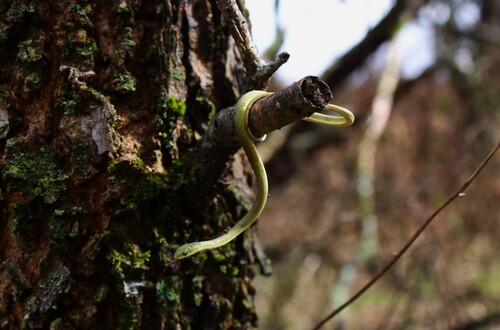
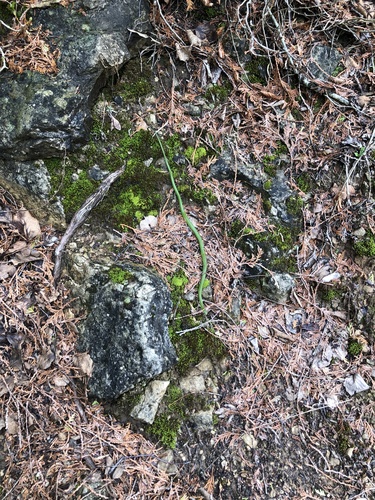
Opheodrys is a small genus of New World colubrids, the large and varied family that includes most of the familiar harmless snakes of North America. As currently recognized, the genus holds two species: the Rough Greensnake (Opheodrys aestivus) and the Smooth Greensnake (Opheodrys vernalis). Both are uniformly bright green above with pale yellow to white bellies, a color scheme that blends almost perfectly into grass and leaves. They are thin-bodied, range roughly from 1 to 3 feet in length, and have large eyes and a gentle build. The two species are told apart mainly by their scales: the Rough Greensnake has keeled (ridged) dorsal scales, while the Smooth Greensnake has smooth ones.
These snakes are spread across the eastern and central United States and into southern Canada and parts of Mexico. The Rough Greensnake favors dense shrubs, vines, and streamside vegetation, where it is highly arboreal and spends much of its life climbing through branches. The Smooth Greensnake leans toward open grassy habitats, meadows, marshes, and woodland edges, staying closer to the ground. Both are diurnal and rely on camouflage and stillness rather than speed or aggression to avoid being seen.
Green snakes are completely harmless to people. They are non-venomous, do not constrict large prey, and almost never bite even when handled, instead relying on their camouflage to stay hidden. Their diet is built around insects and other small invertebrates such as caterpillars, crickets, grasshoppers, and spiders, which makes them beneficial in gardens and natural areas. They lay eggs rather than giving live birth, and because their green pigment can fade after death, they often turn blue or gray in old preserved specimens. There is no medical danger from these snakes, and if any unidentified snakebite ever causes concern, contact emergency services or US Poison Control at 1-800-222-1222.
Opheodrys belongs to the Colubridae family (Colubrids). The largest snake family, and the one most snakes you meet belong to. Typically round pupils, a head only slightly wider than the neck, and no heat-sensing facial pit or rattle. Scales may be smooth and glossy or keeled and matte depending on the species.
Danger: Almost all colubrids are harmless. A small number are rear-fanged with medically significant venom, the boomslang and the twig (vine) snakes of Africa being the dangerous exceptions. Most colubrids will flee or bluff rather than bite.
All species (2)
Keep learning
- What Is a Snake? Anatomy and the BasicsA clear overview of what makes a snake a snake: limbless body plan, anatomy, evolution from lizards, species diversity, and why they are ectothermic.
- How Snakes Move, Hunt, and EatHow snakes move without legs, hunt as ambushers or active foragers, kill by constriction or venom, and swallow prey wider than their head.
- What Do Snakes Eat?All snakes are carnivores. Learn what snakes eat, how diet changes with size and age, how often they feed, and how they hunt and swallow prey.
- Venomous vs Nonvenomous: How to Tell the DifferenceThe folk rules for telling venomous snakes apart, where each one fails, and why location-based identification beats guessing by sight.