
Pythonidae
Northern White-lipped Python
HarmlessLeiopython albertisii
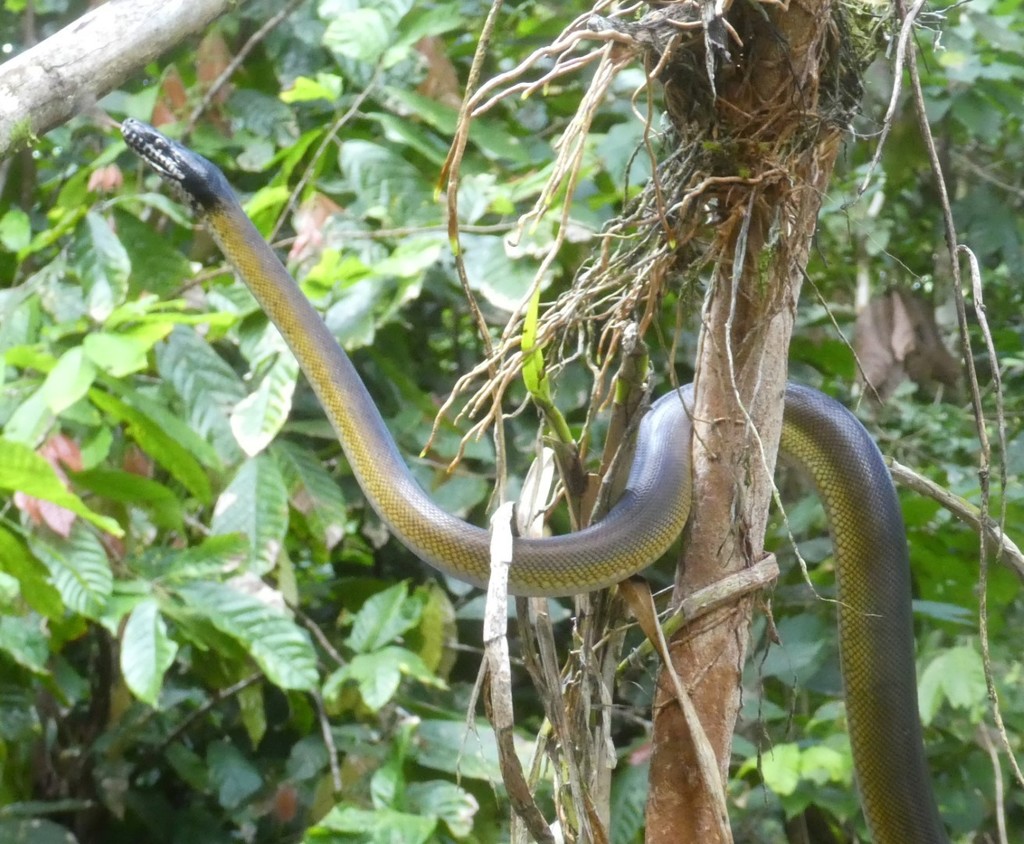
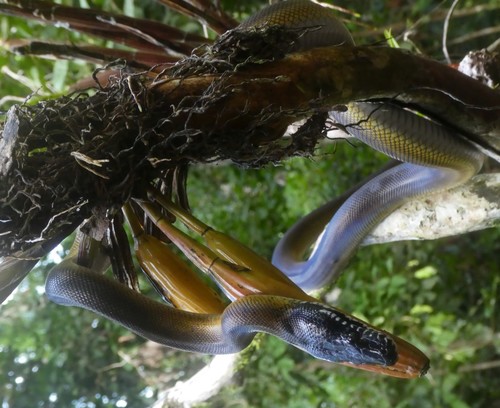
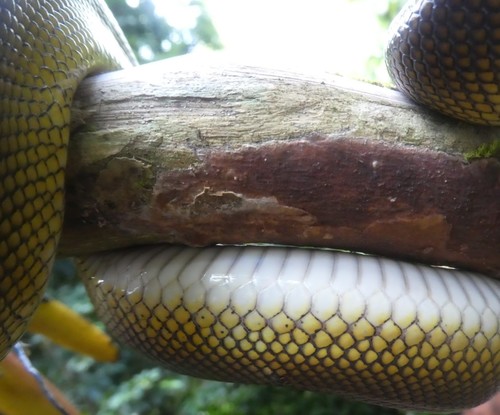
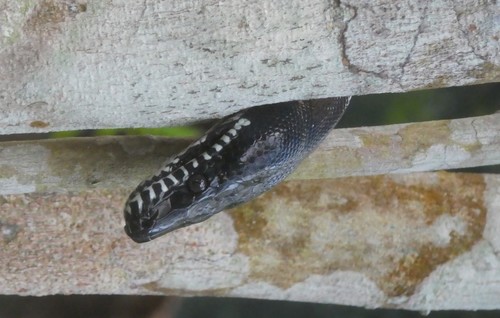
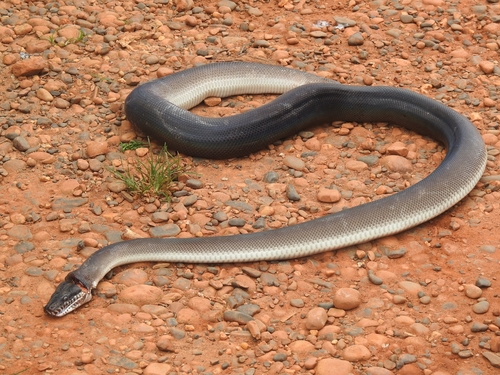
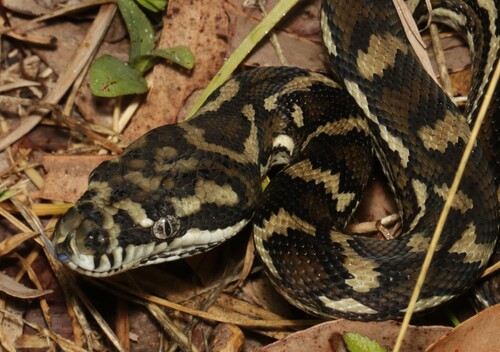
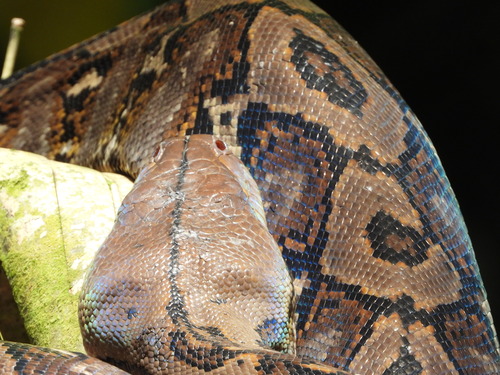
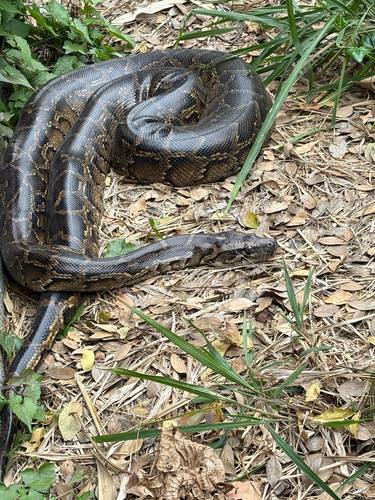
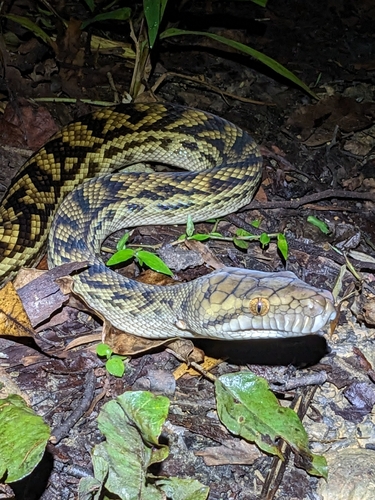
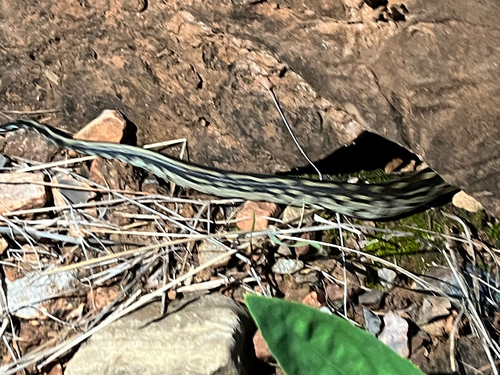
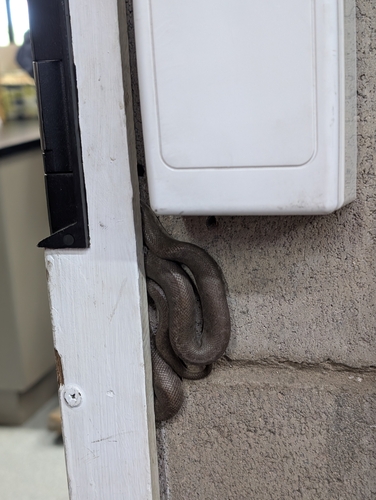
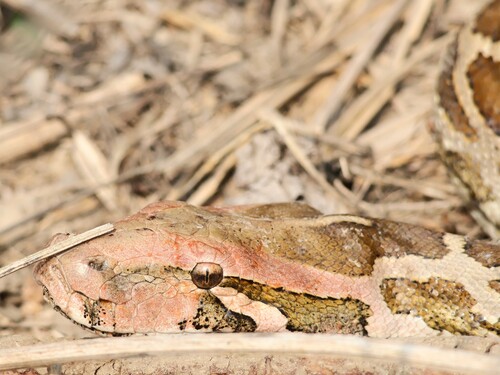
4 photographs of the Northern White-lipped Python. © Micha Baum.
The Northern White-lipped Python (Leiopython albertisii) is a non-venomous snake in the Pythonidae family, recorded in 5 countries.
- Family
- Pythonidae
About the Northern White-lipped Python
D'Albertis' python (Leiopython albertisii), also known commonly as D'Albert's water python or the northern white-lipped python, is a species of python, a non-venomous snake in the family Pythonidae. The species is endemic to New Guinea. There are no subspecies that are recognized as being valid.
Geographic range and habitat
L. albertisii is found in most of New Guinea below 1,200 m (3,900 ft), including the islands of Salawati and Biak, Normanby, Mussau and Emirau, as well as a few islands in the Torres Strait.
The type locality given is "Kapaor in Nova Guinea boreali occidentali ... et prope Andai ". The authors also stated localities for two additional specimens: "... un esemplare a Kapaor fra i Papua Onin..." and "... un secondo esemplare ad Andai presso Dorei..." (= Kapoar, Onin Peninsula and Andai, near Dorei, Irian Jaya, Indonesia).
Some doubt can be cast on its occurrence on Normanby, as McDowell (1975) had erroneously assigned Bara Bara to this island, rather than to the mainland of Papua New Guinea in Milne Bay Province as stated by Boulenger (1898) and Koopman (1982).
Etymology
The specific name, albertisii, is in honor of Italian explorer Luigi D'Albertis.
Description
Female adults of L. albertisii grow to an average of about 213 cm (6–7 ft) in total length (including tail). Both sexes are patternless, except for some light markings on the postoculars. The dorsum of the head is shiny black, and the upper and lower labial scales are white with black markings on the anterior edge of the scales. Body color is either brownish-violet fading to yellowish ventrally or blackish-blue fading to gray.
Behavior
Although mostly terrestrial, L. albertisii can and is known to occasionally climb. White-lipped pythons are reportedly aggressive, though this is reduced in those born and raised in captivity. L. albertisii also has been observed to regularly regurgitate fur balls from its prey.
Diet
The diet of L. albertisii includes a range of small-sized to medium-sized birds and mammals. Neonates and juveniles often feed on lizards. Heat sensitive pits in the upper and lower jaws are used to help locate prey during nocturnal hunting.
Reproduction
L. albertisii is oviparous. A sexually mature female may lay a clutch of about a dozen eggs. The eggs stick together in a compact pile, and the female coils around them. The hatchlings emerge after about two months of incubation and are about 38 cm (15 in) in length.
Adapted from Wikipedia, available under CC BY-SA.
Frequently asked: Northern White-lipped Python
- Is the Northern White-lipped Python venomous?
- No. The Northern White-lipped Python (Leiopython albertisii) is non-venomous and is not considered dangerous to humans. Like most snakes, it will retreat rather than bite when given the chance.
- Is the Northern White-lipped Python poisonous?
- Snakes are venomous, not poisonous. "Poisonous" means harmful to eat or touch; "venomous" means injecting toxins through a bite. The Northern White-lipped Python is neither poisonous nor venomous.
- Is the Northern White-lipped Python dangerous?
- The Northern White-lipped Python is not dangerous to humans. It has no medically significant venom and bites only defensively if cornered or handled.
- Where does the Northern White-lipped Python live?
- The Northern White-lipped Python has verified records in 5 countries, including Papua New Guinea, Indonesia, Australia. See the distribution section below for its full range.
- What does the Northern White-lipped Python eat?
- The diet of L. albertisii includes a range of small-sized to medium-sized birds and mammals. Neonates and juveniles often feed on lizards. Heat sensitive pits in the upper and lower jaws are used to help locate prey during nocturnal hunting.
- Why is it called the Northern White-lipped Python?
- The specific name, albertisii, is in honor of Italian explorer Luigi D'Albertis.
Where it is found
More Pythonidae snakes
Classification
How scientists group this snake, from the broadest category down to the exact species. Each step narrows to its closest relatives.
- OrderThe broad group of scaled reptiles: all snakes and lizards
- Squamata
- FamilyA group of related snakes that share key traits
- Pythonidae
- GenusA close-knit group of very similar species
- Leiopython
- SpeciesThis exact snake, named in the two-part scientific name
- Leiopython albertisii
Keep learning
- What to Do If You Find a SnakeFound a snake at home or on a trail? Here is how to stay calm, give it space, identify it safely, and know when to call a professional.
- Venomous vs Nonvenomous: How to Tell the DifferenceThe folk rules for telling venomous snakes apart, where each one fails, and why location-based identification beats guessing by sight.
- What Is a Snake? Anatomy and the BasicsA clear overview of what makes a snake a snake: limbless body plan, anatomy, evolution from lizards, species diversity, and why they are ectothermic.
- How to Keep Snakes Out of Your Yard and HomeA practical guide to keeping snakes out of your yard and home using habitat changes that work, plus what to skip and what to do if one shows up.
Distribution from GBIF & iNaturalist. Venom status per CDC. Background: Wikipedia. Informational only. Never handle a snake to identify it.