
Viperidae
Chinese Moccasin
VenomousDeinagkistrodon acutus
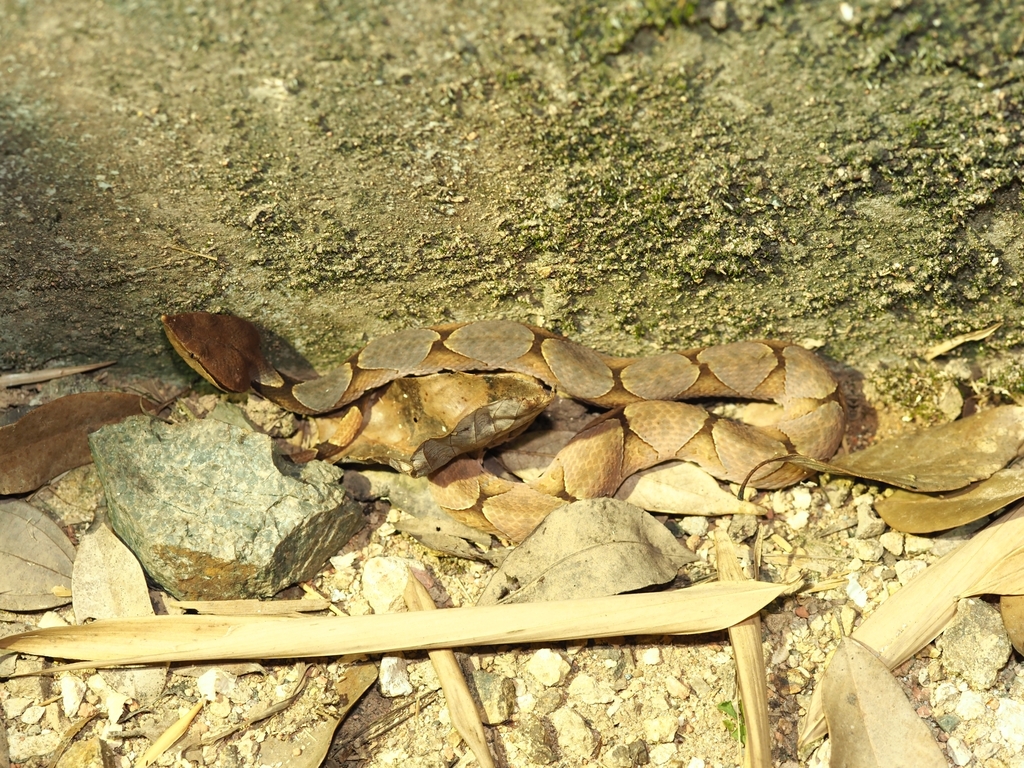
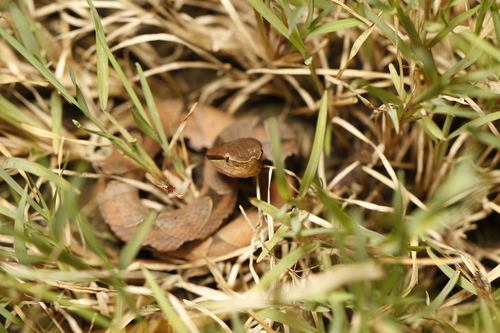
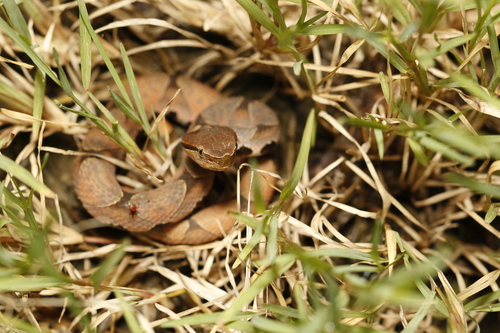
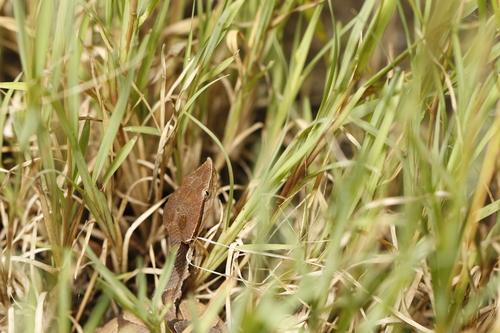
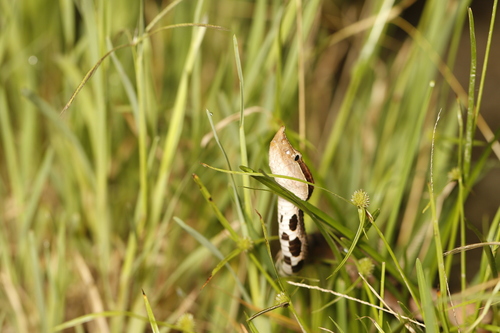
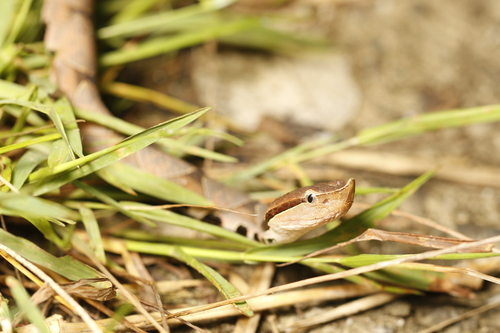
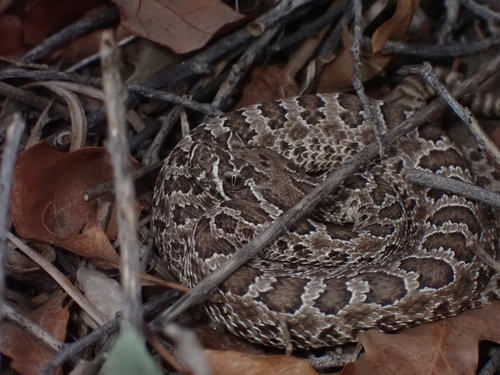
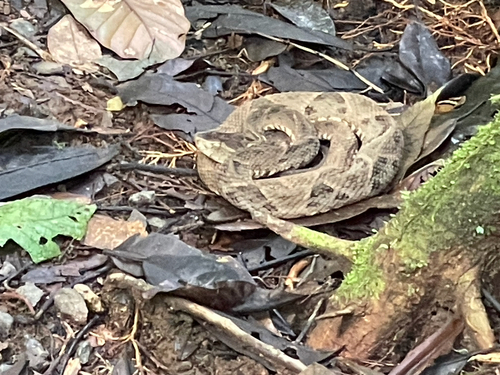
6 photographs of the Chinese Moccasin. © angryphyco.
The Chinese Moccasin (Deinagkistrodon acutus) is a venomous snake in the Viperidae family, recorded in 6 countries.
If you are bitten
This is a venomous snake. Treat any bite as a medical emergency: stay calm, keep the bitten limb still and roughly level with the heart, remove rings and tight clothing, and get to emergency care immediately. Do not apply a tourniquet, cut the wound, apply ice, or try to suck out venom. Call your local emergency number or poison center.
- Family
- Viperidae
- Danger
- high
About the Chinese Moccasin
Deinagkistrodon is a monotypic genus created for the pit viper species, Deinagkistrodon acutus, which is endemic to Southeast Asia. No subspecies are currently recognized.
Description
Deinagkistrodon acutus is light brown or greyish brown dorsally, with a series of dark brown lateral triangles on each side. The two pointed tops of the two opposite triangles meet each other at the mid-line, forming a series of about 20 light brown, squarish blotches on the back. A row of large black spots extends along each side near the belly. The top and upper sides of the head are uniformly black, with a black streak from the eye to the angle of the mouth. D. acutus is yellowish ventrally, spotted with dark brown. The young are much lighter than the adults with essentially the same pattern. The head is large, triangular, with an upturned snout. The body is very stout. The tail is short, ending in a compressed, pointed slightly curved cornified scale. The top of the head is covered with nine large shields. The dorsal scales are strongly and tubercularly keeled. The subcaudals are mostly in pairs, some of the anterior ones are single. This stout snake, usually between 0.8 and 1.0 metre (2.6 and 3.3 ft) in total length (including tail), reaches a maximum total length of 1.57 metres (5.2 ft) in males and 1.41 metres (4.6 ft) in females. The largest specimen on record measured approximately 1.549 metres (5.08 ft).
Common names
Common names for D. acutus include sharp-nosed viper, snorkel viper, hundred pacer, Chinese moccasin, Chinese copperhead, five-pacer, hundred-pace snake, long-nosed pit viper, sharp-nosed pit viper, hundred-pace pit viper.
In culture
The snake has been an object of veneration by indigenous Taiwanese peoples. The Paiwan for example believe it as the parent of their hero Aljis who saved them from famine and taught them agriculture; he transforms into a mountain hawk-eagle after his work is done and gives them his feathers in memory which their chiefs have worn since. The viper (vulung) also adorns their homes as a symbol of power.
Geographic range
Deinagkistrodon acutus is found in southern China (Zhejiang, Fujian, Hunan, Hubei, Guangdong), Taiwan, northern Vietnam, and possibly Laos. The type locality was not included in the original description. It was later given as "Wusueh [Wuxue], Hupeh [Hubei] Province, China" by Pratt (1892) and Pope (1935). Listed as "Mountains N. of Kiu Kiang [Jiujiang]" in the catalogue of the British Museum of Natural History.
Habitat
The species D. acutus inhabits high, forested mountains up to 1,350 metres (4,430 ft), but has also been found in low coastal regions (100 metres (330 ft)). It prefers lower mountain slopes or rocky hills with small valleys.
Diet
Adapted from Wikipedia, available under CC BY-SA.
Local and regional names
The Chinese Moccasin is known by these names across the regions where it lives:
- Chinese
- 尖吻腹蛇, 尖吻蝮, 尖吻蝮屬, 尖吻蝰, 百步蛇
- Czech
- ploskolebec nosorohý
- English
- Five-pacer Viper, Hundred-pace Viper, Sharp-nosed Viper
- German
- Chinesische Nasenotter, Chinesischer Kupferkopf
- Hungarian
- hegyesorrú mokaszinkígyó
- Japanese
- ヒャッポダ
- Russian
- Китайский щитомордник
- Vietnamese
- Rắn lục mũi hếch
Frequently asked: Chinese Moccasin
- Is the Chinese Moccasin venomous?
- Yes. The Chinese Moccasin (Deinagkistrodon acutus) is venomous and belongs to the Viperidae family (viper). Its bite is considered high risk to people. Treat any bite as a medical emergency.
- Is the Chinese Moccasin poisonous?
- Snakes are venomous, not poisonous. "Poisonous" means harmful to eat or touch; "venomous" means injecting toxins through a bite. The Chinese Moccasin is venomous, delivering venom through a bite.
- Is the Chinese Moccasin dangerous?
- This is a venomous snake. Treat any bite as a medical emergency: stay calm, keep the bitten limb still and roughly level with the heart, remove rings and tight clothing, and get to emergency care immediately. Do not apply a tourniquet, cut the wound, apply ice, or try to suck out venom. Call your local emergency number or poison center.
- Where does the Chinese Moccasin live?
- The Chinese Moccasin has verified records in 6 countries, including China, Chinese Taipei, Viet Nam. See the distribution section below for its full range.
- What does the Chinese Moccasin eat?
- The diet of D. acutus consists of small mammals such as rats and mice, birds, toads, frogs and lizards. Chinese herpetologist Zhao Ermi reported a specimen of a total length of 1.04 metres (3.4 ft) and weighing 600 grams (1.3 lb) having eaten a specimen of Rattus rattus of a total length of 51.5 centimetres (20.3 in) and a weight of 530 grams (1.17 lb).
- Why is it called the Chinese Moccasin?
- Common names for D. acutus include sharp-nosed viper, snorkel viper, hundred pacer, Chinese moccasin, Chinese copperhead, five-pacer, hundred-pace snake, long-nosed pit viper, sharp-nosed pit viper, hundred-pace pit viper.
If you are bitten by the Chinese Moccasin
Do
- Get away from the snake and stay calm. Most bites worsen when people panic or try again to handle the snake.
- Call 911 or Poison Control (1-800-222-1222) right away. Antivenom works best when given early.
- Note the time of the bite and, from a safe distance, the snake's color and pattern, a phone photo is enough. Do not chase it.
- Keep the bitten limb still and at roughly heart level. Sit or lie down and limit movement.
- Remove rings, watches, and tight clothing near the bite before swelling starts.
- Gently wash the bite with soap and water and cover it with a clean, dry dressing.
Do not
- Do not cut the wound or try to suck out the venom.
- Do not apply a tourniquet or ice.
- Do not drink alcohol or caffeine.
- Do not take aspirin or ibuprofen, they can worsen bleeding. Acetaminophen is safer for pain.
- Do not try to catch or kill the snake. A dead snake can still bite by reflex.
First-aid guidance adapted from the U.S. Centers for Disease Control and Prevention (CDC NIOSH), Venomous Snakes. Educational only; always follow the instructions of emergency responders.
Where it is found
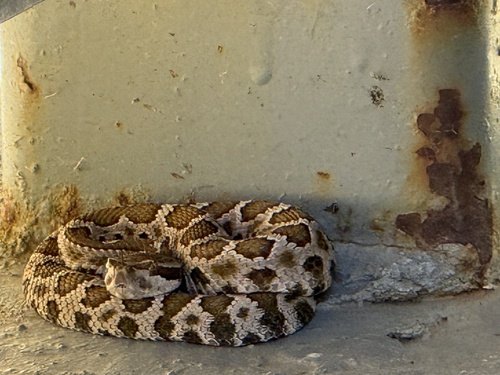
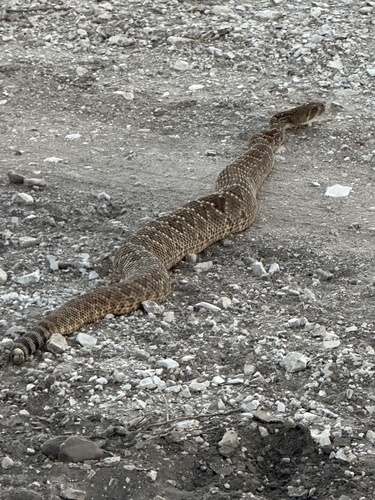
More Viperidae snakes
Classification
How scientists group this snake, from the broadest category down to the exact species. Each step narrows to its closest relatives.
- OrderThe broad group of scaled reptiles: all snakes and lizards
- Squamata
- FamilyA group of related snakes that share key traits
- Viperidae
- GenusA close-knit group of very similar species
- Deinagkistrodon
- SpeciesThis exact snake, named in the two-part scientific name
- Deinagkistrodon acutus
Keep learning
- Are Snakes Dangerous? The Real Risk, in PerspectiveMost snakes are harmless and avoid people. Here is the honest picture of snakebite risk worldwide and how to lower your own.
- Snakebite First Aid: What to Do (and What Never to Do)A clear, CDC-based guide to snakebite first aid: the steps that help, the popular myths that hurt, and how to tell a serious bite from a minor one.
- Venomous vs Nonvenomous: How to Tell the DifferenceThe folk rules for telling venomous snakes apart, where each one fails, and why location-based identification beats guessing by sight.
- What to Do If You Find a SnakeFound a snake at home or on a trail? Here is how to stay calm, give it space, identify it safely, and know when to call a professional.
Distribution from GBIF & iNaturalist. Venom status per CDC. Background: Wikipedia. Informational only. Never handle a snake to identify it.