
Pythonidae
Woma Python
HarmlessAspidites ramsayi
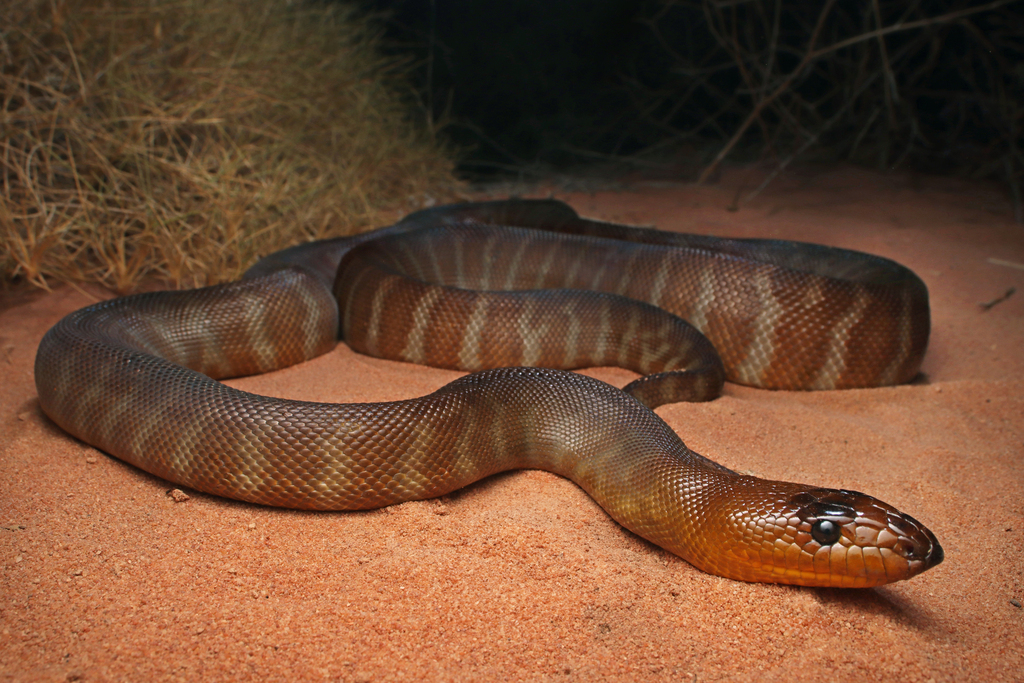
The Woma Python (Aspidites ramsayi) is a non-venomous snake in the Pythonidae family, recorded in 2 countries.
- Family
- Pythonidae
About the Woma Python
The woma python (Aspidites ramsayi), also known commonly as Ramsay's python, the sand python, and simply the woma, is a species of snake in the family Pythonidae, endemic to Australia. Once common throughout Western Australia, it has become critically endangered in some regions.
Taxonomy
William John Macleay originally described the species in 1882 as Aspidiotes ramsayi. The specific name, ramsayi, is in honor of Australian zoologist Edward Pierson Ramsay.
This is one of two species of Aspidites, the pitless pythons, an Australian genus of the family Pythonidae. The generic name, Aspidites, translates to "shield bearer" in reference to the symmetrically shaped head scales.
Description
Adults of A. ramsayi typically are around 1.5 m (4.5 feet) in total length (including tail). The head is narrow, and the eyes are small. The body is broad and flattish in profile, while the tail tapers to a thin point.
The dorsal scales are small and smooth, with 50–65 rows at midbody. The ventral scales are 280–315 in number, with an undivided anal plate, and 40–45 mostly single subcaudal scales. Some of the posterior subcaudals may be irregularly divided.
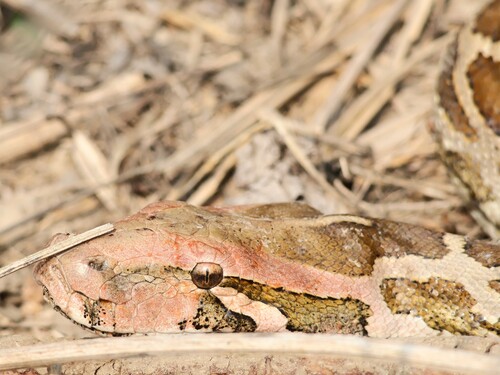
The dorsal color may be pale brown to nearly black. The pattern consists of a ground color that varies from medium brown and olive to lighter shades of orange, pink, and red, overlaid with darker striped or brindled markings. The belly is cream or light yellow with brown and pink blotches. The scales around the eyes are usually a darker color than the rest of the head.
Aspidites ramsayi may reach a total length of 2.3 m (7.5 ft), with a snout-vent length (SVL) of 2.0 m (6.6 ft).
Snakes of the genus Aspidites lack the heat-sensing pits of all other pythons. A. ramsayi is similar in appearance to A. melanocephalus, but without an obvious neck. The coloration or desire to locate this species may lead to confusion with the venomous species Pseudonaja nuchalis, commonly known as the gwardar.
Distribution and habitat
Aspidites ramsayi lives in the west and center of Australia, from Western Australia through southern Northern Territory and northern South Australia to southern Queensland and northwestern New South Wales. Its range may be discontinuous. The type locality is "near Forte Bourke" New South Wales, Australia.
The range in Southwest Australia extends from Shark Bay, along the coast and inland regions, and was previously common on sandplains. The species was recorded in regions to the south and east, with once extensive wheatbelt and goldfield populations.
Conservation status
A. ramsayi is classified as Least Concern on the IUCN Red List of Threatened Species.
The Adelaide Zoo in South Australia is co-ordinating a captive breeding program for the species, and the offspring raised have been released into the Arid Recovery Reserve in the states north with no success due to mulga snake, Pseudechis australis, predation.
Adapted from Wikipedia, available under CC BY-SA.
Frequently asked: Woma Python
- Is the Woma Python venomous?
- No. The Woma Python (Aspidites ramsayi) is non-venomous and is not considered dangerous to humans. Like most snakes, it will retreat rather than bite when given the chance.
- Is the Woma Python poisonous?
- Snakes are venomous, not poisonous. "Poisonous" means harmful to eat or touch; "venomous" means injecting toxins through a bite. The Woma Python is neither poisonous nor venomous.
- Is the Woma Python dangerous?
- The Woma Python is not dangerous to humans. It has no medically significant venom and bites only defensively if cornered or handled.
- Where does the Woma Python live?
- The Woma Python has verified records in 2 countries, including Australia, United States of America. See the distribution section below for its full range.
- What does the Woma Python eat?
- Aspidites ramsayi preys upon a variety of terrestrial vertebrates such as small mammals, ground birds, and lizards. It catches much of its prey in burrows where there is not enough room to maneuver coils around the prey; instead, the woma pushes a loop of its body against the animal to pin it against the side of the burrow. Many adult womas are covered in scars from retaliating prey as this technique does not kill prey as quickly as normal constriction.
Where it is found
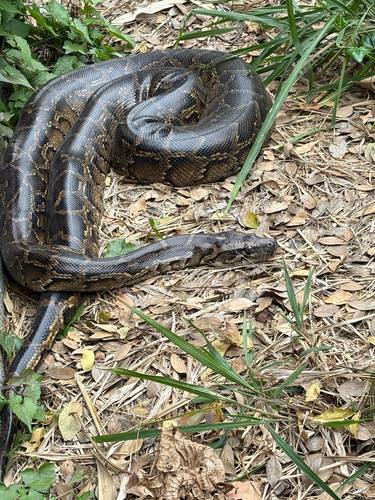
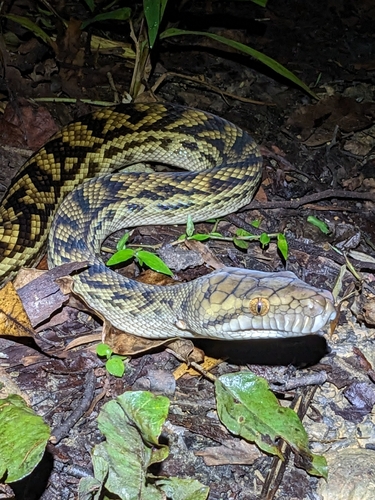
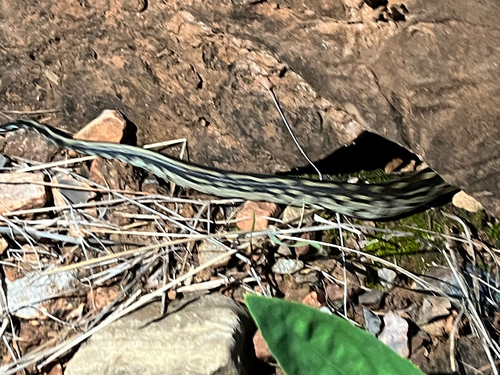
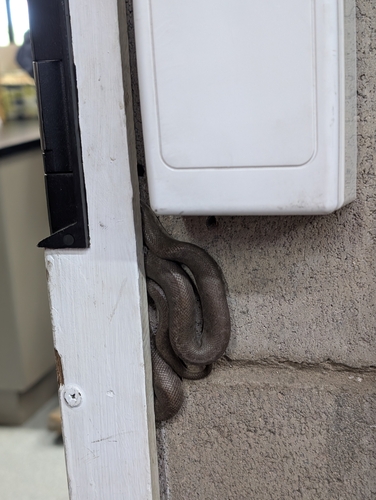
More Pythonidae snakes
Classification
How scientists group this snake, from the broadest category down to the exact species. Each step narrows to its closest relatives.
- OrderThe broad group of scaled reptiles: all snakes and lizards
- Squamata
- FamilyA group of related snakes that share key traits
- Pythonidae
- GenusA close-knit group of very similar species
- Aspidites
- SpeciesThis exact snake, named in the two-part scientific name
- Aspidites ramsayi
Keep learning
- What to Do If You Find a SnakeFound a snake at home or on a trail? Here is how to stay calm, give it space, identify it safely, and know when to call a professional.
- Venomous vs Nonvenomous: How to Tell the DifferenceThe folk rules for telling venomous snakes apart, where each one fails, and why location-based identification beats guessing by sight.
- What Is a Snake? Anatomy and the BasicsA clear overview of what makes a snake a snake: limbless body plan, anatomy, evolution from lizards, species diversity, and why they are ectothermic.
- How to Keep Snakes Out of Your Yard and HomeA practical guide to keeping snakes out of your yard and home using habitat changes that work, plus what to skip and what to do if one shows up.
Distribution from GBIF & iNaturalist. Venom status per CDC. Background: Wikipedia. Informational only. Never handle a snake to identify it.