
Genus · Pythonidae
Types of pythons
2 species make up the genus Aspidites, the snakes commonly called pythons. None are considered dangerous to humans.
About Australian pythons (woma and black-headed python)
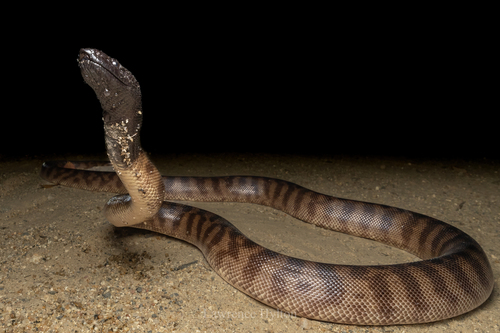
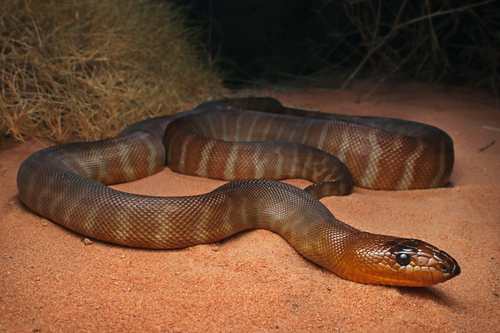
Aspidites are two heavy-bodied Australian pythons unique in the family for lacking the heat-sensing facial pits found in their relatives.
Aspidites is a small genus in the python family, Pythonidae, made up of just two species: the black-headed python (Aspidites melanocephalus) and the woma python (Aspidites ramsayi). Both are endemic to Australia. What sets the genus apart from nearly all other pythons is the absence of the labial heat-sensing pits that most pythons use to detect warm-blooded prey. This trait, along with their smooth, glossy scales and distinctive head coloring, makes Aspidites easy to place within the family once you know the markers. They are large but not giant snakes, typically reaching roughly 1.5 to 2.5 meters depending on species and locality.
These pythons occupy arid and semi-arid habitats across much of Australia, including deserts, shrublands, dry woodlands, and sandy or rocky country, with the black-headed python also ranging into more tropical northern regions. The woma is named for the patterned, banded body that contrasts with a paler head, while the black-headed python has a glossy jet-black head and neck above a banded tan-to-brown body. Both spend time sheltering in burrows, hollows, and dense ground cover, and are largely terrestrial rather than arboreal. Their coloration helps them blend into the dry, warm-toned landscapes they inhabit.
Like all pythons, Aspidites are nonvenomous constrictors. They kill prey by coiling and constriction rather than venom, and they are not considered dangerous to people in the way venomous snakes are, though any large snake can deliver a painful bite and should be left alone in the wild. They are notable for preying heavily on other reptiles, including lizards and snakes, and are even reported to take venomous snakes, which may relate to their habit of subduing prey within tight burrows. Females lay eggs and are known to coil around the clutch to incubate it, a brooding behavior typical of pythons. Encountering one in the wild calls for observation from a distance, not handling.
Aspidites belongs to the Pythonidae family (Pythons). Old-World egg-laying constrictors, including the longest snakes on Earth. Large and heavy-bodied with blotched or banded patterns, smooth scales, and heat-sensing pits along the lips. No rattle or fangs.
Danger: Non-venomous. Only the very largest species could be a physical danger, and bites are defensive, not venomous.
All species (2)
Keep learning
- What Is a Snake? Anatomy and the BasicsA clear overview of what makes a snake a snake: limbless body plan, anatomy, evolution from lizards, species diversity, and why they are ectothermic.
- How Snakes Move, Hunt, and EatHow snakes move without legs, hunt as ambushers or active foragers, kill by constriction or venom, and swallow prey wider than their head.
- What Do Snakes Eat?All snakes are carnivores. Learn what snakes eat, how diet changes with size and age, how often they feed, and how they hunt and swallow prey.
- Venomous vs Nonvenomous: How to Tell the DifferenceThe folk rules for telling venomous snakes apart, where each one fails, and why location-based identification beats guessing by sight.