
Boidae
Dark-spotted Anaconda
HarmlessEunectes deschauenseei

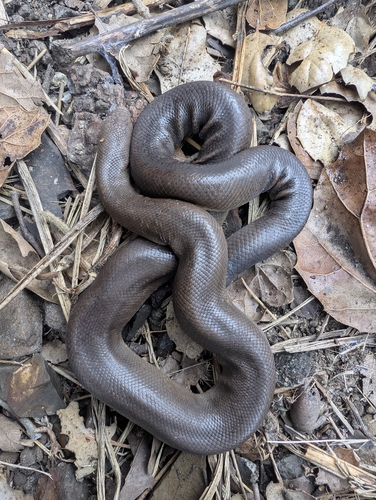
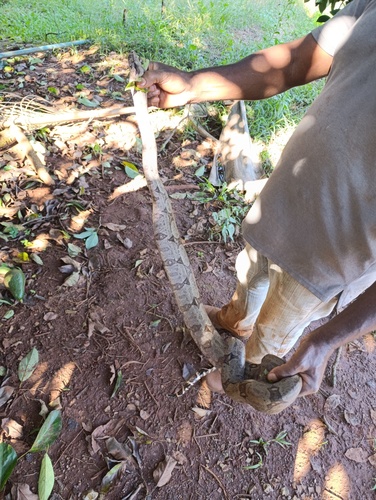
The Dark-spotted Anaconda (Eunectes deschauenseei) is a non-venomous snake in the Boidae family, recorded in 3 countries.
- Family
- Boidae
About the Dark-spotted Anaconda
Eunectes deschauenseei, commonly known as the dark-spotted anaconda or De Schauensee's anaconda, is a species of snake in the subfamily Boinae of the family Boidae. The species is native to northeastern South America. Like all boas, it is a nonvenomous constrictor. No subspecies are currently recognized.
Taxonomy
The specific name, deschauenseei, is in honor of American ornithologist Rodolphe Meyer de Schauensee, who donated a specimen to the Philadelphia Zoo in 1924. The type locality given is "probably collected on the island of Marajo at the mouth of the Amazon".
Distribution and habitat
Eunectes deschauenseei is found in South America, in northern Brazil (the Pará and Amapá states), French Guiana and possibly Suriname. E. deschauenseei is a semi-aquatic species usually found in swampy, seasonally flooded freshwater areas at elevations below 300 m (980 ft).
Description
Adult males of E. deschauenseei measure 130–211 cm (51–83 in) and adult females 120–231 cm (47–91 in) in snout-to-vent length (SVL).
Reproduction
Vitellogenesis in E. deschauenseei probably occurs from autumn to spring (May to December). Gestation may last as long as nine months. Litter size among five gravid females ranged from 3 to 27 (mean 10.6). Newborns measure 29–53 cm (11–21 in) in snout–vent length.
Conservation
The savanna habitat of E. deschauenseei is highly threatened by agricultural expansion, but the threat posed on this species is not known.
Adapted from Wikipedia, available under CC BY-SA.
Frequently asked: Dark-spotted Anaconda
- Is the Dark-spotted Anaconda venomous?
- No. The Dark-spotted Anaconda (Eunectes deschauenseei) is non-venomous and is not considered dangerous to humans. Like most snakes, it will retreat rather than bite when given the chance.
- Is the Dark-spotted Anaconda poisonous?
- Snakes are venomous, not poisonous. "Poisonous" means harmful to eat or touch; "venomous" means injecting toxins through a bite. The Dark-spotted Anaconda is neither poisonous nor venomous.
- Is the Dark-spotted Anaconda dangerous?
- The Dark-spotted Anaconda is not dangerous to humans. It has no medically significant venom and bites only defensively if cornered or handled.
- Where does the Dark-spotted Anaconda live?
- The Dark-spotted Anaconda has verified records in 3 countries, including Brazil, French Guiana, Iceland. See the distribution section below for its full range.
Where it is found
More Boidae snakes
Classification
How scientists group this snake, from the broadest category down to the exact species. Each step narrows to its closest relatives.
Keep learning
- What to Do If You Find a SnakeFound a snake at home or on a trail? Here is how to stay calm, give it space, identify it safely, and know when to call a professional.
- Venomous vs Nonvenomous: How to Tell the DifferenceThe folk rules for telling venomous snakes apart, where each one fails, and why location-based identification beats guessing by sight.
- What Is a Snake? Anatomy and the BasicsA clear overview of what makes a snake a snake: limbless body plan, anatomy, evolution from lizards, species diversity, and why they are ectothermic.
- How to Keep Snakes Out of Your Yard and HomeA practical guide to keeping snakes out of your yard and home using habitat changes that work, plus what to skip and what to do if one shows up.
Distribution from GBIF & iNaturalist. Venom status per CDC. Background: Wikipedia. Informational only. Never handle a snake to identify it.