
Genus · Boidae
Types of anacondas
4 species make up the genus Eunectes, the snakes commonly called anacondas. None are considered dangerous to humans.
About anacondas
Eunectes is the genus of the anacondas, large semi-aquatic boas of tropical South America that subdue prey by constriction rather than venom. Our database lists 4 species, none of them venomous.
Eunectes belongs to the boa family, Boidae, and brings together the snakes commonly called anacondas. What defines the genus is a combination of great bulk, a life spent in and around water, and a way of killing that involves no venom at all. An anaconda seizes its prey, throws coils around it, and tightens until circulation stops. These are New World boas, and like other boas they give live birth rather than laying eggs, with the female carrying developing young inside her body and delivering fully formed neonates.
The standout fact about the genus belongs to the green anaconda, Eunectes murinus, which is the heaviest snake in the world and one of the longest. The bulkiest females are so massive that they far outweigh even a long reticulated python, which is the only snake that regularly grows longer. Length records belong to the python, but for sheer mass the green anaconda has no rival. That weight is part of what ties the genus to water: a body that heavy is supported and made nimble by water in a way it never could be on land.
Anacondas are semi-aquatic and spend much of their time in slow rivers, swamps, oxbow lakes, and seasonally flooded grasslands such as the Llanos of Venezuela and Colombia and the Pantanal of Brazil. The genus is found across tropical South America east of the Andes. A floating, buoyant snake can carry its own bulk easily and lurk at the surface waiting for prey to come to the water, which is the central feature of how anacondas hunt. They are ambush predators rather than active chasers, and the water is both their cover and their hunting ground.
To recognize an anaconda, look first at the sheer girth of the body, which is heavier than almost any other snake of comparable length. A telling detail is the placement of the eyes and nostrils high on the top of the head, an arrangement that lets the snake rest just below the surface with only those sensors exposed while the rest of the body stays hidden underwater. Coloring is typically olive or greenish to brownish, marked with rows of dark oval blotches. As with any snake, patterns and colors vary, so these are clues rather than certainties, and females of the genus are much larger than males.
Ecologically, anacondas are powerful ambush predators that take capybara, caiman, deer, fish, and birds, helping regulate the populations of the animals they prey on across the wetlands they inhabit. On the honest safety question: these snakes are not venomous, so there is no venom risk from a bite, and the dramatic stories of anacondas routinely eating people are vastly exaggerated. They are still very strong animals, and the largest individuals are formidable by their muscular power alone, so the right response to seeing a wild anaconda is to give it room and let it be. Never attempt to handle or catch a large wild snake.
Eunectes belongs to the Boidae family (Boas). Powerful non-venomous constrictors that give birth to live young. Heavy body, smooth scales, and (in many species) heat-sensing pits along the lips. No rattle and no fangs.
Danger: Non-venomous and not dangerous to people. Large individuals are strong and can bite defensively, but they are not a venom threat.
All species (4)
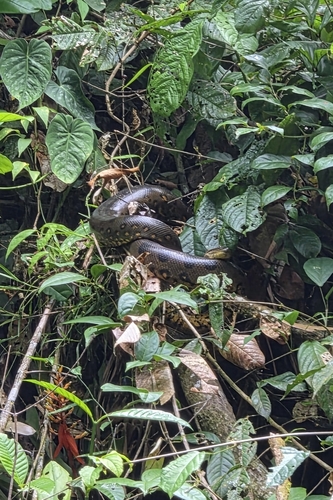
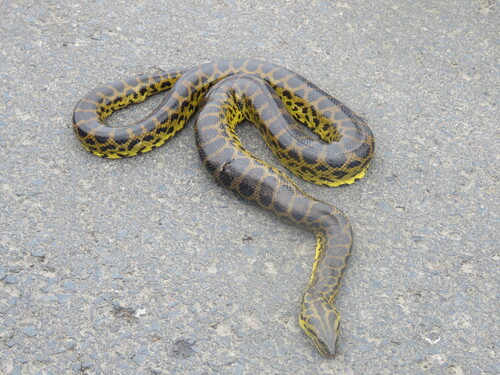
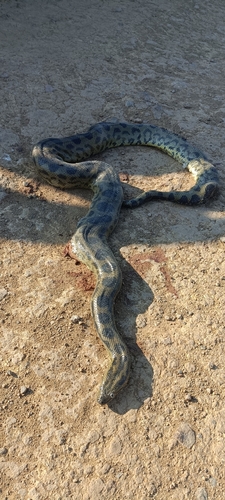

Keep learning
- What Is a Snake? Anatomy and the BasicsA clear overview of what makes a snake a snake: limbless body plan, anatomy, evolution from lizards, species diversity, and why they are ectothermic.
- How Snakes Move, Hunt, and EatHow snakes move without legs, hunt as ambushers or active foragers, kill by constriction or venom, and swallow prey wider than their head.
- What Do Snakes Eat?All snakes are carnivores. Learn what snakes eat, how diet changes with size and age, how often they feed, and how they hunt and swallow prey.
- Venomous vs Nonvenomous: How to Tell the DifferenceThe folk rules for telling venomous snakes apart, where each one fails, and why location-based identification beats guessing by sight.