
Colubridae
Common Tree Snake
HarmlessDendrelaphis punctulatus
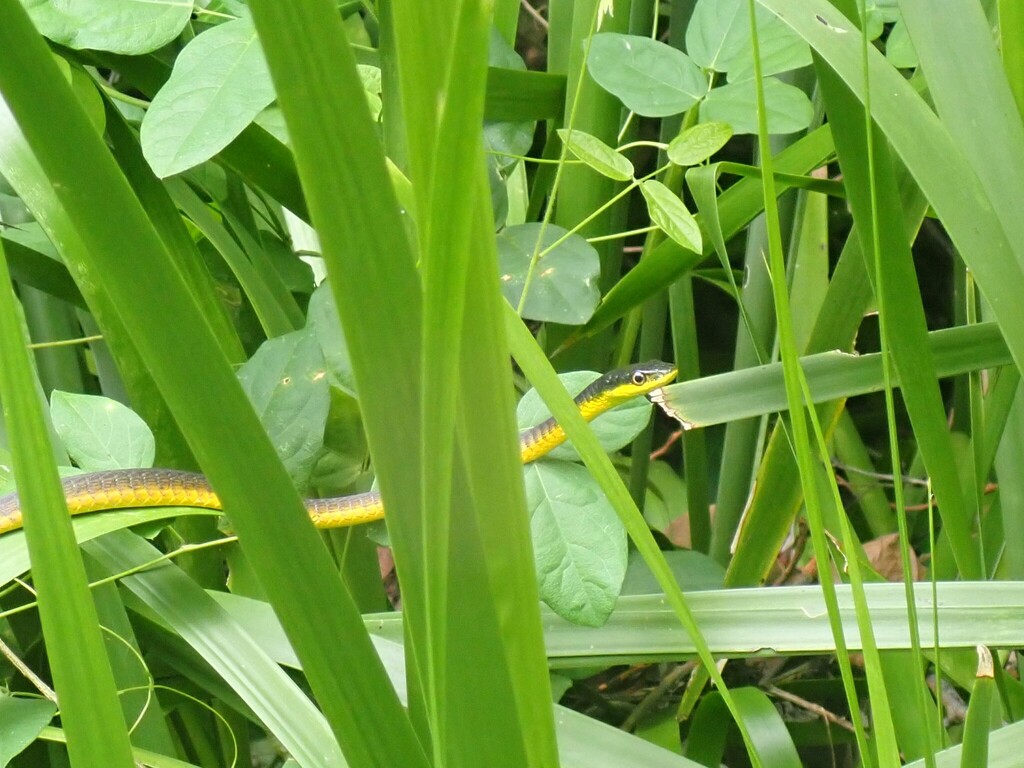
The Common Tree Snake (Dendrelaphis punctulatus) is a non-venomous snake in the Colubridae family, recorded in 10 countries.
- Family
- Colubridae
About the Common Tree Snake
Dendrelaphis punctulatus, also known commonly as the Australian tree snake, the common tree snake, and the green tree snake, is a species of slender, large-eyed, diurnal, non-venomous snake in the family Colubridae. The species is native to many parts of Australia, especially in the northern and eastern coastal areas, and to Papua New Guinea.
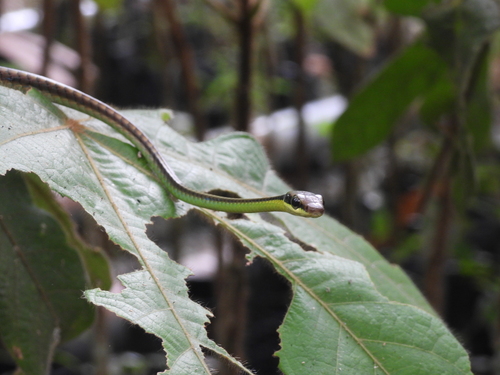
It is an agile snake with a very slender body and tail and is also a strong swimmer, using the water for hunting and avoiding predation. The ventral body colour varies from golden yellow, to bright green, to olive-green, to black, sometimes even blue, while its back is typically dark in colour. It is frequently pale yellow on the throat and belly, but other pale colours have been noted. Blue flecks are present on the flanks. The eyes are large, with typically golden-coloured irises and large round pupils.
It is found in a variety of habitats ranging from rainforest to woodland to urban areas where it preys on fish, frogs, and other small animals.
It is a non-venomous species and does not constrict its prey, but rather relies on its sharp, angled teeth to 'chew' its prey down the oesophagus.
Description
A study of D. punctulatus in Queensland showed females having an average snout–vent length of 101 centimetres (40 in) with males slightly shorter at 93 centimetres (37 in). Studies show that the snake may attain a total length in females of 200 centimetres (79 in) in females, while other sources state an overall maximum of 164 centimetres (65 in), which includes a tail 44 cm (17 in) long. It has 24–26 maxillary teeth. The dorsal scales are arranged in 13 rows at midbody. The ventrals number 191–220. The anal plate is divided. The subcaudals, which are also divided, number 120–144.
Distribution and habitat
D. punctulatus is common in Australia's northern tropics and eastern Australia. It is also found from the Kimberley region (Western Australia) to Cape York and Torres Strait (Queensland), extending down the east coast into New South Wales, and north into Papua New Guinea.
The common tree snake lives in a wide variety of habitats, including: bushland; well vegetated banks of rivers, creeks and streams; rainforest edges; eucalypt forests; heathland and areas with trees, long grass, and lush vegetation – especially near water. It can be found at altitudes from sea level to 500 m (1,600 ft).
The peak activity period for D. punctulatus, as determined from callouts by members of the public, in the Darwin region is during the northern dry season (May–July).
Behaviour
When D. punctulatus is near water it often looks for long grass, blending in to hide while watching for its prey to come to nearby rocks or banks to bask or play. It will also enter house gardens that have fountains or ponds surrounded by long grass or shrubs. It is active during the day, and rests at night in hollow trees, logs, foliage, or rock crevices. It is often found resting in trees; hence the name "tree snake".
Feeding
Adapted from Wikipedia, available under CC BY-SA.
Frequently asked: Common Tree Snake
- Is the Common Tree Snake venomous?
- No. The Common Tree Snake (Dendrelaphis punctulatus) is non-venomous and is not considered dangerous to humans. Like most snakes, it will retreat rather than bite when given the chance.
- Is the Common Tree Snake poisonous?
- Snakes are venomous, not poisonous. "Poisonous" means harmful to eat or touch; "venomous" means injecting toxins through a bite. The Common Tree Snake is neither poisonous nor venomous.
- Is the Common Tree Snake dangerous?
- The Common Tree Snake is not dangerous to humans. It has no medically significant venom and bites only defensively if cornered or handled.
- Where does the Common Tree Snake live?
- The Common Tree Snake has verified records in 10 countries, including Australia, Papua New Guinea, Indonesia. See the distribution section below for its full range.
- What does the Common Tree Snake eat?
- Frogs, water skinks, and small reptiles and their eggs form a large part of the common tree snake's diet, but it will also eat small fish, mammals, geckos, and turtle hatchlings.
Where it is found
More Colubridae snakes
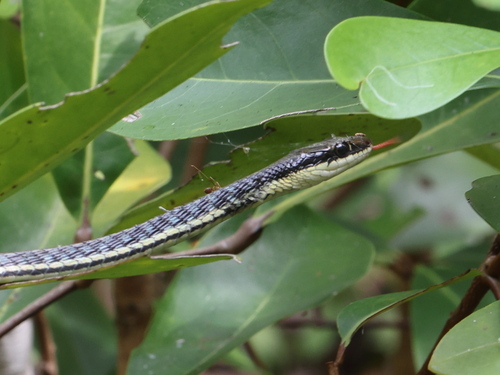 Painted BronzebackDendrelaphis pictus
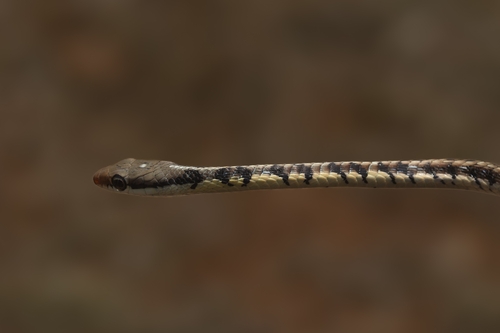 Common Bronzeback Tree SnakeDendrelaphis tristis
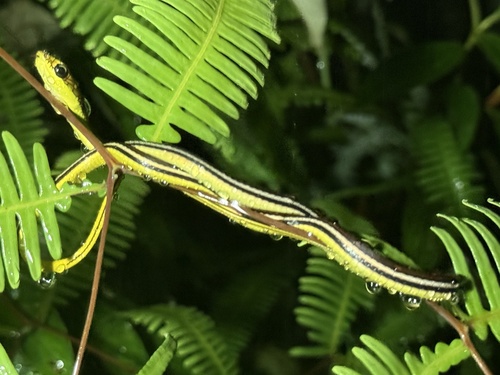 Striped BronzebackDendrelaphis caudolineatus
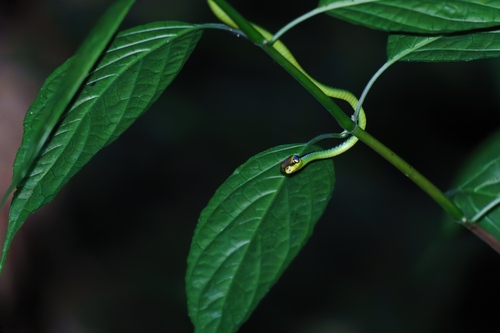 Elegant BronzebackDendrelaphis formosus
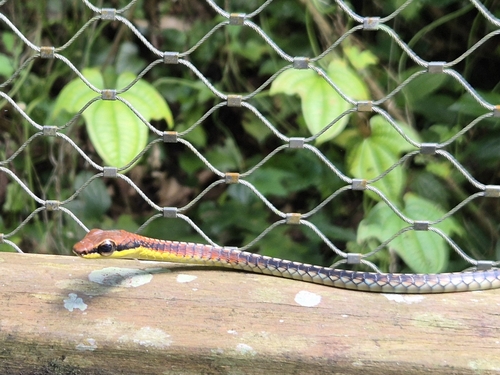 Kopstein's BronzebackDendrelaphis kopsteini
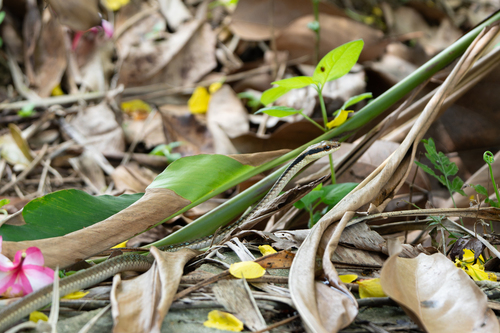 Vietnamese BronzebackDendrelaphis ngansonensis
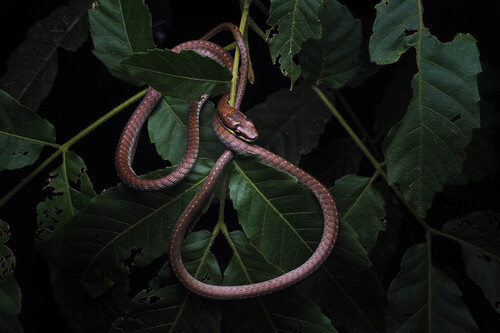 Northern Tree SnakeDendrelaphis calligaster
 Blue BronzebackDendrelaphis cyanochloris
Classification
How scientists group this snake, from the broadest category down to the exact species. Each step narrows to its closest relatives.
- OrderThe broad group of scaled reptiles: all snakes and lizards
- Squamata
- FamilyA group of related snakes that share key traits
- Colubridae
- GenusA close-knit group of very similar species
- Dendrelaphis
- SpeciesThis exact snake, named in the two-part scientific name
- Dendrelaphis punctulatus
Keep learning
- What to Do If You Find a SnakeFound a snake at home or on a trail? Here is how to stay calm, give it space, identify it safely, and know when to call a professional.
- Venomous vs Nonvenomous: How to Tell the DifferenceThe folk rules for telling venomous snakes apart, where each one fails, and why location-based identification beats guessing by sight.
- What Is a Snake? Anatomy and the BasicsA clear overview of what makes a snake a snake: limbless body plan, anatomy, evolution from lizards, species diversity, and why they are ectothermic.
- How to Keep Snakes Out of Your Yard and HomeA practical guide to keeping snakes out of your yard and home using habitat changes that work, plus what to skip and what to do if one shows up.
Distribution from GBIF & iNaturalist. Venom status per CDC. Background: Wikipedia. Informational only. Never handle a snake to identify it.