
Acrochordidae
Javan File Snake
HarmlessAcrochordus javanicus
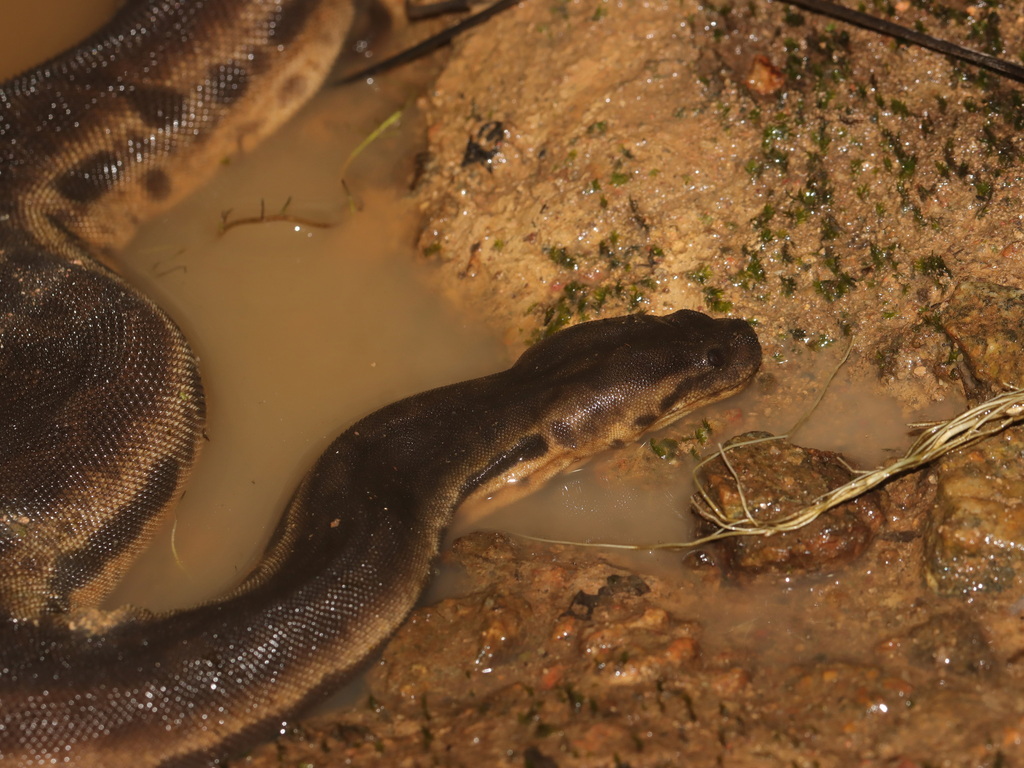
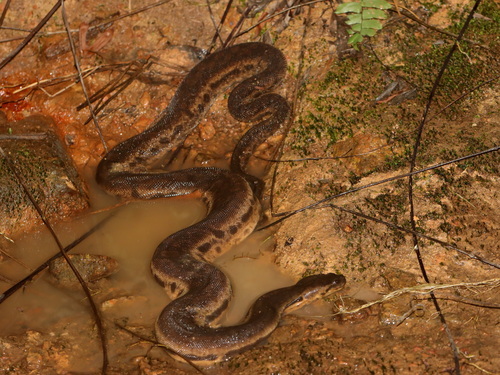
2 photographs of the Javan File Snake. © Ian Dugdale.
The Javan File Snake (Acrochordus javanicus) is a non-venomous snake in the Acrochordidae family, recorded in 9 countries.
- Family
- Acrochordidae
About the Javan File Snake
The elephant trunk snake or the Javan file snake (Acrochordus javanicus), is a species of snake in the family Acrochordidae, a family which represents a group of primitive non-venomous aquatic snakes.
Description
The elephant trunk snake possesses a wide and flat head, and its nostrils are situated on the top of the snout. Those head particularities confer to A. javanicus a certain resemblance with boas. However, its head is only as wide as its body. Females are bigger than males, and the maximum total length (including tail) of an individual is 2.4 m (94 in). The dorsal side of the snake's body is brown, and its ventral side is pale yellow.
The skin is baggy and loose giving the impression that it is too big for the animal. The skin is covered with small rough adjacent scales. The skin is also used in the tannery industry.
The top of the head has no large shields, but instead is covered with very small granular scales. There are no ventral scales. The body scales are in about 120 rows around the body. The body is stout, and the tail is short and prehensile.
The elephant trunk snake is fully adapted to live underwater so much that its body cannot support its weight out of water and leaving the water can cause it serious injury.
Reproduction
An aquatic snake, the elephant trunk snake is ovoviviparous, with the incubation lasting 5 to 6 months and the female expelling 6 to 17 young.
Geographic range
The elephant trunk snake is found in Southeast Asia west of the Wallace Line: southern Thailand, the west coast of Peninsular Malaysia, Singapore, Borneo (Kalimantan, Sarawak), a number of Indonesian islands (Java, Sumatra, and (possibly) Bali); possibly also in Cambodia and Vietnam, although the last is discredited by the IUCN.
Habitat
The elephant trunk snake has a coastal living habitat like rivers, estuaries and lagoons. But it prefers freshwater and brackish environments.
Feeding
The elephant trunk snake is an ambush predator that preys on fishes and amphibians. It usually catches its prey by folding its body firmly around the prey. Its loose, baggy skin and its sharp scales find their utility by limiting any risk of escape of the prey, in particular fishes which have bodies covered with a viscous, protective mucus.
Behaviour
The elephant trunk snake is nocturnal. It spends most of its life under water and rarely goes on land. It can stay under water for up to 40 minutes.
Original publication
Hornstedt CF (1787). "Beskrifning på en Ny Orm från Java ". Kongl. Vetenskaps Akademiens Handlingar 4: 306-308 + Plate XII. (Acrochordus javanicus, new species). (in Latin and Swedish).
Adapted from Wikipedia, available under CC BY-SA.
Frequently asked: Javan File Snake
- Is the Javan File Snake venomous?
- No. The Javan File Snake (Acrochordus javanicus) is non-venomous and is not considered dangerous to humans. Like most snakes, it will retreat rather than bite when given the chance.
- Is the Javan File Snake poisonous?
- Snakes are venomous, not poisonous. "Poisonous" means harmful to eat or touch; "venomous" means injecting toxins through a bite. The Javan File Snake is neither poisonous nor venomous.
- Is the Javan File Snake dangerous?
- The Javan File Snake is not dangerous to humans. It has no medically significant venom and bites only defensively if cornered or handled.
- Where does the Javan File Snake live?
- The Javan File Snake has verified records in 9 countries, including Indonesia, Thailand, Malaysia. See the distribution section below for its full range.
- What does the Javan File Snake eat?
- The elephant trunk snake is an ambush predator that preys on fishes and amphibians. It usually catches its prey by folding its body firmly around the prey. Its loose, baggy skin and its sharp scales find their utility by limiting any risk of escape of the prey, in particular fishes which have bodies covered with a viscous, protective mucus.
Where it is found
More Acrochordidae snakes
Classification
How scientists group this snake, from the broadest category down to the exact species. Each step narrows to its closest relatives.
- OrderThe broad group of scaled reptiles: all snakes and lizards
- Squamata
- FamilyA group of related snakes that share key traits
- Acrochordidae
- GenusA close-knit group of very similar species
- Acrochordus
- SpeciesThis exact snake, named in the two-part scientific name
- Acrochordus javanicus
Keep learning
- What to Do If You Find a SnakeFound a snake at home or on a trail? Here is how to stay calm, give it space, identify it safely, and know when to call a professional.
- Venomous vs Nonvenomous: How to Tell the DifferenceThe folk rules for telling venomous snakes apart, where each one fails, and why location-based identification beats guessing by sight.
- What Is a Snake? Anatomy and the BasicsA clear overview of what makes a snake a snake: limbless body plan, anatomy, evolution from lizards, species diversity, and why they are ectothermic.
- How to Keep Snakes Out of Your Yard and HomeA practical guide to keeping snakes out of your yard and home using habitat changes that work, plus what to skip and what to do if one shows up.
Distribution from GBIF & iNaturalist. Venom status per CDC. Background: Wikipedia. Informational only. Never handle a snake to identify it.