
Atractaspididae
Elongate Quill-snouted Snake
HarmlessXenocalamus mechowii
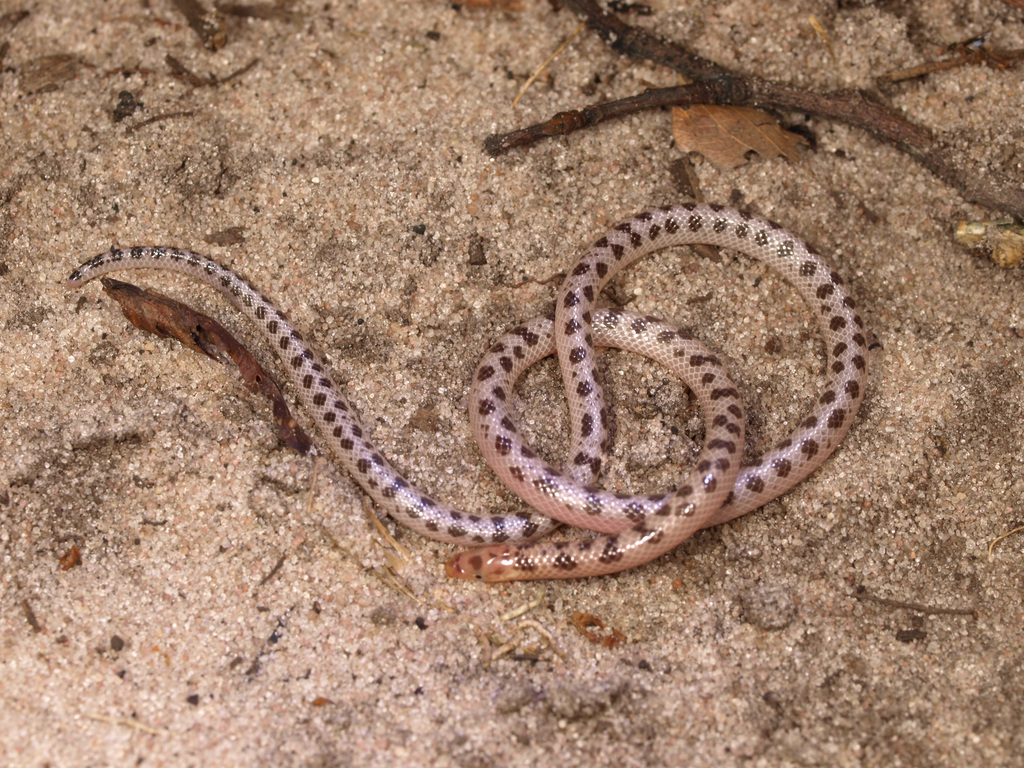
The Elongate Quill-snouted Snake (Xenocalamus mechowii) is a non-venomous snake in the Atractaspididae family, recorded in 8 countries.
- Family
- Atractaspididae
- Danger
- high
About the Elongate Quill-snouted Snake
Xenocalamus mechowii, or the elongate quill-snouted snake, is a species of mildly venomous rear-fanged snake in the subfamily Aparallactinae of the family Atractaspididae. The species is endemic to Africa. There are two recognized subspecies.
Etymology
The specific name or epithet, mechowii, is in honor of Friedrich Wilhelm Alexander von Mechow, a Silesian-German explorer of Africa.
Geographic range
Xenocalamus mechowii is found in Angola, Botswana, Republic of the Congo, Democratic Republic of the Congo, Namibia, Zambia, and Zimbabwe.
Habitat
The preferred habitat of Xenocalamus mechowii is savanna on Kalahari sand, at elevations up to 1,000 m (3,300 ft).
Description
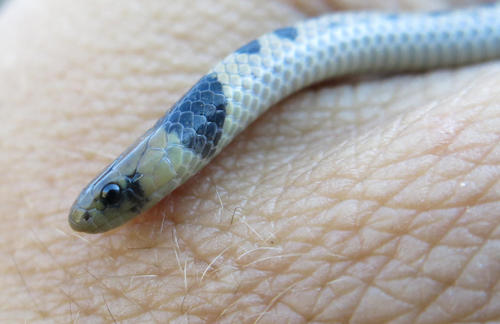
Dorsally, Xenocalamus mechowii is yellowish with brown spots, some spots arranged in alternating confluent pairs, others forming crossbands. The upper lip, sides of the body, and venter are unspotted.
A subadult 22.5 cm (8+3⁄4 in) in total length has a tail 3.5 cm (1+3⁄8 in) long.
The species exhibits sexual dimorphism. Adult males may attain a snout-to-vent length (SVL) of 58 cm (23 in). Females are larger, and may attain 80 cm (31 in) SVL.
The dorsal scales are smooth, without apical pits, arranged in 17 rows. The ventrals number 229–239. The anal plate is divided, and the subcaudals which number 31–36 are also divided.
The head scalation is the same as Xenocalamus bicolor, except there are no supraoculars and two postoculars.
The snout is very depressed and very prominent.
Behavior
Xenocalamus mechowii is terrestrial and fossorial.
Diet
Xenocalamus mechowii preys on amphisbaenians, which it finds by burrowing.
Reproduction
Xenocalamus mechowii is oviparous. An adult female may lay a clutch of as many as four eggs.
Subspecies
Two subspecies of Xenocalamus mechowii are recognized as being valid, including the nominate race.
Xenocalamus mechowii inornatus de Witte & Laurent, 1947
Xenocalamus mechowii mechowii W. Peters, 1881
Intergrades of these two subspecies can be found in North-Western Province, Zambia.
Adapted from Wikipedia, available under CC BY-SA.
Frequently asked: Elongate Quill-snouted Snake
- Is the Elongate Quill-snouted Snake venomous?
- No. The Elongate Quill-snouted Snake (Xenocalamus mechowii) is non-venomous and is not considered dangerous to humans. Like most snakes, it will retreat rather than bite when given the chance.
- Is the Elongate Quill-snouted Snake poisonous?
- Snakes are venomous, not poisonous. "Poisonous" means harmful to eat or touch; "venomous" means injecting toxins through a bite. The Elongate Quill-snouted Snake is neither poisonous nor venomous.
- Is the Elongate Quill-snouted Snake dangerous?
- The Elongate Quill-snouted Snake is not dangerous to humans. It has no medically significant venom and bites only defensively if cornered or handled.
- Where does the Elongate Quill-snouted Snake live?
- The Elongate Quill-snouted Snake has verified records in 8 countries, including Zimbabwe, Zambia, Namibia. See the distribution section below for its full range.
- What does the Elongate Quill-snouted Snake eat?
- Xenocalamus mechowii preys on amphisbaenians, which it finds by burrowing.
- Why is it called the Elongate Quill-snouted Snake?
- The specific name or epithet, mechowii, is in honor of Friedrich Wilhelm Alexander von Mechow, a Silesian-German explorer of Africa.
Where it is found
More Atractaspididae snakes
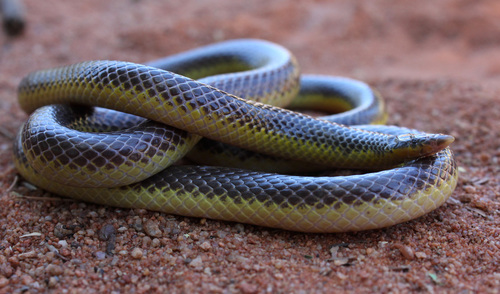 Slender Quill-snouted SnakeXenocalamus bicolor
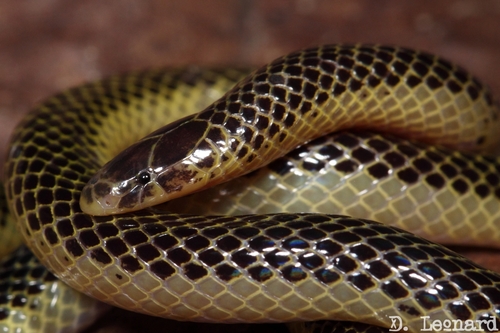 Transvaal Quill-snouted SnakeXenocalamus transvaalensis
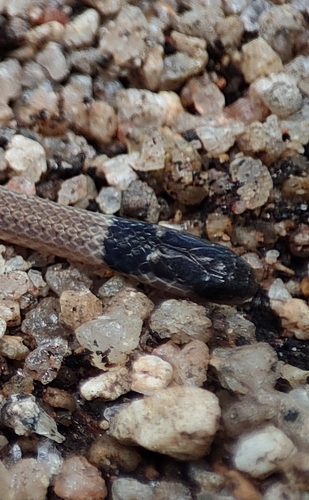 Cape Centipede-EaterAparallactus capensis
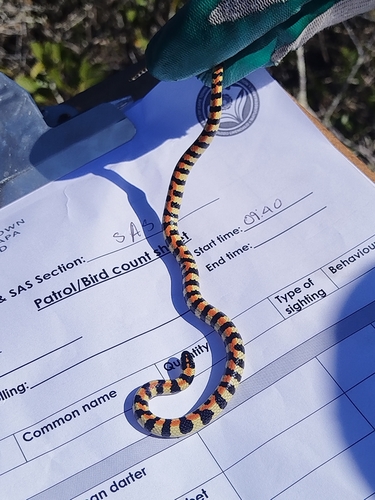 Spotted Harlequin SnakeHomoroselaps lacteus
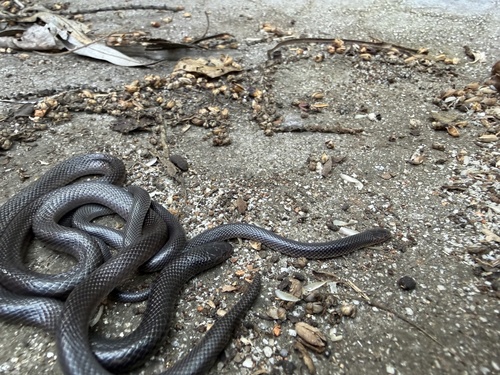 Southern Stiletto SnakeAtractaspis bibronii
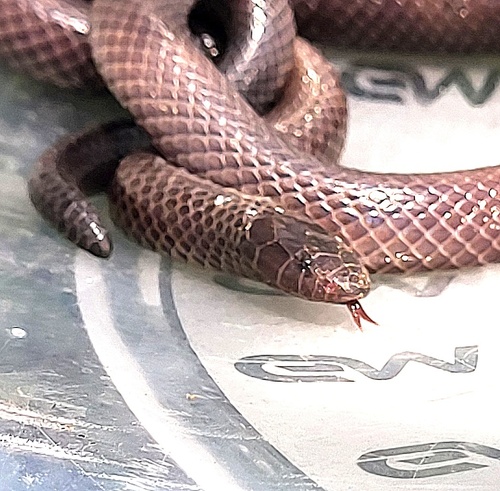 Common Purple-glossed SnakeAmblyodipsas polylepis
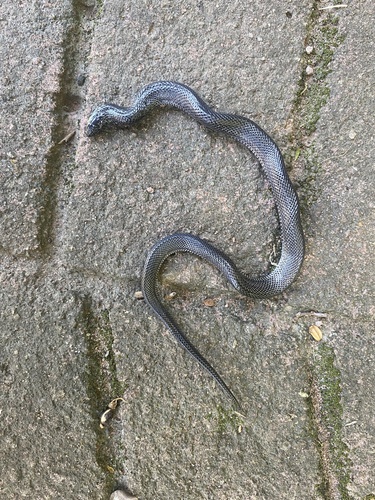 Natal Black SnakeMacrelaps microlepidotus
 Reticulated Centipede-EaterAparallactus lunulatus
Classification
How scientists group this snake, from the broadest category down to the exact species. Each step narrows to its closest relatives.
- OrderThe broad group of scaled reptiles: all snakes and lizards
- Squamata
- FamilyA group of related snakes that share key traits
- Atractaspididae
- GenusA close-knit group of very similar species
- Xenocalamus
- SpeciesThis exact snake, named in the two-part scientific name
- Xenocalamus mechowii
Keep learning
- What to Do If You Find a SnakeFound a snake at home or on a trail? Here is how to stay calm, give it space, identify it safely, and know when to call a professional.
- Venomous vs Nonvenomous: How to Tell the DifferenceThe folk rules for telling venomous snakes apart, where each one fails, and why location-based identification beats guessing by sight.
- What Is a Snake? Anatomy and the BasicsA clear overview of what makes a snake a snake: limbless body plan, anatomy, evolution from lizards, species diversity, and why they are ectothermic.
- How to Keep Snakes Out of Your Yard and HomeA practical guide to keeping snakes out of your yard and home using habitat changes that work, plus what to skip and what to do if one shows up.
Distribution from GBIF & iNaturalist. Venom status per CDC. Background: Wikipedia. Informational only. Never handle a snake to identify it.