
Watersnake
Banded Watersnake
HarmlessNerodia fasciata
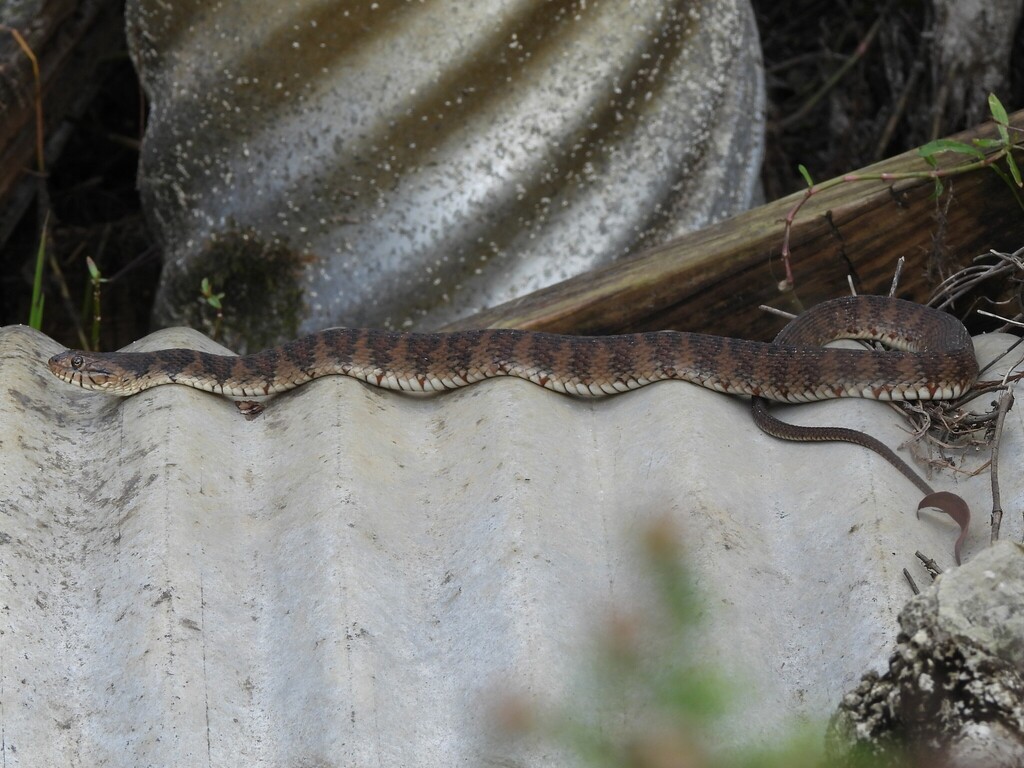
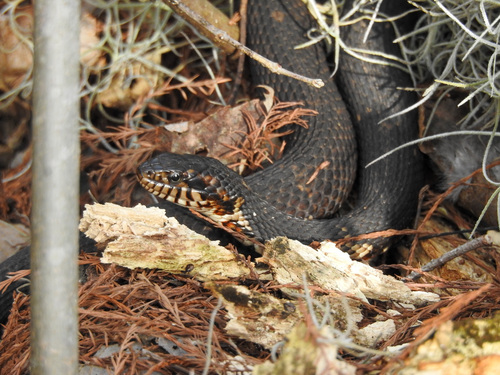
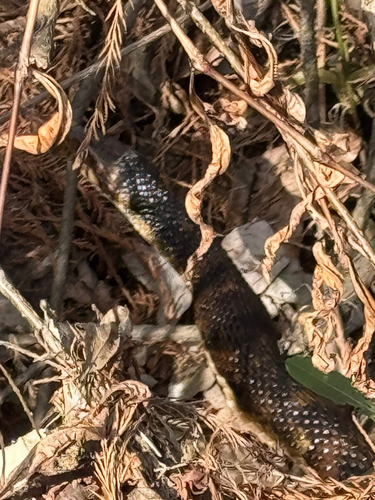
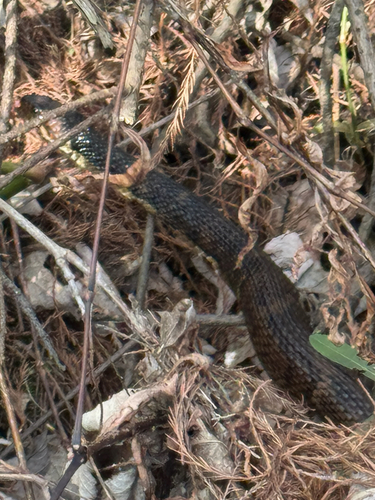
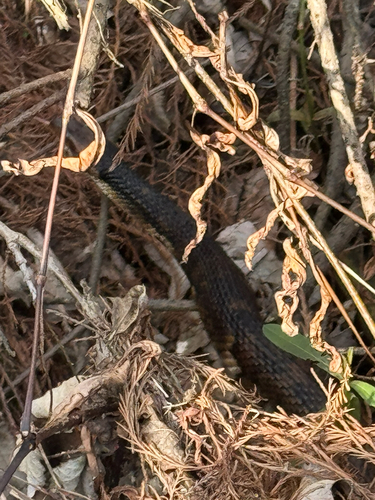
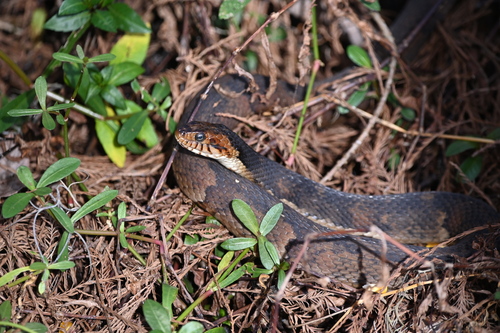
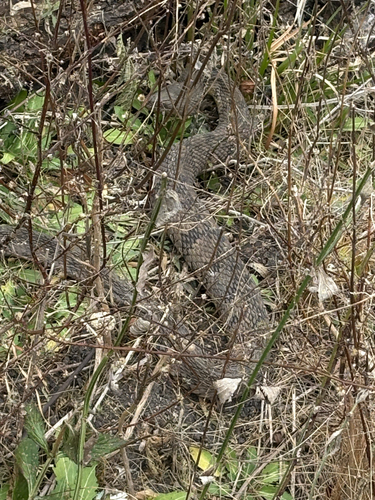
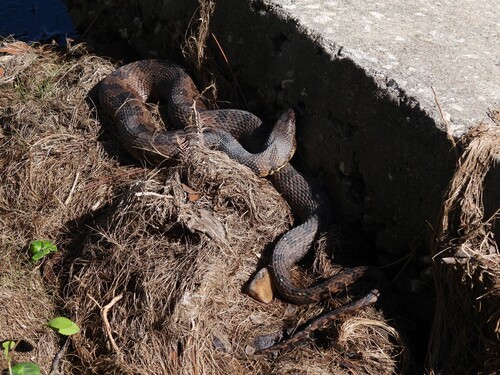
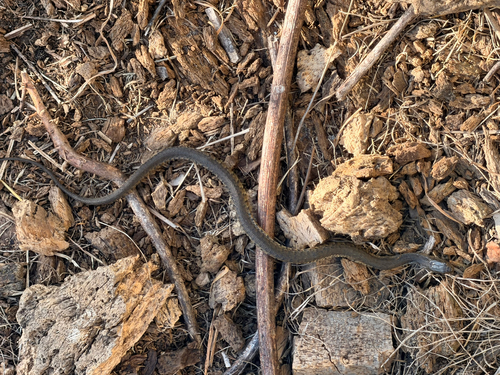
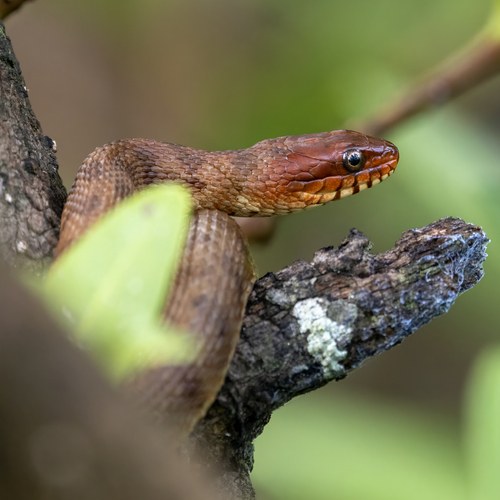
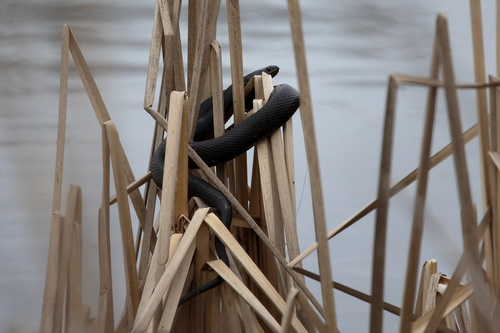
6 photographs of the Banded Watersnake. © geosesarma.
The Banded Watersnake (Nerodia fasciata) is a non-venomous snake in the Colubridae family, recorded in 3 countries.
- Also called
- Watersnake
- Family
- Colubridae
- Size
- Heavy-bodied, 2–4.5 ft.
- Habitat
- Lakes, rivers, ponds, swamps, and ditches.
- Behavior
- Strong swimmers that flee into water but will bite and musk if cornered. Very frequently mistaken for cottonmouths.
- Identify
- Heavy banded or blotched body, round pupils, and a narrow head — unlike the cottonmouth's broad, blocky head.
About the Banded Watersnake
The banded water snake or southern water snake (Nerodia fasciata) is a species of mostly aquatic, nonvenomous, colubrid snakes most commonly found in the Midwest, Southeastern United States.
Geographic range
Nerodia fasciata is natively found from southern Illinois, south to Louisiana, and east to North Carolina and Florida. Introduced populations exist in Texas and California; other sources include eastern Texas in its natural range. In 1992, its congener Nerodia sipedon (northern or common water snake) and it were found in three sites in California by the US Fish and Wildlife Service (USFWS). In 2009, more than 300 banded water snakes were caught in suburbs of Los Angeles by the Nerodia Working Group of USFWS. Then in May 2016, the species was found in the Colorado River basin near Yuma, Arizona. Further trapping did indeed catch large numbers of them, indicating that a thriving invasive population exists in that area.
Description
Adults of the banded water snake typically range from 56 to 107 cm (22 to 42 in) in total length, with a record size (in the Florida subspecies) of 159 cm (62.5 in) in total length.
It is typically gray, greenish-gray, or brown in color, with dark crossbanding. Many specimens are so dark in color that their patterning is barely discernible. The ventrum (belly) is typically an off-white to white. They have flat heads, and are fairly heavy-bodied. Banded water snakes may also be identified by a dark stripe which extends from the eye to the angle of the jaw. If irritated, they release a foul-smelling musk to deter predators. This species also exhibits sexual dimorphism in which the female is generally longer and heavier than the male. The average frequency of skin shedding has been found to be every four weeks.
Their appearance leads them to be frequently mistaken for other snakes with which they share a habitat, including the venomous cottonmouth.
Habitat
Nerodia fasciata inhabits most freshwater environments such as lakes, marshes, ponds, and streams. Banded water snakes are active both day and night and may be seen basking on logs or branches overhanging the water or foraging in shallow water. They will typically stay within emergent vegetation along the shoreline or in the shallow littoral zone of their habitat. They move more frequently than other Nerodia species.
Diet
The species preys mainly on fish and frogs. On occasion, they prey on small turtles, small snakes, birds, earthworms, and crawfish. Juveniles mainly consume fish and shift towards eating frogs as adults. This shift may be caused by large frogs being mechanically too difficult for juveniles to consume (which may suggest juveniles may be unable to open their jaws wide enough for adult frogs), because large frogs are energetically too costly for juveniles to catch, or because juveniles are at risk if swallowing prey requires a long time. Individuals less than 500 mm snout–vent length (SVL) primarily consume relatively light mosquito fish and topminnows, whereas individuals exceeding 500 mm SVL begin taking massive bufonid (toad) and ranid (frog) prey.
Adapted from Wikipedia, available under CC BY-SA.
Frequently asked: Banded Watersnake
- Is the Banded Watersnake venomous?
- No. The Banded Watersnake (Nerodia fasciata) is non-venomous and is not considered dangerous to humans. Like most snakes, it will retreat rather than bite when given the chance.
- Is the Banded Watersnake poisonous?
- Snakes are venomous, not poisonous. "Poisonous" means harmful to eat or touch; "venomous" means injecting toxins through a bite. The Banded Watersnake is neither poisonous nor venomous.
- Is the Banded Watersnake dangerous?
- The Banded Watersnake is not dangerous to humans. It has no medically significant venom and bites only defensively if cornered or handled.
- Where does the Banded Watersnake live?
- The Banded Watersnake has verified records in 3 countries, including United States of America, Mexico, Martinique. See the distribution section below for its full range.
- How do I identify the Banded Watersnake?
- Heavy banded or blotched body, round pupils, and a narrow head — unlike the cottonmouth's broad, blocky head.
- How big does the Banded Watersnake get?
- Heavy-bodied, 2–4.5 ft.
- What does the Banded Watersnake eat?
- The species preys mainly on fish and frogs. On occasion, they prey on small turtles, small snakes, birds, earthworms, and crawfish. Juveniles mainly consume fish and shift towards eating frogs as adults. This shift may be caused by large frogs being mechanically too difficult for juveniles to consume (which may suggest juveniles may be unable to open their jaws wide enough for adult frogs), because large frogs are energetically too costly for juveniles to catch, or because juveniles are at risk if swallowing prey requires a long time.
Where it is found
Snakes it is confused with
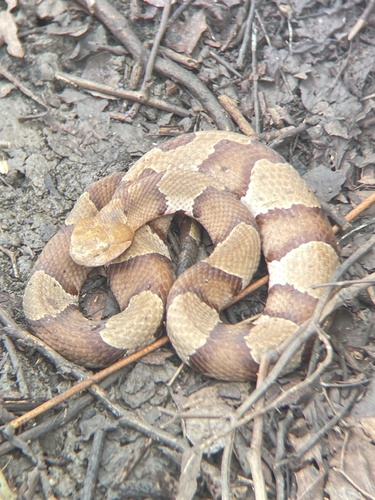
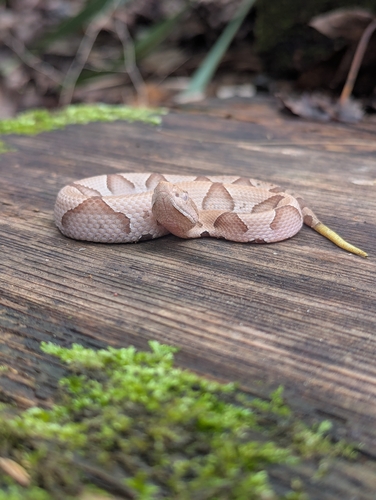 Eastern CopperheadVenomous
Harmless watersnakes are sometimes mistaken for copperheads near water; watersnakes have round pupils and banded, not hourglass, markings.
Banded Watersnake vs Eastern Copperhead→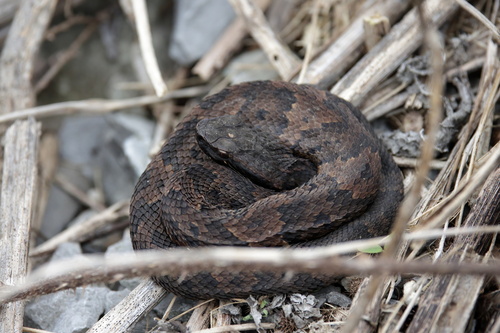 Northern CottonmouthVenomous
Harmless watersnakes are constantly mistaken for the venomous cottonmouth. Watersnakes have round heads and round pupils and flee into the water.
Banded Watersnake vs Northern Cottonmouth→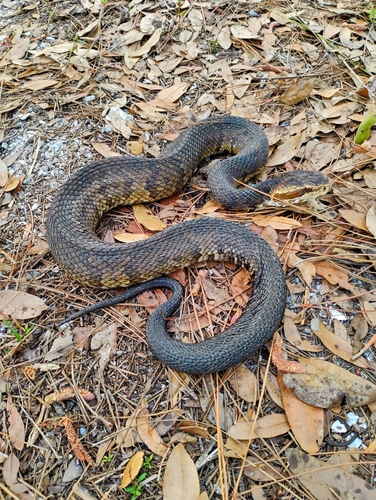
More Colubridae snakes
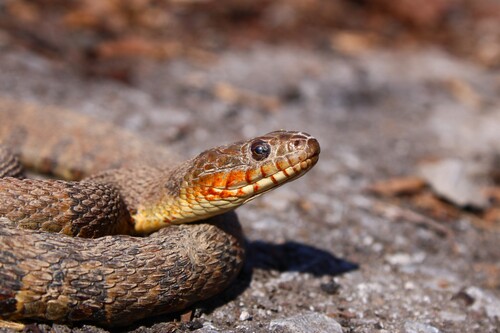 Common WatersnakeNerodia sipedon
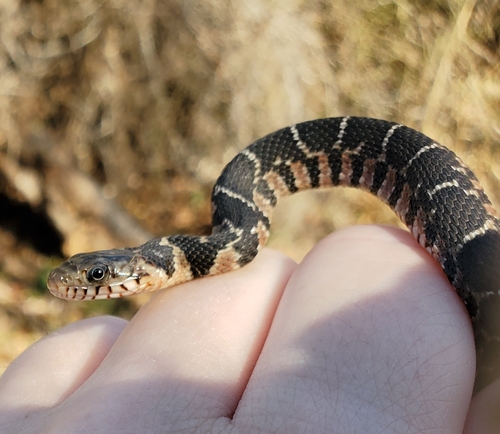 Plain-bellied WatersnakeNerodia erythrogaster
 Diamondback WatersnakeNerodia rhombifer
 Brown WatersnakeNerodia taxispilota
 Florida Green WatersnakeNerodia floridana
 Saltmarsh SnakeNerodia clarkii
 Mississippi Green WatersnakeNerodia cyclopion
 Brazos River WatersnakeNerodia harteri
Classification
How scientists group this snake, from the broadest category down to the exact species. Each step narrows to its closest relatives.
- OrderThe broad group of scaled reptiles: all snakes and lizards
- Squamata
- FamilyA group of related snakes that share key traits
- Colubridae
- GenusA close-knit group of very similar species
- Nerodia
- SpeciesThis exact snake, named in the two-part scientific name
- Nerodia fasciata
Keep learning
- What to Do If You Find a SnakeFound a snake at home or on a trail? Here is how to stay calm, give it space, identify it safely, and know when to call a professional.
- Venomous vs Nonvenomous: How to Tell the DifferenceThe folk rules for telling venomous snakes apart, where each one fails, and why location-based identification beats guessing by sight.
- What Is a Snake? Anatomy and the BasicsA clear overview of what makes a snake a snake: limbless body plan, anatomy, evolution from lizards, species diversity, and why they are ectothermic.
- How to Keep Snakes Out of Your Yard and HomeA practical guide to keeping snakes out of your yard and home using habitat changes that work, plus what to skip and what to do if one shows up.
Distribution from GBIF & iNaturalist. Venom status per CDC. Background: Wikipedia. Informational only. Never handle a snake to identify it.