
Colubridae
Baja California Ratsnake
HarmlessBogertophis rosaliae
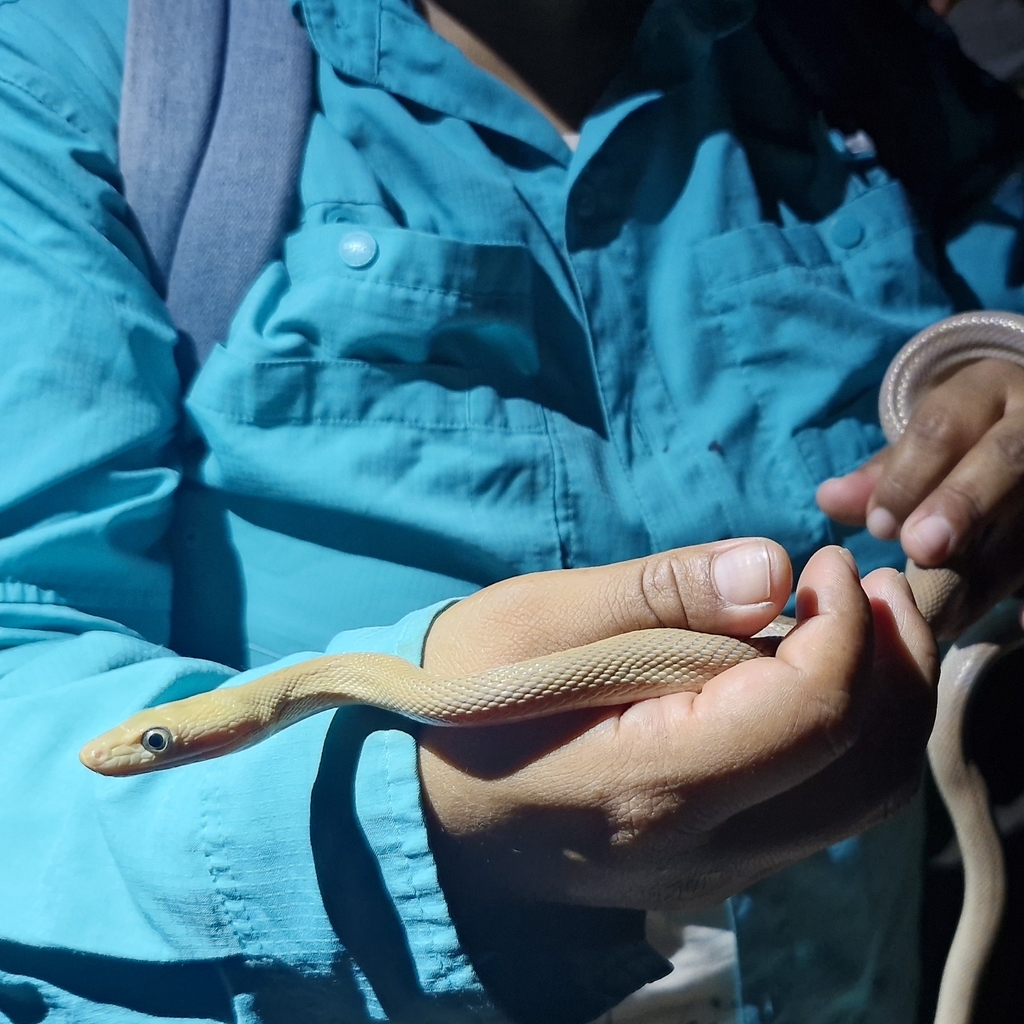
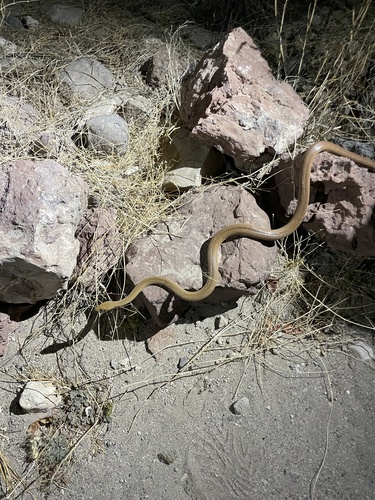
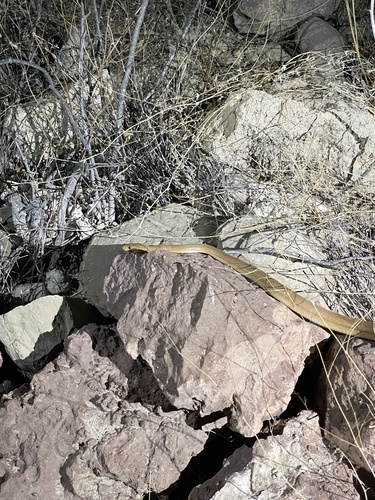
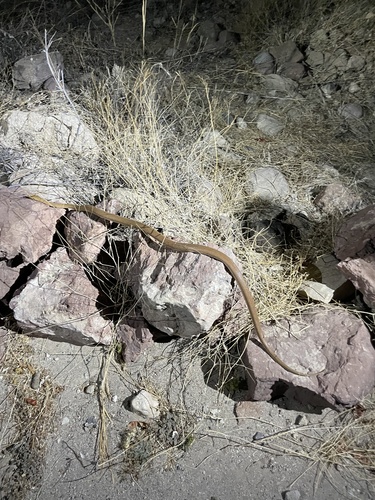
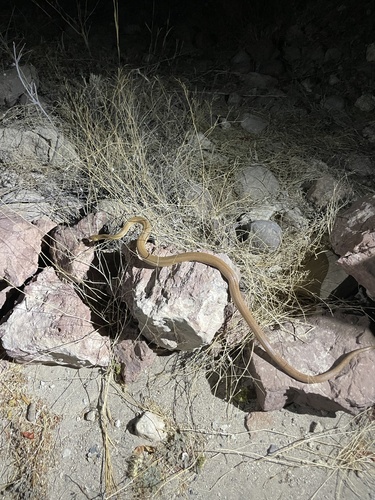
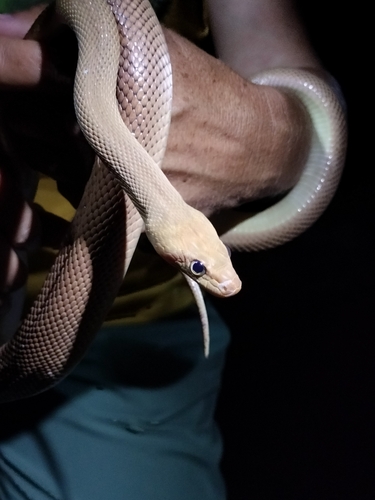
6 photographs of the Baja California Ratsnake. © Diego Maldonado de la Torre.
The Baja California Ratsnake (Bogertophis rosaliae) is a non-venomous snake in the Colubridae family, recorded in 2 countries.
- Family
- Colubridae
About the Baja California Ratsnake
The Baja California rat snake (Bogertophis rosaliae) is a species of nonvenomous snake in the family Colubridae. The species is native to Baja California, Mexico; extreme southern California; and some islands in the Sea of Cortés.
Description
The Baja California rat snake is a large, slender colubrid snake with a long head, large eyes, and smooth dorsal scales. Adults have a total length (including tail) of 85–150 cm (33–59 in). Each dorsal scale contains two apical pits (Price 1990a, 1990b). The dorsum is uniform olive or reddish brown without dark markings on a cream-colored background (Ottley and Jacobsen 1983). Yellowish or greenish coloration extends from the lower sides of the body to the venter (Price 1990b). The iris is yellow-green (Ottley and Jacobsen 1983).
Taxonomic remarks
Dowling and Price (1988) placed this snake in its own genus, Bogertophis, based on immunological data, but complications with the data set and the mode of analysis indicated that it was best to regard this species as a member of the rat snake genus, Elaphe, until further data became available (L. Grismer and John Wright, pers. comm.). No attempts have been made to characterize genetic variation across the geographic range of B. rosaliae. An understanding of that variation is needed to determine whether genetically differentiated populations exist within B. rosaliae. The difficulty in obtaining the requisite material for such a study makes it likely that novel techniques, such as extracting DNA from preserved specimens, will be needed to address this problem.
Geographic range
The Baja California rat snake ranges from extreme southern Imperial County, California, southward into Baja California to Cabo San Lucas (Price 1990a). Over at least the northern half of its range, it is known from widely disjunctive locations (Ottley and Jacobsen 1983, Price 1990b). Its known elevations range from near sea level to ca. 300 m (980 ft). In the United States, B. rosaliae is known from only one road-killed specimen, CSDSNH 644161 taken 26 May 1984 on Interstate Highway 8, 3.84 km (2 mi) east of Mountain Spring (Imperial County), California. Although Stebbins (1985) and others believe this locality to be genuine (L. Grismer and G. Pregill, pers. comm.), some have questioned the validity of this record (S. Barry, J. Copp, and C. Fagan, pers. comm.).
Life history
The life history of B. rosaliae is virtually unknown (Price 1990b). The species seems to be nocturnal or crepuscular and may be surface active during daylight hours under suitable conditions (Ottley and Jacobsen 1983). Nothing is known about reproduction or growth except that clutches with an unspecified number of eggs have been laid in captivity (Price 1990b). The few data on diet and behavior are based on captive specimens and are difficult to interpret in the absence of data on this snake under field conditions. If similar to other rat snakes, it climbs easily (Wright and Wright 1957) and adults are probably long-lived (see Bowler 1977). No data on movement, colonization abilities, or the potential predators of this taxon exist.
Habitat
Adapted from Wikipedia, available under CC BY-SA.
Frequently asked: Baja California Ratsnake
- Is the Baja California Ratsnake venomous?
- No. The Baja California Ratsnake (Bogertophis rosaliae) is non-venomous and is not considered dangerous to humans. Like most snakes, it will retreat rather than bite when given the chance.
- Is the Baja California Ratsnake poisonous?
- Snakes are venomous, not poisonous. "Poisonous" means harmful to eat or touch; "venomous" means injecting toxins through a bite. The Baja California Ratsnake is neither poisonous nor venomous.
- Is the Baja California Ratsnake dangerous?
- The Baja California Ratsnake is not dangerous to humans. It has no medically significant venom and bites only defensively if cornered or handled.
- Where does the Baja California Ratsnake live?
- The Baja California Ratsnake has verified records in 2 countries, including Mexico, United States of America. See the distribution section below for its full range.
Where it is found
More Colubridae snakes
 Trans-pecos RatsnakeBogertophis subocularis
 Common Garter SnakeThamnophis sirtalis
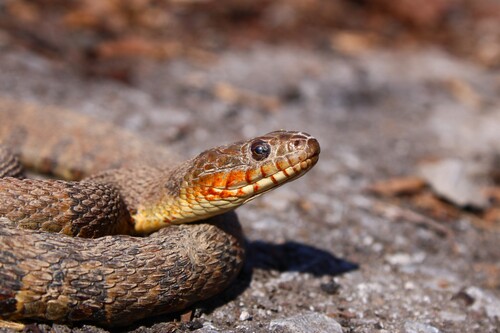 Common WatersnakeNerodia sipedon
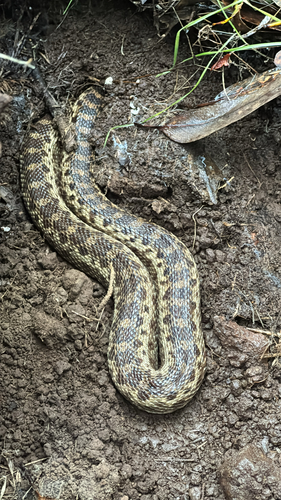 Gopher SnakePituophis catenifer
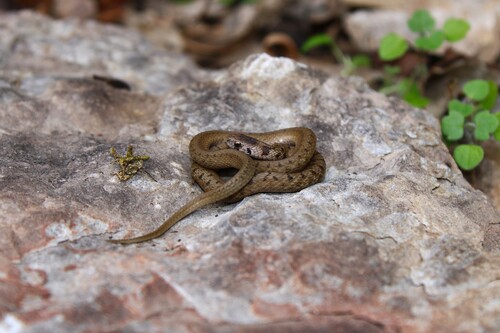 DeKay's BrownsnakeStoreria dekayi
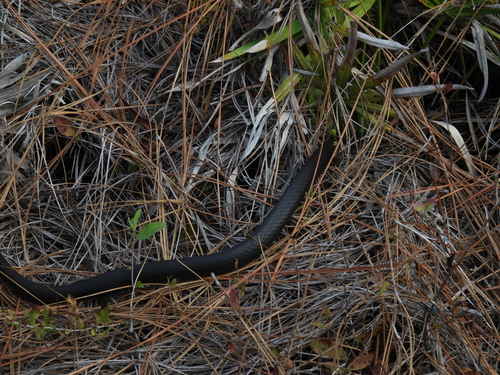 North American RacerColuber constrictor
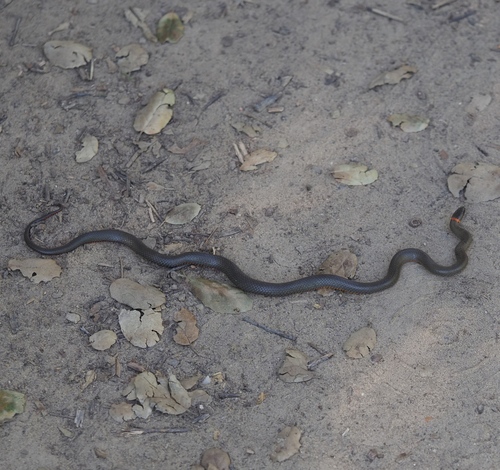 Ring-necked SnakeDiadophis punctatus
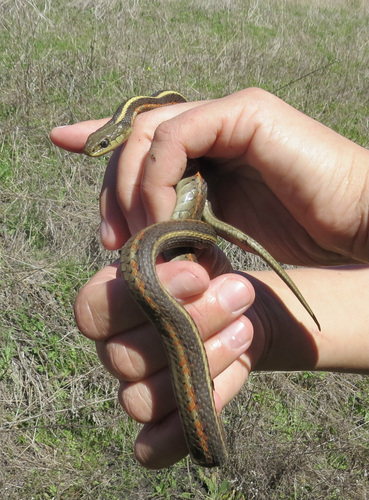 Western Terrestrial Garter SnakeThamnophis elegans
Classification
How scientists group this snake, from the broadest category down to the exact species. Each step narrows to its closest relatives.
- OrderThe broad group of scaled reptiles: all snakes and lizards
- Squamata
- FamilyA group of related snakes that share key traits
- Colubridae
- GenusA close-knit group of very similar species
- Bogertophis
- SpeciesThis exact snake, named in the two-part scientific name
- Bogertophis rosaliae
Keep learning
- What to Do If You Find a SnakeFound a snake at home or on a trail? Here is how to stay calm, give it space, identify it safely, and know when to call a professional.
- Venomous vs Nonvenomous: How to Tell the DifferenceThe folk rules for telling venomous snakes apart, where each one fails, and why location-based identification beats guessing by sight.
- What Is a Snake? Anatomy and the BasicsA clear overview of what makes a snake a snake: limbless body plan, anatomy, evolution from lizards, species diversity, and why they are ectothermic.
- How to Keep Snakes Out of Your Yard and HomeA practical guide to keeping snakes out of your yard and home using habitat changes that work, plus what to skip and what to do if one shows up.
Distribution from GBIF & iNaturalist. Venom status per CDC. Background: Wikipedia. Informational only. Never handle a snake to identify it.