
Pythonidae
Halmahera Python
HarmlessSimalia tracyae
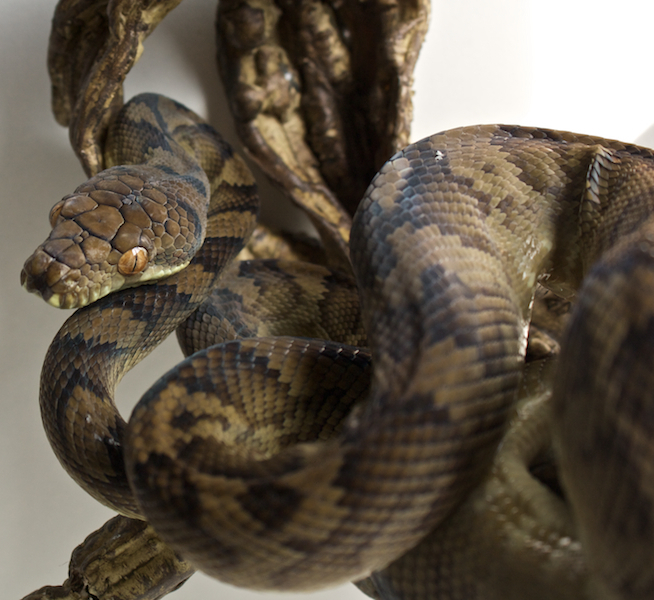
The Halmahera Python (Simalia tracyae) is a non-venomous snake in the Pythonidae family, recorded in 1 country.
- Family
- Pythonidae
About the Halmahera Python
Simalia tracyae, the Halmahera python, is a species of python found only on the Indonesian island of Halmahera. It belongs to the family Pythonidae and the genus Simalia. This snake was previously believed to have belonged to the Simalia amesthistina species; however, studies in recent years have caused scientists to distinguish between the two types of snakes, resulting in the reclassification of the Halmahera python as its own species.
Taxonomy and etymology
Until recently, Morelia tracyae was considered to be part of the species Morelia amesthistina. Previously, the scientific community believed that this species, despite the large varieties in appearance and wide range of habitat, was thought simply to have "exceptional dispersal abilities". However, more recent scientific studies have indicated Morelia amesthistina's lack of mobility between habitats, leading to the realization that this type of snake is "more prone to speciation than other pythons".
David G. Barker, a herpetologist and avid python collector, suspected that the high level of variety of Indonesian pythons indicated the presence of multiple species. In 1995, David G. Barker and Michael B. Harvey, herpetological expert and professor at the University of Texas, conducted a study of various specimens of Indonesian snakes. By examining both live specimens and museum specimens, these scientists observed morphological differences and phylogenetically analyzed the snakes' molecular DNA sequences. In its molecular sequencing, Morelia tracyae showed a 6-7% divergence in from all other scrub pythons in the surrounding area. The resultant conclusions of this study led to the identification of three new species: M. clastolepis, M. nauta, and M. tracyae.
The Halmhera python has been recognized by the scientific community as a separate species since Barker and Harvey's publication of their data in 2000.
The species Morelia tracyae was named for David G. Barker's wife, Tracy M. Barker, who is also a herpetologist specialized in pythons.
In 2014, a phylogenetic analysis of Pythonidae based on a combined analysis of eight nuclear DNA loci and three mitochondrial DNA regions concluded the Halmahera python belonged in genus Simalia with six other species.
Description
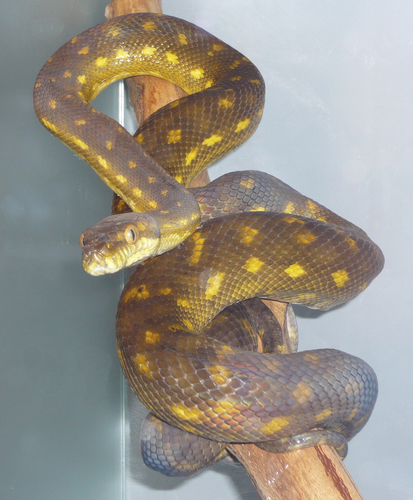
Simalia tracyae is a large species of python, and can range anywhere from 2.5 to 4 m (8.2 to 13.1 ft) in length. It is described as “heavy-bodied,” and more closely resembles the boa than any other species of python. The Halmahera python is recognized by its distinct red irises, as compared to the typical brown or gold irises of other closely related species. Other facial features include its rounded snout, black tongue, and pale blueish grey oral mucosa. One way to distinguish the sex of a Halmahera python is by noticing the snout: females have a somewhat shorter snout, which leads to the appearance of having a wider head. Simalia tracyae is also marked by two or three pairs of enlarged parietal scales on either side of its head.
Adapted from Wikipedia, available under CC BY-SA.
Frequently asked: Halmahera Python
- Is the Halmahera Python venomous?
- No. The Halmahera Python (Simalia tracyae) is non-venomous and is not considered dangerous to humans. Like most snakes, it will retreat rather than bite when given the chance.
- Is the Halmahera Python poisonous?
- Snakes are venomous, not poisonous. "Poisonous" means harmful to eat or touch; "venomous" means injecting toxins through a bite. The Halmahera Python is neither poisonous nor venomous.
- Is the Halmahera Python dangerous?
- The Halmahera Python is not dangerous to humans. It has no medically significant venom and bites only defensively if cornered or handled.
- Where does the Halmahera Python live?
- The Halmahera Python has verified records in 1 country, including Indonesia. See the distribution section below for its full range.
- Why is it called the Halmahera Python?
- Until recently, Morelia tracyae was considered to be part of the species Morelia amesthistina. Previously, the scientific community believed that this species, despite the large varieties in appearance and wide range of habitat, was thought simply to have "exceptional dispersal abilities". However, more recent scientific studies have indicated Morelia amesthistina's lack of mobility between habitats, leading to the realization that this type of snake is "more prone to speciation than other pythons".
Where it is found
More Pythonidae snakes
Classification
How scientists group this snake, from the broadest category down to the exact species. Each step narrows to its closest relatives.
- OrderThe broad group of scaled reptiles: all snakes and lizards
- Squamata
- FamilyA group of related snakes that share key traits
- Pythonidae
- GenusA close-knit group of very similar species
- Simalia
- SpeciesThis exact snake, named in the two-part scientific name
- Simalia tracyae
Keep learning
- What to Do If You Find a SnakeFound a snake at home or on a trail? Here is how to stay calm, give it space, identify it safely, and know when to call a professional.
- Venomous vs Nonvenomous: How to Tell the DifferenceThe folk rules for telling venomous snakes apart, where each one fails, and why location-based identification beats guessing by sight.
- What Is a Snake? Anatomy and the BasicsA clear overview of what makes a snake a snake: limbless body plan, anatomy, evolution from lizards, species diversity, and why they are ectothermic.
- How to Keep Snakes Out of Your Yard and HomeA practical guide to keeping snakes out of your yard and home using habitat changes that work, plus what to skip and what to do if one shows up.
Distribution from GBIF & iNaturalist. Venom status per CDC. Background: Wikipedia. Informational only. Never handle a snake to identify it.