
Regional field guide
Snakes in Oklahoma
50+ snake species have verified records in Oklahoma, including 9 venomous. Pick your county below to see exactly which snakes live near you.
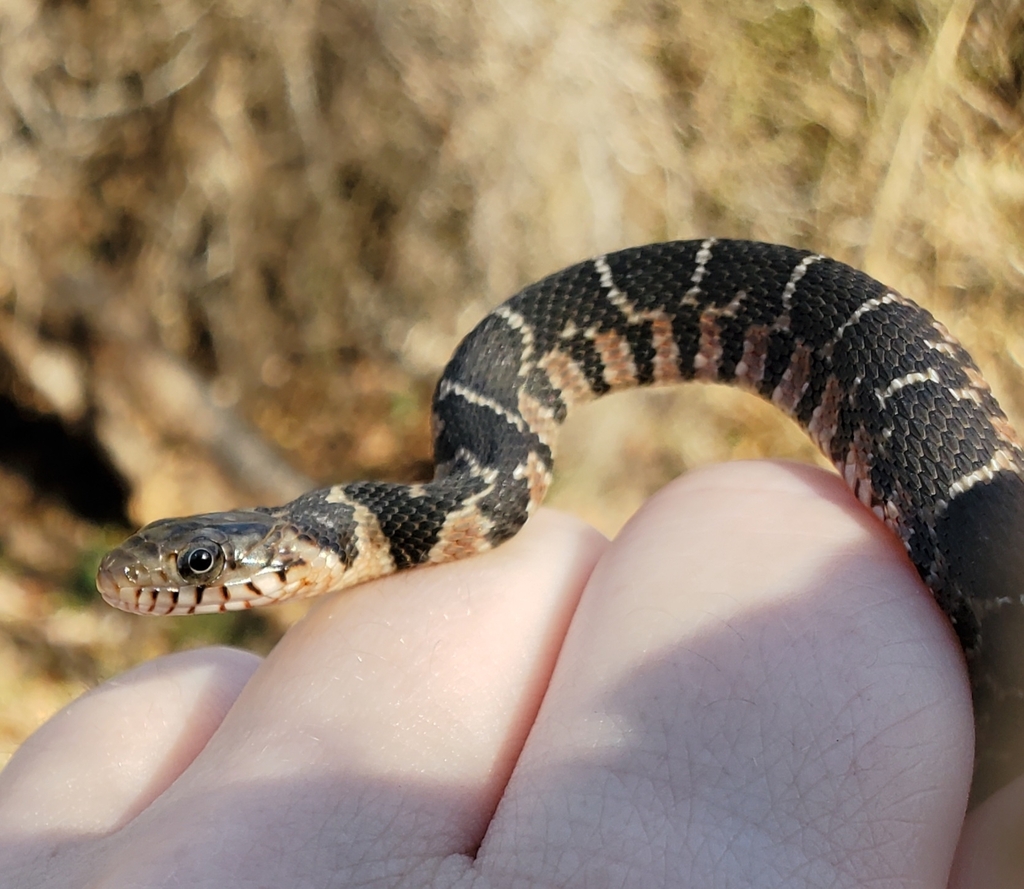
Snakes of Oklahoma
Oklahoma is home to about 50+ species of snakes, and only 9 of them are venomous. That means the large majority of snakes you encounter in the state are harmless and spend their lives quietly hunting rodents, frogs, and insects. Oklahoma sits where several regions meet, so it carries a generous slice of the country's rattlesnakes alongside the copperheads and cottonmouth of the wetter east. Snakes turn up in yards, on ranchland, along creeks, and in the rocky hills, but most are non-venomous and more interested in escaping than in any confrontation.
The state's snake diversity tracks a strong east-to-west gradient. The humid southeast, with its pine and hardwood forests, swamps, and river bottoms, supports water-loving and woodland species. Moving west, the land opens into tallgrass and mixed-grass prairie, then dries further into the rolling plains, mesas, and gypsum hills of the panhandle and far west. The Ouachita and Arbuckle uplands add rocky slopes and dens. This range from wet eastern forest to dry western shortgrass is what lets so many different snakes share one state.
The venomous lineup leans heavily on rattlesnakes. The Western Diamond-backed Rattlesnake roams the central and western brush and prairie, the Prairie Rattlesnake holds the dry western plains, the Timber Rattlesnake works the wooded east, and the small Pygmy Rattlesnake hides in pine and creekside cover. The Western and Eastern Massasauga are small wetland and prairie rattlesnakes that have grown scarce. In the wetter east you find the Eastern and Broad-banded Copperheads, common pit vipers of rocky woods, and the Northern Cottonmouth, the dark semi-aquatic snake of swamps, sloughs, and slow water. Oklahoma has no coral snake, so its venomous snakes are all pit vipers.
The snakes Oklahomans see most are harmless. Bullsnakes and gophersnakes put on a loud hissing-and-rattling bluff but cannot hurt you, ratsnakes climb into barns and trees after mice, and coachwhips and racers streak across open ground. Kingsnakes are worth protecting because some of them eat other snakes, including rattlesnakes, and hognose snakes flatten their necks and play dead rather than bite. Watersnakes patrol ponds and rivers and are constantly mistaken for cottonmouths and killed by error.
On safety: bites do happen in Oklahoma, but deaths are very rare when a bite gets prompt antivenom and proper medical care. Nearly every serious bite traces back to someone trying to handle, harass, or kill a snake rather than simply walking away. Give a snake space and it will almost always retreat on its own. Never assume a wild snake is safe to handle, even one that seems still or sluggish. If a bite occurs, call Poison Control at 1-800-222-1222 or 911 immediately.
Venomous snakes in Oklahoma
- Western Diamond-backed RattlesnakeCrotalus atrox Venomous
- Northern CottonmouthAgkistrodon piscivorus Venomous
- Eastern CopperheadAgkistrodon contortrix Venomous
- Broad-banded CopperheadAgkistrodon laticinctus Venomous
- Timber RattlesnakeCrotalus horridus Venomous
- Pygmy RattlesnakeSistrurus miliarius Venomous
- Western MassasaugaSistrurus tergeminus Venomous
- Prairie RattlesnakeCrotalus viridis Venomous
- Eastern MassasaugaSistrurus catenatus Venomous
Most commonly seen
- Plain-bellied WatersnakeCommonly seen
- Western RatsnakeCommonly seen
- Western Ribbon SnakeCommonly seen
- Ring-necked SnakeCommonly seen
- Flat-headed SnakeCommonly seen
- Ground SnakeCommonly seen
- DeKay's BrownsnakeCommonly seen
- Diamondback WatersnakeCommonly seen
- Western Diamond-backed RattlesnakeCommonly seen
- Rough GreensnakeCommonly seen
- North American RacerCommonly seen
- Northern CottonmouthCommonly seen
Counties in Oklahoma
77 listed- Adair23
- Alfalfa18
- Atoka31
- Beaver19
- Beckham24
- Blaine19
- Bryan21
- Caddo18
- Canadian16
- Carter26
- Cherokee29
- Choctaw21
- Cimarron21
- Cleveland29
- Coal8
- Comanche35
- Cotton16
- Craig10
- Creek22
- Custer13
- Delaware22
- Dewey7
- Ellis21
- Garfield17
- Garvin14
- Grady12
- Grant9
- Greer21
- Harmon13
- Harper15
- Haskell8
- Hughes16
- Jackson15
- Jefferson12
- Johnston19
- Kay21
- Kingfisher16
- Kiowa19
- Latimer28
- Le Flore31
- Lincoln19
- Logan22
- Love24
- Major15
- Marshall26
- Mayes23
- McClain17
- McCurtain32
- McIntosh19
- Murray22
- Muskogee28
- Noble22
- Nowata10
- Okfuskee5
- Oklahoma29
- Okmulgee28
- Osage29
- Ottawa16
- Pawnee22
- Payne26
- Pittsburg17
- Pontotoc13
- Pottawatomie22
- Pushmataha27
- Roger Mills16
- Rogers28
- Seminole20
- Sequoyah23
- Stephens16
- Texas15
- Tillman14
- Tulsa33
- Wagoner25
- Washington14
- Washita7
- Woods24
- Woodward24
Snakes in Oklahoma: FAQ
- Are there venomous snakes in Oklahoma?
- Yes. 9 venomous snake species have verified records in Oklahoma, including Western Diamond-backed Rattlesnake, Northern Cottonmouth, Eastern Copperhead, Broad-banded Copperhead. Most snakes in Oklahoma, however, are harmless.
- How many snake species live in Oklahoma?
- 50+ snake species have verified records in Oklahoma, of which 9 are venomous.
- What is the most commonly seen snake in Oklahoma?
- The Plain-bellied Watersnake is the most frequently reported snake in Oklahoma, based on verified wildlife observations.
- What should I do if I see a venomous snake in Oklahoma?
- Keep your distance and do not try to catch or kill it. Most bites happen when people handle or corner a snake. If someone is bitten, contact local emergency services or poison control immediately.