
Kingsnake / Milksnake
San Luis Potosi Mountain Kingsnake
HarmlessLampropeltis mexicana

The San Luis Potosi Mountain Kingsnake (Lampropeltis mexicana) is a non-venomous snake in the Colubridae family, recorded in 2 countries.
- Also called
- Kingsnake / Milksnake
- Family
- Colubridae
- Size
- 2–5 ft.
- Habitat
- Forests, farmland, grasslands, and suburbs.
- Behavior
- Powerful constrictors that eat other snakes — including venomous ones; gentle but may musk or vibrate the tail.
- Identify
- Smooth, glossy scales with bold bands or chain-like patterns. Milksnakes mimic coral snakes, but red touches black.
About the San Luis Potosi Mountain Kingsnake
Lampropeltis mexicana, the Mexican kingsnake, is a colubrid snake that is endemic to Mexico.
Description
The Mexican kingsnake is a smooth-skinned, slender, sub-cylindrical snake which is more flattened ventrally than most members of the genus Lampropeltis. It has a wide head, large eyes and a long tail. Adults grow to a length of about 140–200 cm (55–79 in). This snake has broad red saddle-shaped markings, bordered with black and separated by cream, brown or pinkish bars. The sequence of colors does not vary but the proportions and shades of the color bands are quite variable. The nominate subspecies has distinctive red markings and intricate patterning on its head. The species is known for sexual dichromatism, with the males being slightly more vividly colored than the females.
Distribution and habitat
The Mexican kingsnake is endemic to northeastern Mexico. The nominate subspecies is found in the state of San Luis Potosí. The typical habitat of this snake is rocky hillsides, valleys and deserts in mountainous regions as well as woodlands, oak forests and grassy areas. Its altitudinal range is 1,300 to 2,400 m (4,265 to 7,874 ft) above sea level.
Behavior
The Mexican kingsnake is a secretive, nocturnal species that is seldom seen, hiding under rocks and fallen trees by day. It feeds on reptiles, small mammals and amphibians, but its main prey is diurnal lizards. It is oviparous and lays a clutch of three to five eggs.
Conservation
The IUCN has listed the Mexican kingsnake as being of "Least Concern". This is because it has a wide range and the population is presumed to be large and seems to be stable. It is sometimes misidentified as a venomous coral snake and killed by humans, but it otherwise faces no major threats. Part of its range occurs within the confines of the state of Santa Rosa protected area.
Adapted from Wikipedia, available under CC BY-SA.
Frequently asked: San Luis Potosi Mountain Kingsnake
- Is the San Luis Potosi Mountain Kingsnake venomous?
- No. The San Luis Potosi Mountain Kingsnake (Lampropeltis mexicana) is non-venomous and is not considered dangerous to humans. Like most snakes, it will retreat rather than bite when given the chance.
- Is the San Luis Potosi Mountain Kingsnake poisonous?
- Snakes are venomous, not poisonous. "Poisonous" means harmful to eat or touch; "venomous" means injecting toxins through a bite. The San Luis Potosi Mountain Kingsnake is neither poisonous nor venomous.
- Is the San Luis Potosi Mountain Kingsnake dangerous?
- The San Luis Potosi Mountain Kingsnake is not dangerous to humans. It has no medically significant venom and bites only defensively if cornered or handled.
- Where does the San Luis Potosi Mountain Kingsnake live?
- The San Luis Potosi Mountain Kingsnake has verified records in 2 countries, including Mexico, United States of America. See the distribution section below for its full range.
- How do I identify the San Luis Potosi Mountain Kingsnake?
- Smooth, glossy scales with bold bands or chain-like patterns. Milksnakes mimic coral snakes, but red touches black.
- How big does the San Luis Potosi Mountain Kingsnake get?
- 2–5 ft.
Where it is found
More Colubridae snakes
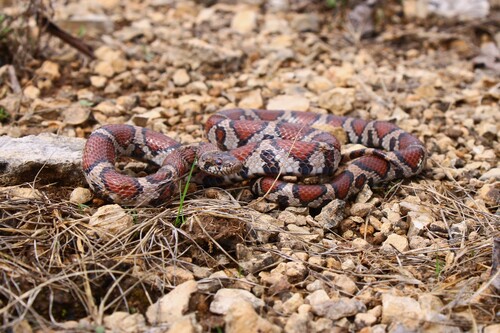 Eastern MilksnakeLampropeltis triangulum
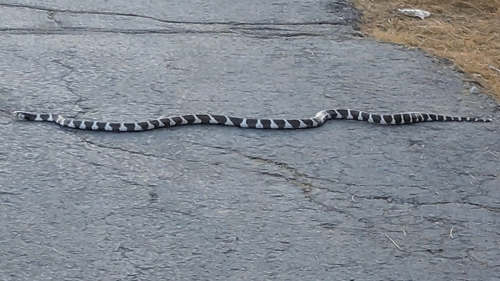 California King SnakeLampropeltis californiae
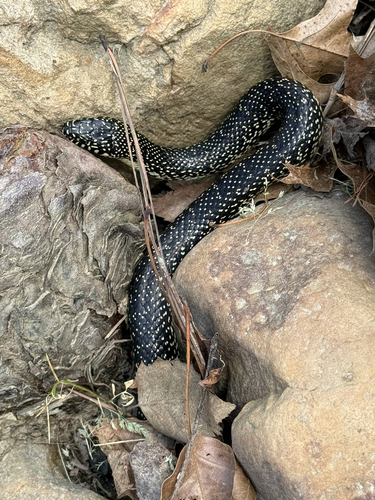 Speckled KingsnakeLampropeltis holbrooki
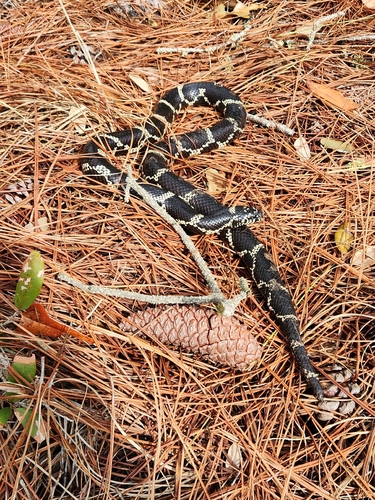 Eastern KingsnakeLampropeltis getula
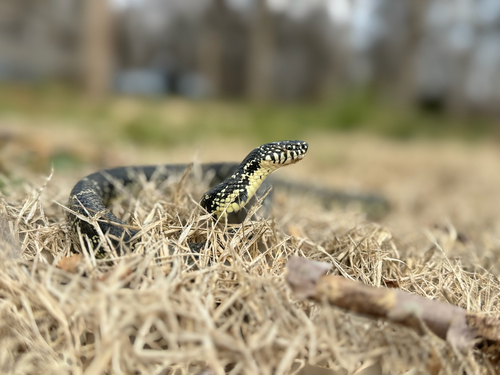 Black KingsnakeLampropeltis nigra
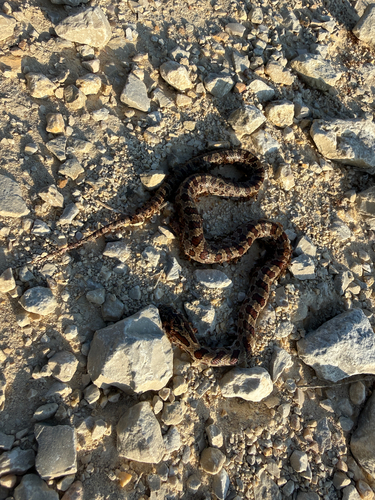 Prairie KingsnakeLampropeltis calligaster
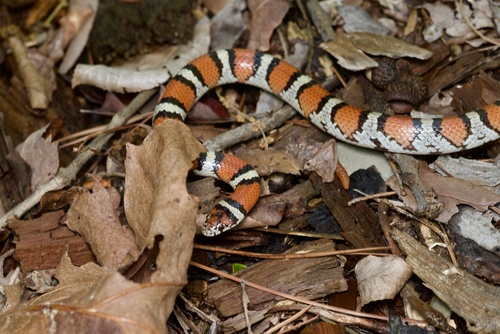 Western MilksnakeLampropeltis gentilis
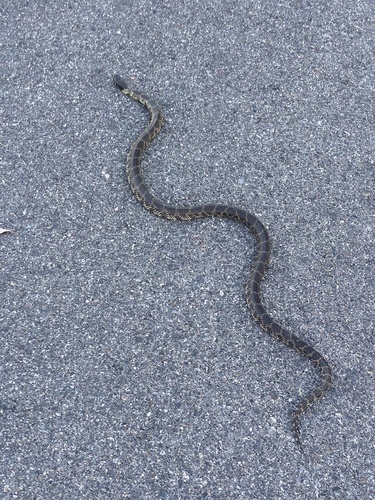 Desert KingsnakeLampropeltis splendida
Classification
How scientists group this snake, from the broadest category down to the exact species. Each step narrows to its closest relatives.
- OrderThe broad group of scaled reptiles: all snakes and lizards
- Squamata
- FamilyA group of related snakes that share key traits
- Colubridae
- GenusA close-knit group of very similar species
- Lampropeltis
- SpeciesThis exact snake, named in the two-part scientific name
- Lampropeltis mexicana
Keep learning
- What to Do If You Find a SnakeFound a snake at home or on a trail? Here is how to stay calm, give it space, identify it safely, and know when to call a professional.
- Venomous vs Nonvenomous: How to Tell the DifferenceThe folk rules for telling venomous snakes apart, where each one fails, and why location-based identification beats guessing by sight.
- What Is a Snake? Anatomy and the BasicsA clear overview of what makes a snake a snake: limbless body plan, anatomy, evolution from lizards, species diversity, and why they are ectothermic.
- How to Keep Snakes Out of Your Yard and HomeA practical guide to keeping snakes out of your yard and home using habitat changes that work, plus what to skip and what to do if one shows up.
Distribution from GBIF & iNaturalist. Venom status per CDC. Background: Wikipedia. Informational only. Never handle a snake to identify it.