
Colubridae
Red Whip Snake
HarmlessPlatyceps collaris
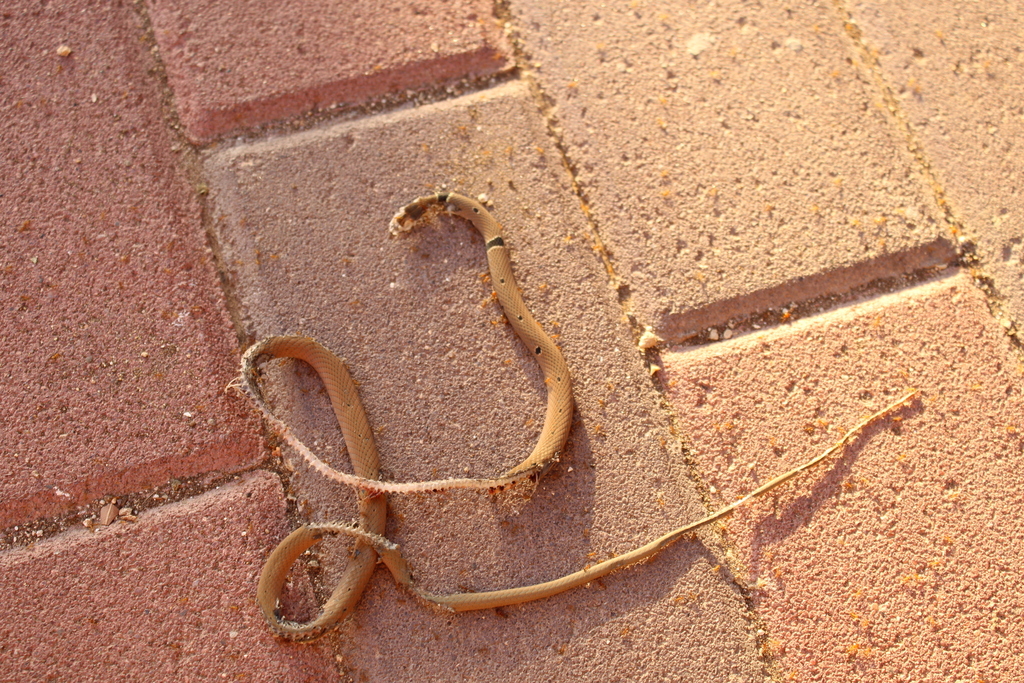
The Red Whip Snake (Platyceps collaris) is a non-venomous snake in the Colubridae family, recorded in 9 countries.
- Family
- Colubridae
About the Red Whip Snake
The red whip snake or collared dwarf racer (Platyceps collaris) is a species of snake in the family Colubridae. Native to the Middle East, its natural habitats are Mediterranean-type shrubby vegetation, rocky areas, arable land, pastureland, plantations, and rural gardens.
Description
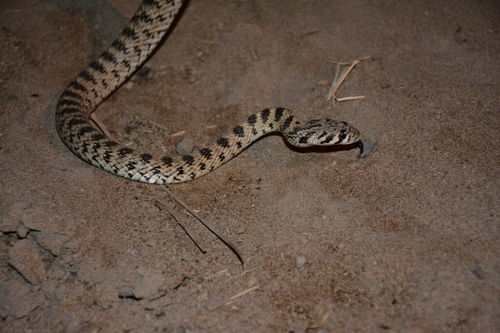
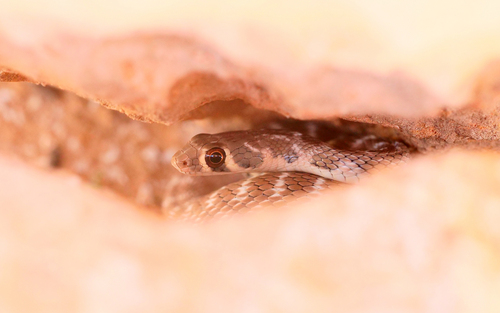
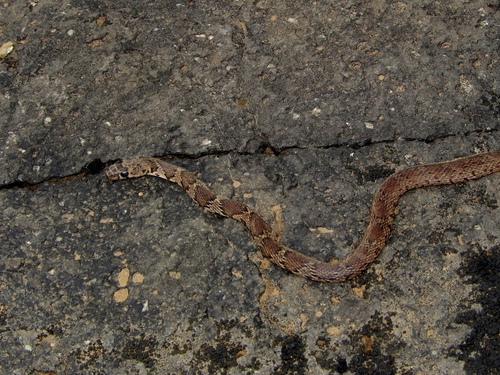
The red whip snake is a slender, long-tailed snake that grows to a length of 70 cm (28 in) in Europe but up to 100 cm (39 in) in the eastern part of its range in Asia. It closely resembles Dahl's whip snake but differs in having a smaller, flatter head. The upper surface is reddish-brown or reddish grey, with a dark band with pale margins on the neck and scattered, smaller dark bands with pale rims on the fore-parts, these markings being more widely spaced than those of Dahl's whip snake. Another distinguishing feature is the fact that the scales on the belly of that species have a keel on each side whereas the belly scales on the red whip snake do not. The eye is surrounded by a ring of pale skin and the area of skin in front of and behind this is dark. The underparts are whitish-yellow.
Distribution and habitat
The red whip snake is native to Bulgaria, Israel, Jordan, Lebanon, Palestinian Territory, Syria, and Turkey. It is typically found on dry rocky areas such as coastal plains with low scrub, bushes and other vegetation. It is also found on agricultural land and in gardens, and its altitudinal range is from sea level up to 1,500 metres (4,900 ft).
Behaviour
The red whip snake is a diurnal species. It can move very rapidly, running at prey and grabbing it with its jaws. It feeds mostly on lizards, with large insects supplementing the diet. Females lay clutches of three to five cylindrical eggs 25 to 30 mm (1.0 to 1.2 in) long and 8 to 9 mm (0.3 to 0.4 in) wide.
Status
The International Union for Conservation of Nature has listed the red whip snake as being of least conservation concern. This is on the basis that the population trend is steady, the snake has a large total population spread out over a wide range, it is common in many areas and tolerates some degree of habitat modification. It does not seem to face any particular threats although in some areas it is persecuted by humans.
Adapted from Wikipedia, available under CC BY-SA.
Frequently asked: Red Whip Snake
- Is the Red Whip Snake venomous?
- No. The Red Whip Snake (Platyceps collaris) is non-venomous and is not considered dangerous to humans. Like most snakes, it will retreat rather than bite when given the chance.
- Is the Red Whip Snake poisonous?
- Snakes are venomous, not poisonous. "Poisonous" means harmful to eat or touch; "venomous" means injecting toxins through a bite. The Red Whip Snake is neither poisonous nor venomous.
- Is the Red Whip Snake dangerous?
- The Red Whip Snake is not dangerous to humans. It has no medically significant venom and bites only defensively if cornered or handled.
- Where does the Red Whip Snake live?
- The Red Whip Snake has verified records in 9 countries, including Israel, Türkiye, Bulgaria. See the distribution section below for its full range.
Where it is found
More Colubridae snakes
Classification
How scientists group this snake, from the broadest category down to the exact species. Each step narrows to its closest relatives.
- OrderThe broad group of scaled reptiles: all snakes and lizards
- Squamata
- FamilyA group of related snakes that share key traits
- Colubridae
- GenusA close-knit group of very similar species
- Platyceps
- SpeciesThis exact snake, named in the two-part scientific name
- Platyceps collaris
Keep learning
- What to Do If You Find a SnakeFound a snake at home or on a trail? Here is how to stay calm, give it space, identify it safely, and know when to call a professional.
- Venomous vs Nonvenomous: How to Tell the DifferenceThe folk rules for telling venomous snakes apart, where each one fails, and why location-based identification beats guessing by sight.
- What Is a Snake? Anatomy and the BasicsA clear overview of what makes a snake a snake: limbless body plan, anatomy, evolution from lizards, species diversity, and why they are ectothermic.
- How to Keep Snakes Out of Your Yard and HomeA practical guide to keeping snakes out of your yard and home using habitat changes that work, plus what to skip and what to do if one shows up.
Distribution from GBIF & iNaturalist. Venom status per CDC. Background: Wikipedia. Informational only. Never handle a snake to identify it.