
Mud / Rainbow snake
Mudsnake
HarmlessFarancia abacura
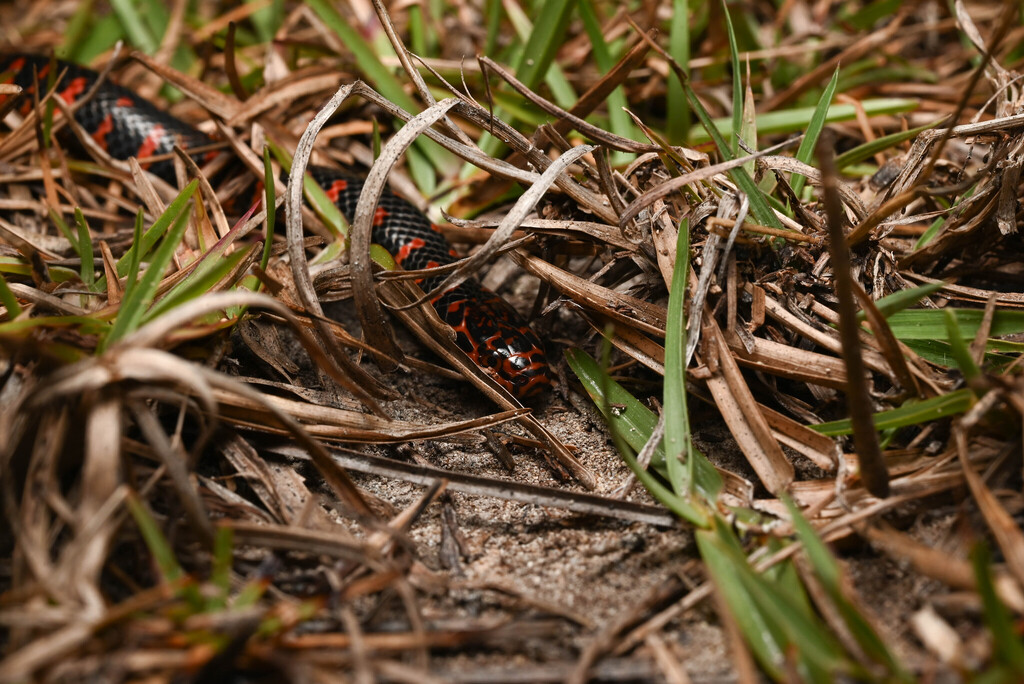
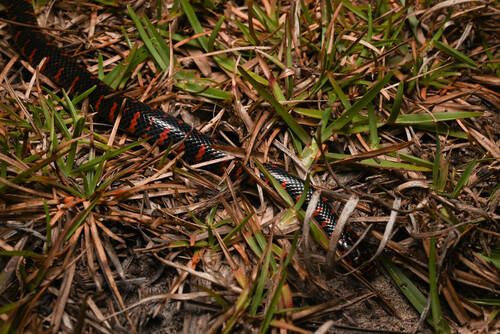
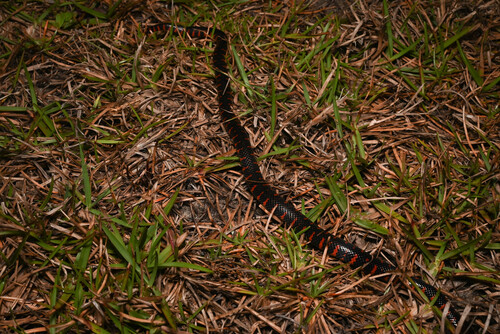
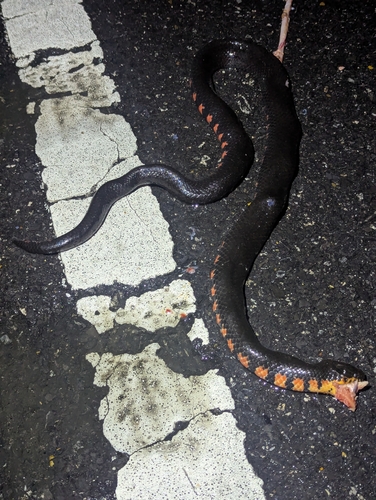
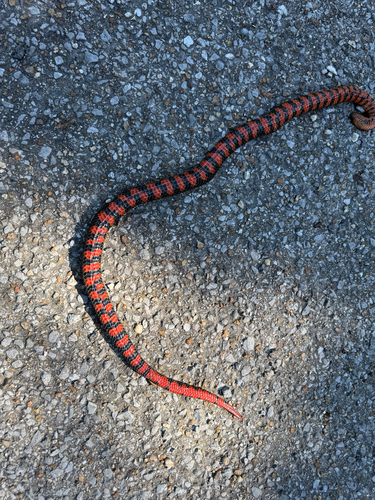
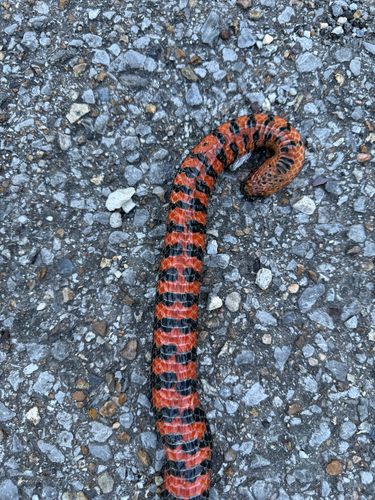
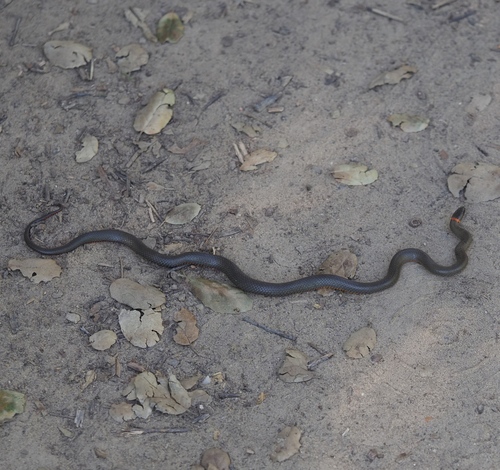
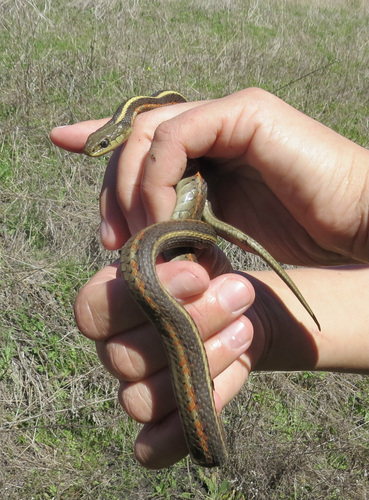
6 photographs of the Mudsnake. © Anders Hastings.
The Mudsnake (Farancia abacura) is a non-venomous snake in the Colubridae family, recorded in 1 country.
- Also called
- Mud / Rainbow snake
- Family
- Colubridae
- Size
- Large and aquatic, 3–5+ ft.
- Habitat
- Swamps, blackwater rivers, and marshes.
- Behavior
- Highly aquatic and secretive; harmless.
- Identify
- Glossy, smooth body — mud snakes are black with red bars; rainbow snakes have red stripes.
About the Mudsnake
The mud snake (Farancia abacura) is a species of nonvenomous, semiaquatic, colubrid snake endemic to the southeastern United States.
Description
The mud snake usually grows to a total length (including tail) of 40 to 54 inches (1-1.4 m), with the record total length being slightly over 80 inches (2 m).
This species is sexually dimorphic in size. Female adults are larger than males in total length.
The upperside of the mud snake is glossy black. The underside is red and black, and the red extends up the sides to form bars of reddish-pink, although some have a completely black body with slightly lighter black spots instead of the common reddish colors.
The heavy body is cylindrical in cross section, and the short tail has a terminal spine.
The head scalation is distinctive in that there is only one internasal scale, no preocular scale, and one anterior temporal scale. The dorsal scales are smooth, and are arranged in 19 rows at midbody. There are 168–208 ventral scales and 31–55 subcaudal scales. The anal plate is divided.
Farancia abacura is the only species that belongs to the Farancia genus, with two different subspecies within itself.
Subspecies
There are two recognized subspecies of Farancia abacura, including the nominotypical subspecies:
Farancia abacura abacura (Holbrook, 1836) – eastern mud snake
Farancia abacura reinwardtii (Schlegel, 1837) – western mud snake
Geographic range
The mud snake is found in the southeastern United States, in the states of Alabama, Arkansas, Florida, Georgia, Illinois, Kentucky, Louisiana, Mississippi, Missouri, North Carolina, Oklahoma, South Carolina, Tennessee, Texas, and Virginia.
Habitat
F. abacura inhabits the edges of streams and cypress swamps, among dense vegetation or under ground debris, using wet conditions to burrow itself into the mud. It is almost fully aquatic and rarely leaves the water, except to lay eggs, hibernate, or during drought to escape drying wetlands. After heavy rain fall, its home range may increase to take advantage of new food sources. It occupies aquatic habitats with freshwater or brackish waters. For hibernation, they commonly use cavities in soil or old tree stumps.
Behavior
The mud snake is mostly aquatic and nocturnal. It preys mostly on giant aquatic salamanders in the genera Siren and Amphiuma, but it also eats other amphibians.
They are known to use their sharply pointed tails to prod prey items, leading to the nickname "stinging snake", although their tail is not a stinger and cannot sting. Enlarged teeth occur at the rear of the upper jaw, which presumably help to hold slippery prey. Upon being disturbed, mud snakes will sometimes tuck their head beneath their coils and expose the red underside on the tail as a warning display.
Reproduction
Adapted from Wikipedia, available under CC BY-SA.
Frequently asked: Mudsnake
- Is the Mudsnake venomous?
- No. The Mudsnake (Farancia abacura) is non-venomous and is not considered dangerous to humans. Like most snakes, it will retreat rather than bite when given the chance.
- Is the Mudsnake poisonous?
- Snakes are venomous, not poisonous. "Poisonous" means harmful to eat or touch; "venomous" means injecting toxins through a bite. The Mudsnake is neither poisonous nor venomous.
- Is the Mudsnake dangerous?
- The Mudsnake is not dangerous to humans. It has no medically significant venom and bites only defensively if cornered or handled.
- Where does the Mudsnake live?
- The Mudsnake has verified records in 1 country, including United States of America. See the distribution section below for its full range.
- How do I identify the Mudsnake?
- Glossy, smooth body — mud snakes are black with red bars; rainbow snakes have red stripes.
- How big does the Mudsnake get?
- Large and aquatic, 3–5+ ft.
Where it is found
More Colubridae snakes
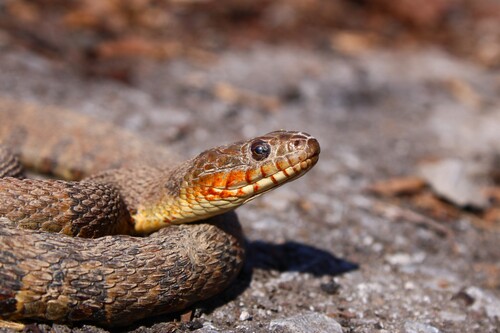
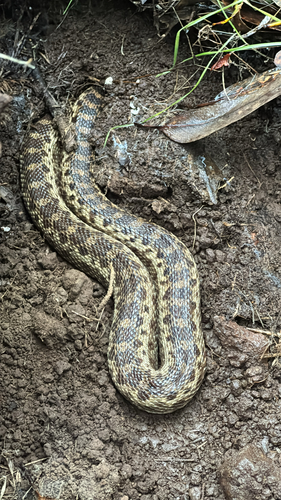
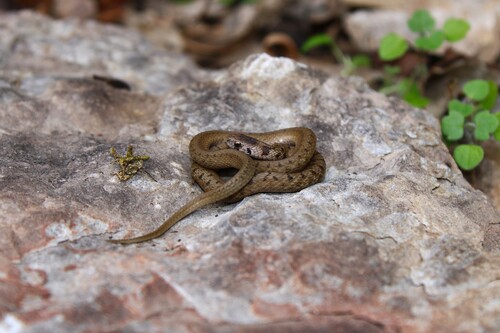
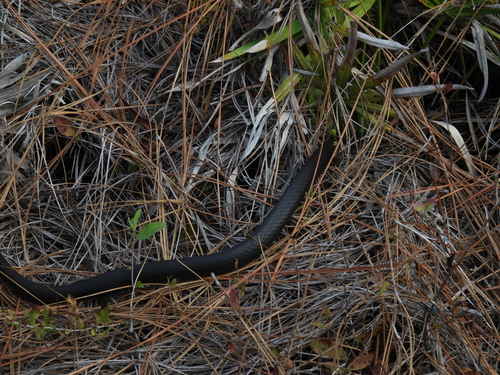
Classification
How scientists group this snake, from the broadest category down to the exact species. Each step narrows to its closest relatives.
- OrderThe broad group of scaled reptiles: all snakes and lizards
- Squamata
- FamilyA group of related snakes that share key traits
- Colubridae
- GenusA close-knit group of very similar species
- Farancia
- SpeciesThis exact snake, named in the two-part scientific name
- Farancia abacura
Keep learning
- What to Do If You Find a SnakeFound a snake at home or on a trail? Here is how to stay calm, give it space, identify it safely, and know when to call a professional.
- Venomous vs Nonvenomous: How to Tell the DifferenceThe folk rules for telling venomous snakes apart, where each one fails, and why location-based identification beats guessing by sight.
- What Is a Snake? Anatomy and the BasicsA clear overview of what makes a snake a snake: limbless body plan, anatomy, evolution from lizards, species diversity, and why they are ectothermic.
- How to Keep Snakes Out of Your Yard and HomeA practical guide to keeping snakes out of your yard and home using habitat changes that work, plus what to skip and what to do if one shows up.
Distribution from GBIF & iNaturalist. Venom status per CDC. Background: Wikipedia. Informational only. Never handle a snake to identify it.