
Genus · Colubridae
Types of mudsnakes
2 species make up the genus Farancia, the snakes commonly called mudsnakes. None are considered dangerous to humans.
About mud and rainbow snakes
Two glossy, semi-aquatic snakes of the American Southeast that live hidden in mud and feed on slippery, eel-like prey.
Farancia is a small genus in the large family Colubridae, the same family that holds most of North America's harmless snakes. It contains just two species: the Mud Snake (Farancia abacura) and the Rainbow Snake (Farancia erytrogramma). Both are heavy-bodied, smooth-scaled, semi-aquatic snakes restricted to the southeastern United States, where they favor swamps, cypress sloughs, blackwater streams, and the muddy margins of slow water. They spend much of their lives burrowed in soft soil or submerged vegetation, so they are rarely seen despite being locally common.
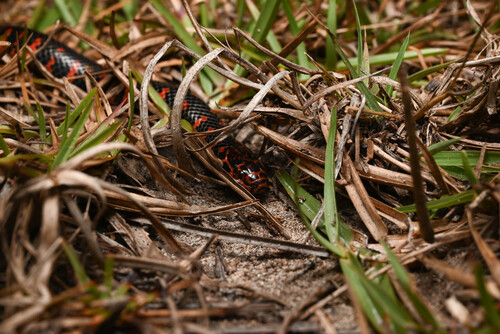
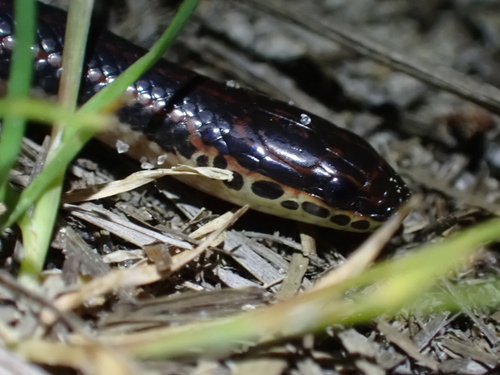
Members are easy to recognize by their glossy, almost iridescent scales and bold ventral color. The Mud Snake is black above with a red or pink checkerboard pattern running up its sides from the belly, and it has a hard, spine-like tip on its tail that gave rise to the harmless folk name hoop snake. The Rainbow Snake is one of the most striking snakes on the continent, with three red stripes running the length of a dark, glossy body over a colorful belly. Both are highly specialized feeders: Mud Snakes eat aquatic salamanders, especially amphiumas and sirens, while Rainbow Snakes feed largely on American eels. Like many colubrids they lay eggs, and females may stay with the clutch in a burrow until hatching.
Both Farancia species are nonvenomous and harmless to people. They are docile and almost never bite, relying on burrowing and hiding rather than defense, and the pointed tail tip of the Mud Snake cannot sting or injure. There is no medical danger from these snakes. As with any wild animal, the responsible practice is to observe and not handle, and to leave them undisturbed in their wetland habitat. If a genuine snakebite emergency of any kind occurs, contact emergency services or US Poison Control at 1-800-222-1222.
Farancia belongs to the Colubridae family (Colubrids). The largest snake family, and the one most snakes you meet belong to. Typically round pupils, a head only slightly wider than the neck, and no heat-sensing facial pit or rattle. Scales may be smooth and glossy or keeled and matte depending on the species.
Danger: Almost all colubrids are harmless. A small number are rear-fanged with medically significant venom, the boomslang and the twig (vine) snakes of Africa being the dangerous exceptions. Most colubrids will flee or bluff rather than bite.
All species (2)
Keep learning
- What Is a Snake? Anatomy and the BasicsA clear overview of what makes a snake a snake: limbless body plan, anatomy, evolution from lizards, species diversity, and why they are ectothermic.
- How Snakes Move, Hunt, and EatHow snakes move without legs, hunt as ambushers or active foragers, kill by constriction or venom, and swallow prey wider than their head.
- What Do Snakes Eat?All snakes are carnivores. Learn what snakes eat, how diet changes with size and age, how often they feed, and how they hunt and swallow prey.
- Venomous vs Nonvenomous: How to Tell the DifferenceThe folk rules for telling venomous snakes apart, where each one fails, and why location-based identification beats guessing by sight.