
Indigo snake
Eastern Indigo Snake
HarmlessDrymarchon couperi
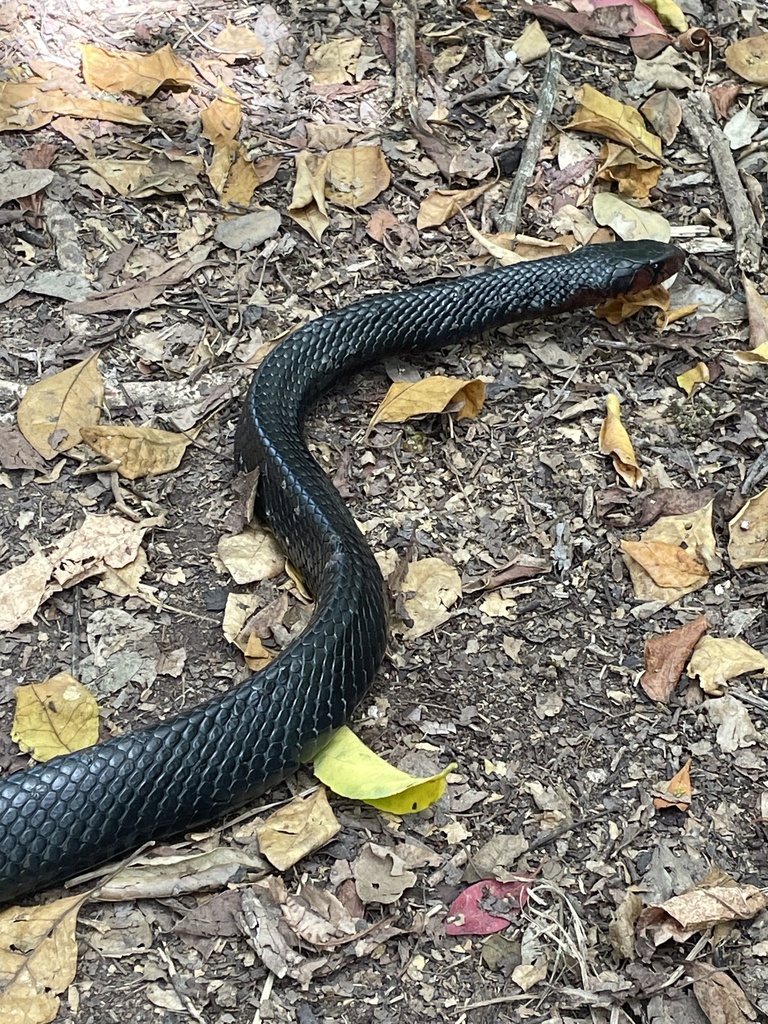
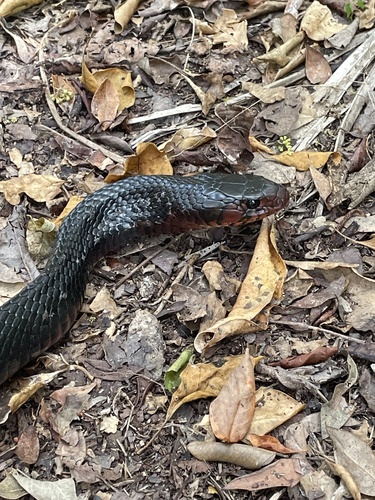
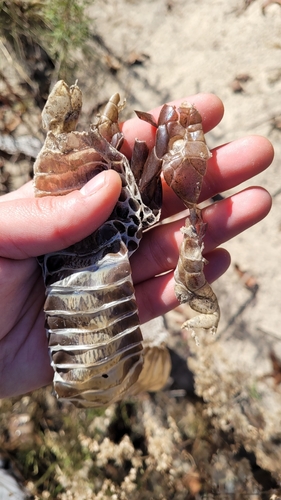
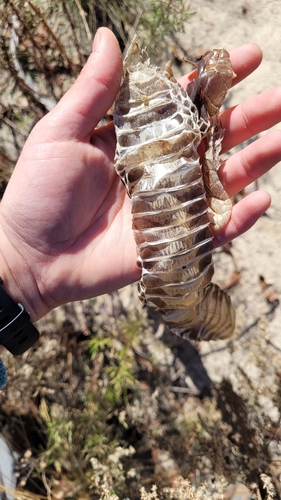
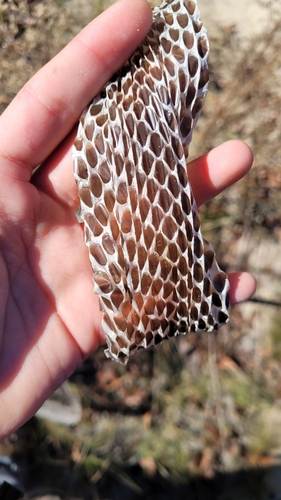
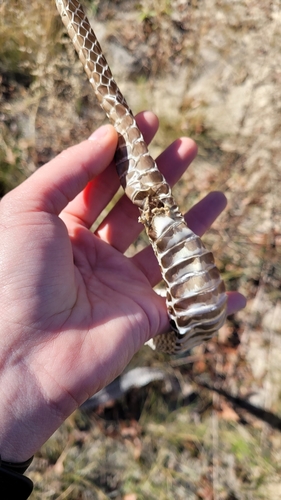
6 photographs of the Eastern Indigo Snake. © Jacqueline Raiford.
The Eastern Indigo Snake (Drymarchon couperi) is a non-venomous snake in the Colubridae family, recorded in 4 countries.
- Also called
- Indigo snake
- Family
- Colubridae
- Size
- Very large, up to 8+ ft — the longest native U.S. snake.
- Habitat
- Sandhills, scrub, and pine flatwoods.
- Behavior
- Day-active and non-venomous; eats other snakes, including venomous ones. Federally protected in parts of its range.
- Identify
- Glossy blue-black body, often with a reddish chin.
About the Eastern Indigo Snake
The eastern indigo snake (Drymarchon couperi) is a species of large, nonvenomous snake in the subfamily Colubrinae of the family Colubridae. Native to the Southeastern United States, it is the longest native snake species in the country.
Taxonomy and etymology
Taxonomy
The eastern indigo snake was first described by John Edwards Holbrook in 1842. For many years, the genus Drymarchon was considered monotypic with one species, Drymarchon corais, with 12 subspecies, until the early 1990s, when Drymarchon corais couperi was elevated to full species status according to the Society for the Study of Amphibians and Reptiles, in their official names list.
Etymology
The generic name, Drymarchon, roughly translates to "lord of the forest". It is composed of the Greek words drymos (Δρυμός), meaning "forest", and archon (ἄρχων), meaning "lord" or "ruler".
The specific name is a latinization of the surname of American planter James Hamilton Couper (1794–1866). Couper brought Holbrook the type specimen from south of the Altamaha River in Wayne County, Georgia.
Common names
Drymarchon couperi has a number of common names, including black snake, blue bull snake, blue gopher snake, blue indigo snake, eastern indigo snake, and indigo snake.
Description
The eastern indigo snake has uniformly blue-black dorsal scales, with some specimens having a reddish-orange to tan color on the throat, cheeks, and chin. This snake received its common name from the glossy, iridescent dorsal and ventral scales which can be seen as blackish-purple in bright light. This smooth-scaled snake is considered to be the longest native snake species in the United States. The longest recorded specimen measured 2.8 m (9.2 ft) in total length (tail included). Unlike many snakes, mature male indigo snakes are slightly larger than females. This is thought to be due to intraspecies competition and combat among males. A typical mature male measures 1.2–2.36 m (3.9–7.7 ft) in total length, with a reported average of 1.58 m (5.2 ft), and weighs 0.72–4.5 kg (1.6–9.9 lb), reportedly averaging 2.2 kg (4.9 lb). Males that measure longer than 1.2 m (4 ft) tend to possess weak keels on mid-dorsal scale rows 3–5, while females lack this characteristic. Mature females typically measure around 1.1–2 m (3.6–6.6 ft) in total length, averaging 1.38 m (4.5 ft), and weigh 0.55–2.7 kg (1.2–6.0 lb), averaging 1.5 kg (3.3 lb). Specimens over 2.6 m (8.5 ft) can weigh up to 5 kg (11 lb). Although the eastern indigo snake is similar in average body mass, extremely large specimens of the bulky, sympatric venomous eastern diamondback rattlesnake can outweigh it.
Geographic distribution
The eastern indigo snake inhabits areas from Florida to the southern areas of Georgia and Alabama. Studies in Georgia showed that the most indigo snake sightings happen within the Tufton Upland region of the Coastal Plain especially in the sand ridges. Their historic range extended into Louisiana, Mississippi, and South Carolina. A related species, the Texas indigo snake (Drymarchon melanurus erebennus), is found in southern Texas and Mexico.
Conservation status
Adapted from Wikipedia, available under CC BY-SA.
Frequently asked: Eastern Indigo Snake
- Is the Eastern Indigo Snake venomous?
- No. The Eastern Indigo Snake (Drymarchon couperi) is non-venomous and is not considered dangerous to humans. Like most snakes, it will retreat rather than bite when given the chance.
- Is the Eastern Indigo Snake poisonous?
- Snakes are venomous, not poisonous. "Poisonous" means harmful to eat or touch; "venomous" means injecting toxins through a bite. The Eastern Indigo Snake is neither poisonous nor venomous.
- Is the Eastern Indigo Snake dangerous?
- The Eastern Indigo Snake is not dangerous to humans. It has no medically significant venom and bites only defensively if cornered or handled.
- Where does the Eastern Indigo Snake live?
- The Eastern Indigo Snake has verified records in 4 countries, including United States of America, Mexico, Venezuela (Bolivarian Republic of). See the distribution section below for its full range.
- How do I identify the Eastern Indigo Snake?
- Glossy blue-black body, often with a reddish chin.
- How big does the Eastern Indigo Snake get?
- Very large, up to 8+ ft — the longest native U.S. snake.
Where it is found
More Colubridae snakes
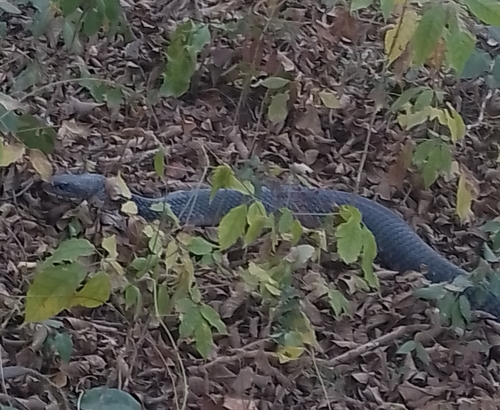 Central American Indigo SnakeDrymarchon melanurus
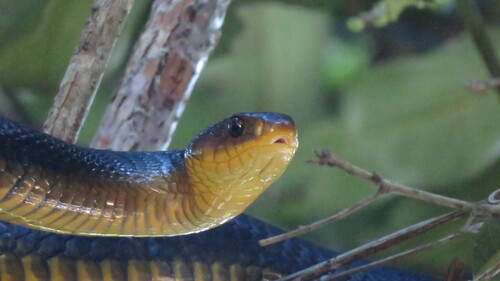 Yellow-tailed Indigo SnakeDrymarchon corais
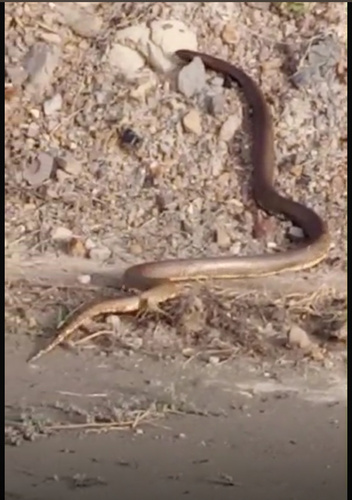 Falcon indigo snakeDrymarchon caudomaculatus
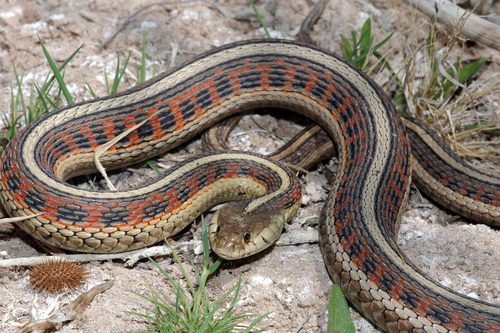 Common Garter SnakeThamnophis sirtalis
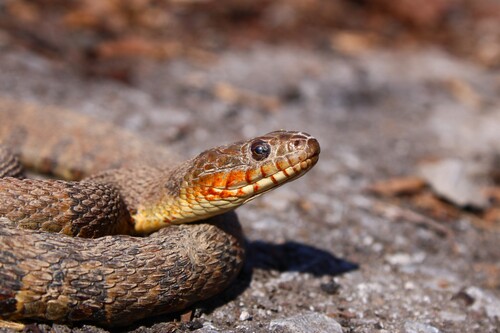 Common WatersnakeNerodia sipedon
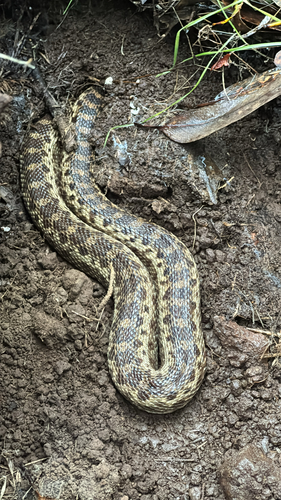 Gopher SnakePituophis catenifer
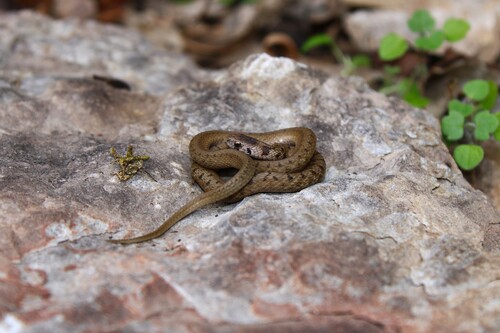 DeKay's BrownsnakeStoreria dekayi
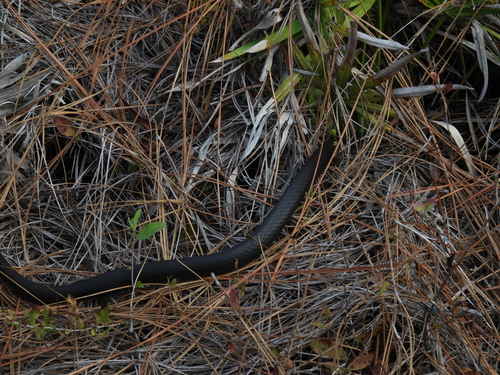 North American RacerColuber constrictor
Classification
How scientists group this snake, from the broadest category down to the exact species. Each step narrows to its closest relatives.
- OrderThe broad group of scaled reptiles: all snakes and lizards
- Squamata
- FamilyA group of related snakes that share key traits
- Colubridae
- GenusA close-knit group of very similar species
- Drymarchon
- SpeciesThis exact snake, named in the two-part scientific name
- Drymarchon couperi
Keep learning
- What to Do If You Find a SnakeFound a snake at home or on a trail? Here is how to stay calm, give it space, identify it safely, and know when to call a professional.
- Venomous vs Nonvenomous: How to Tell the DifferenceThe folk rules for telling venomous snakes apart, where each one fails, and why location-based identification beats guessing by sight.
- What Is a Snake? Anatomy and the BasicsA clear overview of what makes a snake a snake: limbless body plan, anatomy, evolution from lizards, species diversity, and why they are ectothermic.
- How to Keep Snakes Out of Your Yard and HomeA practical guide to keeping snakes out of your yard and home using habitat changes that work, plus what to skip and what to do if one shows up.
Distribution from GBIF & iNaturalist. Venom status per CDC. Background: Wikipedia. Informational only. Never handle a snake to identify it.