
Elapidae
Yellow-faced Whipsnake
VenomousDemansia psammophis
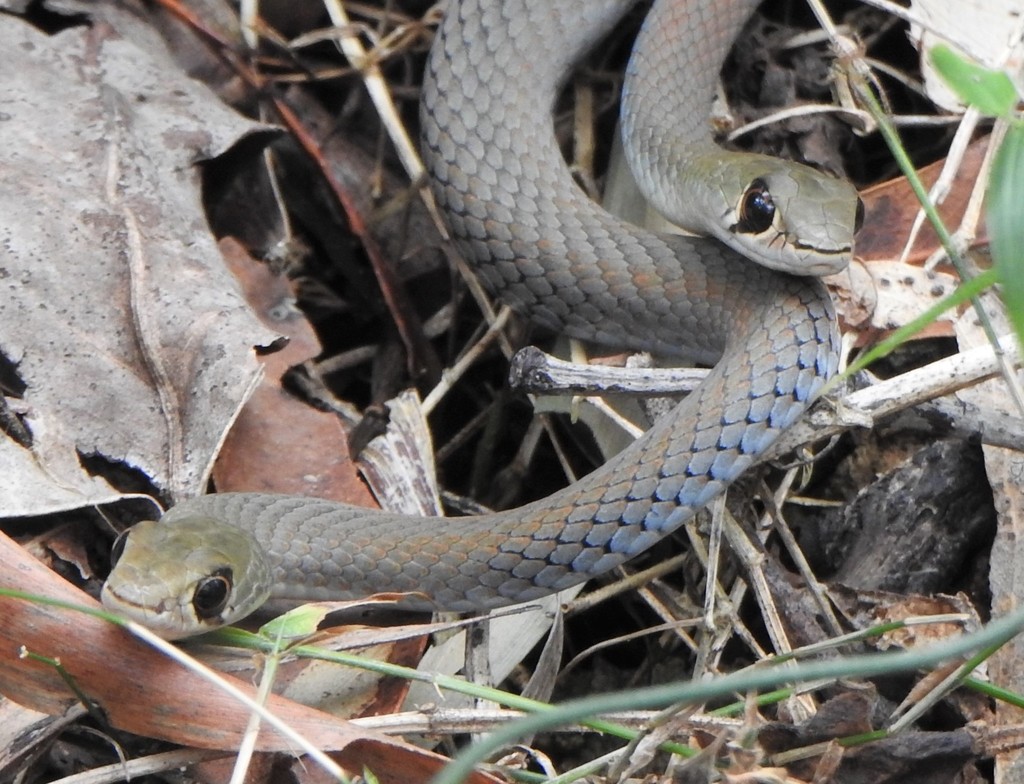
The Yellow-faced Whipsnake (Demansia psammophis) is a venomous snake in the Elapidae family, recorded in 4 countries.
If you are bitten
This is a venomous snake. Treat any bite as a medical emergency: stay calm, keep the bitten limb still and roughly level with the heart, remove rings and tight clothing, and get to emergency care immediately. Do not apply a tourniquet, cut the wound, apply ice, or try to suck out venom. Call your local emergency number or poison center.
- Family
- Elapidae
- Danger
- high
About the Yellow-faced Whipsnake
The yellow-faced whip snake (Demansia psammophis) is a species of venomous snake in the family Elapidae, a family containing many dangerous snakes. D. psammophis is endemic to Australia, found throughout the continent in a variety of habitats from coastal fringes to interior arid scrubland.
Taxonomy
The yellow-faced whip snake is part of the genus Demansia, a group of venomous snakes in the family Elapidae. This genus is composed of whip snakes, characterized by their large eyes and whip-like tail. The genus Demansia is commonly found in the Southern hemisphere around Australia and equatorial countries such as Papua New Guinea. 15 species are assigned to the genus Demansia.
Description
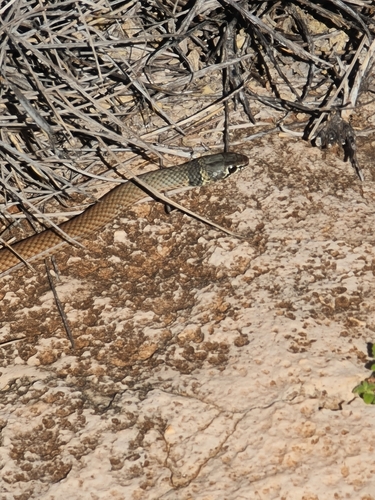
D. psammophis is a thin snake with a narrow head. It grows up to a total length (tail included) of 1 m (39 in), averaging around 80 cm (31 in), females being slightly smaller than males. Characterized by its narrow yellowish head, pale ring around the eyes, and a dark marking curving along the upper lip, D. psammophis becomes distinguishable from other Demansia snakes. Juveniles can be distinguished as a white-edged dark line is seen across the snout. The large prominent eyes surrounded by a pale ring, account for its ability to be a successful diurnal species, having the largest eyes of any Australian snake assisting in prey capture. The colour of the yellow-faced whip snake varies, ranging from olive green, to grey and brown; however, a common characteristic in colour is a "red flush along the anterior third of its back".
To accurately identify this species, there must be a clear view of the head, and the dorsal scales at the snake's mid-body must be counted. D. psammophis has 15 mid-body dorsal scale rows and 165–230 ventrals, with the anal and subcaudals divided. D. psammophis is commonly confused with the eastern brown snake (Pseudonaja textilis), due to their similar appearance.
Distribution and habitat
D. psammophis is distributed throughout the Australian continent, with presence in every state except Tasmania. Although the distribution of D. psammophis is wide, it is endemic to Australia.
Found in a variety of habitats across Australia, D. psammophis ranges from coastal forests to arid scrublands and grasslands in Australia's interior.
It is not uncommon to find more than one D. psammophis as they are community dwellers. Habitats in rock crevices and under logs are common community habitats with communities often aggregating in winter months.
Behaviour
D. psammophis is a diurnal reptile, fast-moving with a nervous disposition, always alert and fleeing quickly when disturbed. The yellow-faced whip snake is subject to brumation, or slowing down its movements, in the winter months, usually only moving to seek sun and water.
Reproduction
Adapted from Wikipedia, available under CC BY-SA.
Local and regional names
The Yellow-faced Whipsnake is known by these names across the regions where it lives:
- Czech
- pakobra štíhlá
- Danish
- Gulmasket Piskegiftsnog
- English
- Yellow-Faced Whip Snake, Yellow-faced Whip-Snake
- German
- Gelbkopf-Peitschenschlange
- Italian
- Serpente a frusta faccia gialla
- Russian
- Коричневая демансия, Песчаная коричневая змея
Frequently asked: Yellow-faced Whipsnake
- Is the Yellow-faced Whipsnake venomous?
- Yes. The Yellow-faced Whipsnake (Demansia psammophis) is venomous and belongs to the Elapidae family (cobra, mamba, coral or sea snake). Its bite is considered high risk to people. Treat any bite as a medical emergency.
- Is the Yellow-faced Whipsnake poisonous?
- Snakes are venomous, not poisonous. "Poisonous" means harmful to eat or touch; "venomous" means injecting toxins through a bite. The Yellow-faced Whipsnake is venomous, delivering venom through a bite.
- Is the Yellow-faced Whipsnake dangerous?
- This is a venomous snake. Treat any bite as a medical emergency: stay calm, keep the bitten limb still and roughly level with the heart, remove rings and tight clothing, and get to emergency care immediately. Do not apply a tourniquet, cut the wound, apply ice, or try to suck out venom. Call your local emergency number or poison center.
- Where does the Yellow-faced Whipsnake live?
- The Yellow-faced Whipsnake has verified records in 4 countries, including Australia, Papua New Guinea, Fiji. See the distribution section below for its full range.
- What does the Yellow-faced Whipsnake eat?
- Small diurnal lizards, and lizard eggs are the main source of food for D. psammophis. Although diurnal, it forages during the night, catching nocturnal forms such as geckos, lerista, and frogs.
If you are bitten by the Yellow-faced Whipsnake
Do
- Get away from the snake and stay calm. Most bites worsen when people panic or try again to handle the snake.
- Call 911 or Poison Control (1-800-222-1222) right away. Antivenom works best when given early.
- Note the time of the bite and, from a safe distance, the snake's color and pattern, a phone photo is enough. Do not chase it.
- Keep the bitten limb still and at roughly heart level. Sit or lie down and limit movement.
- Remove rings, watches, and tight clothing near the bite before swelling starts.
- Gently wash the bite with soap and water and cover it with a clean, dry dressing.
Do not
- Do not cut the wound or try to suck out the venom.
- Do not apply a tourniquet or ice.
- Do not drink alcohol or caffeine.
- Do not take aspirin or ibuprofen, they can worsen bleeding. Acetaminophen is safer for pain.
- Do not try to catch or kill the snake. A dead snake can still bite by reflex.
First-aid guidance adapted from the U.S. Centers for Disease Control and Prevention (CDC NIOSH), Venomous Snakes. Educational only; always follow the instructions of emergency responders.
Where it is found
More Elapidae snakes
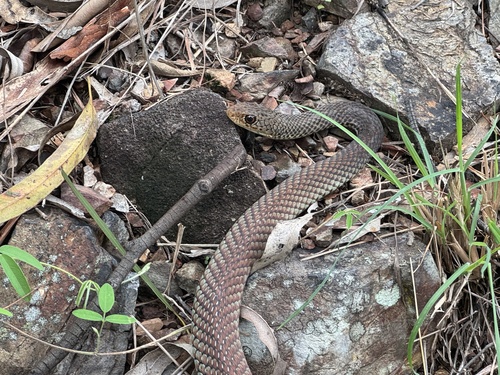 Lesser Black WhipsnakeDemansia vestigiata
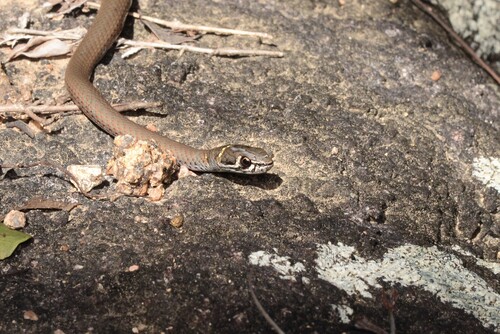 Collared WhipsnakeDemansia torquata
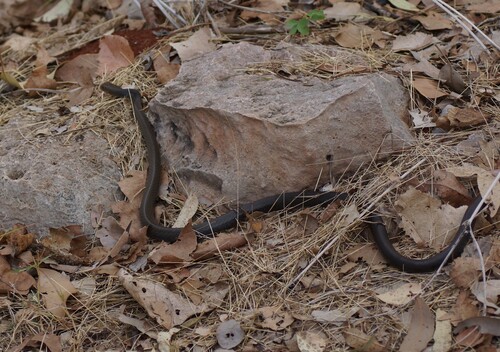 Greater Black WhipsnakeDemansia papuensis
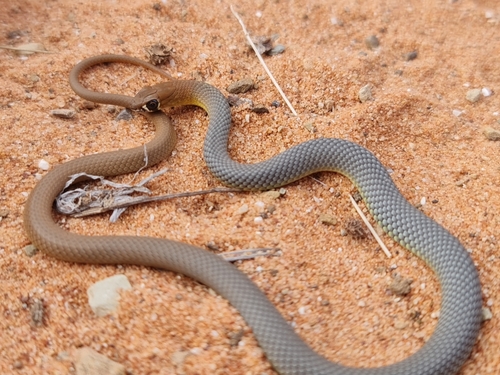 Central WhipsnakeDemansia cyanochasma
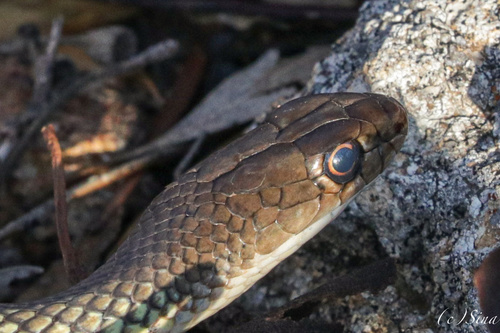 Reticulated WhipsnakeDemansia reticulata
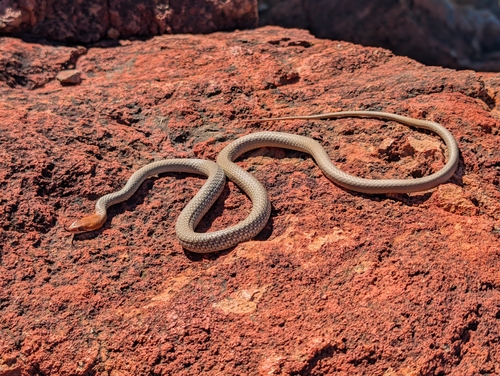 Sombre WhipsnakeDemansia quaesitor
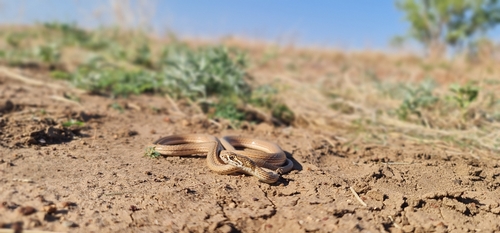 Crack-dwelling WhipsnakeDemansia rimicola
 Black-necked WhipsnakeDemansia calodera
Classification
How scientists group this snake, from the broadest category down to the exact species. Each step narrows to its closest relatives.
Keep learning
- Are Snakes Dangerous? The Real Risk, in PerspectiveMost snakes are harmless and avoid people. Here is the honest picture of snakebite risk worldwide and how to lower your own.
- Snakebite First Aid: What to Do (and What Never to Do)A clear, CDC-based guide to snakebite first aid: the steps that help, the popular myths that hurt, and how to tell a serious bite from a minor one.
- Venomous vs Nonvenomous: How to Tell the DifferenceThe folk rules for telling venomous snakes apart, where each one fails, and why location-based identification beats guessing by sight.
- What to Do If You Find a SnakeFound a snake at home or on a trail? Here is how to stay calm, give it space, identify it safely, and know when to call a professional.
Distribution from GBIF & iNaturalist. Venom status per CDC. Background: Wikipedia. Informational only. Never handle a snake to identify it.