
Psammophiidae
Western Sand Snake
HarmlessPsammophis trigrammus
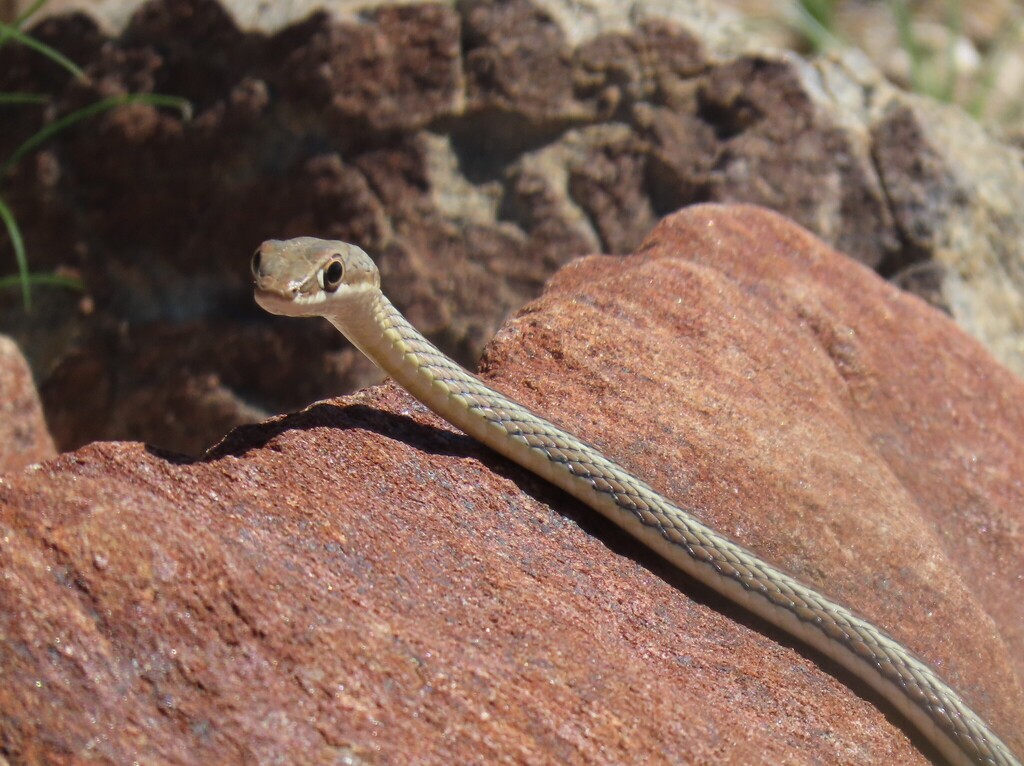
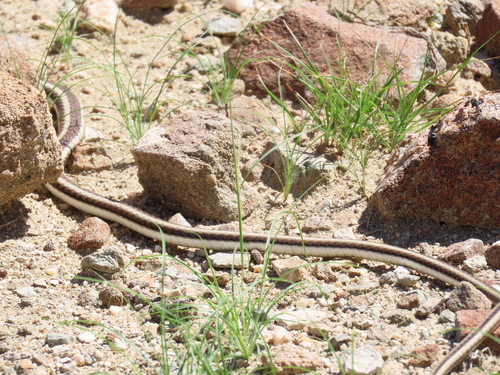
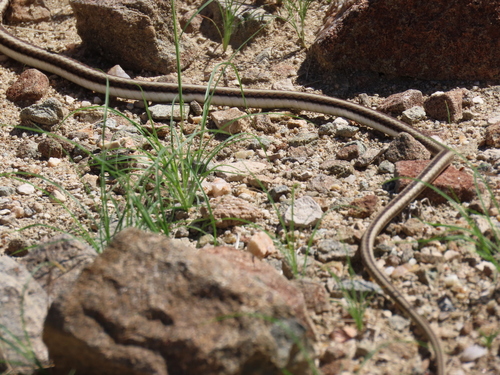
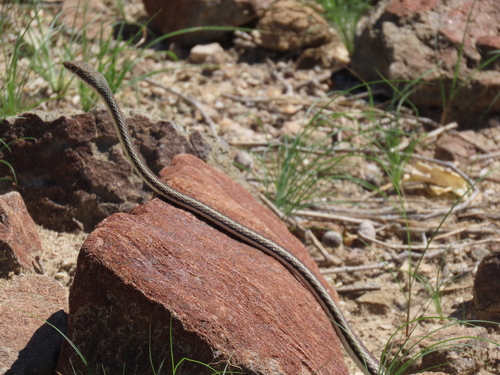
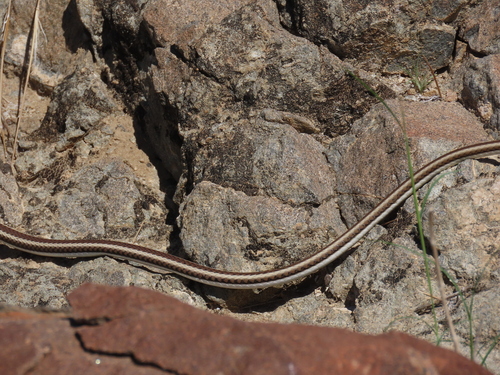
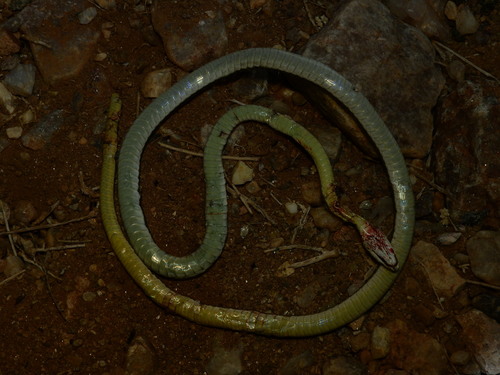
6 photographs of the Western Sand Snake. © Nogga_Eugene.
The Western Sand Snake (Psammophis trigrammus) is a rear-fanged, mildly venomous snake in the Psammophiidae family, recorded in 6 countries.
- Family
- Psammophiidae
About the Western Sand Snake
Psammophis trigrammus, the western sand snake, is a diurnal, terrestrial snake in the family Psammophiidae from southwestern Africa.
Description
Species of Psammophis are notorious for being slender and quick. Females are typically smaller and peak at a snout-vent length (SVL) of 540 mm, whereas males can reach a snout-vent length of up to 750 mm. It weighs 55 - 140 g (2 to 5 ounces), with males being smaller and lighter than females.
P. trigrammus has distinct coloration varying from pale olive to grey- brown along with a reddish to yellowish posterior. It is the Psammophis in southern Africa to have 9 supralabials and it has the highest ventral scale count of any southern African Psammophis.
In the genus Psammophis, the maxillary dentition consists of 10-13 teeth. One to two enlarged fang-like teeth are present near the middle of the maxilla, typically having an interspace, along with the posterior teeth being grooved. Within the mandible, the anterior teeth are elongated, while the posterior ones are smaller.
The head is demarcated from the neck and distinctly elongate, with a well-defined canthus rostralis. The eyes are relatively large with round pupils, the body is slender and cylindrical, covered in smooth dorsal scales arranged in 15 to 17 rows at midbody, bearing apical pits. The ventral scales are laterally rounded/ angulated. A long tail has subcaudal scales arranged in two rows.
Taxonomic history and etymology
Psammophis comes from two branches of the Greek language, combining Hellenistic ψαμμο, "sand" + Classical Greek ὄΦις, "snake", creating the common phrase association "sand-snake".
Psammophis trigrammus was described by Albert Günther in 1865. The type specimen is BMNH 1946.1.8.12, collected in Little Fish Bay in Angola during the European "scramble for Africa".
Geographic range
The species is found from southwestern Angola through western Namibia into northwestern South Africa (Namaqualand, on both sides of the Orange River). The habitat includes arid scrub and moist savanna.
Diet
P. trigrammus primarily feeds on lizards, rodents, and other small vertebrates. Prey are subdued using a combination of constriction and venom.
Venom
Although the western sand snake is a rear-fanged (opisthoglyphous) biologically-venomous snake, it poses no threat to humans due to its mild and relatively weak venom along with non-aggressive behavior.
Reproduction
All species in the genus Psammophis are oviparous. They engage in sexual reproduction, with the mating season typically occurring in spring, usually between April and May. Females lay up to 10 eggs. The average lifespan of the western whip snake is 10 years.
Habitat and behavior
The western sand snake is typically found in low bushes and arid areas. Refugia include cracks in rocky hillsides. They are diurnal and bask in the sun.
Adapted from Wikipedia, available under CC BY-SA.
Frequently asked: Western Sand Snake
- Is the Western Sand Snake venomous?
- The Western Sand Snake (Psammophis trigrammus) is rear-fanged and only mildly venomous. It is not considered dangerous to humans (its venom is weak and its fangs sit at the back of the mouth) but a bite can cause local swelling or irritation, so it should not be handled.
- Is the Western Sand Snake poisonous?
- Snakes are venomous, not poisonous. "Poisonous" means harmful to eat or touch; "venomous" means injecting toxins through a bite. The Western Sand Snake is neither poisonous nor venomous.
- Is the Western Sand Snake dangerous?
- The Western Sand Snake is not dangerous to humans. It has no medically significant venom and bites only defensively if cornered or handled.
- Where does the Western Sand Snake live?
- The Western Sand Snake has verified records in 6 countries, including Namibia, South Africa, Ghana. See the distribution section below for its full range.
- What does the Western Sand Snake eat?
- P. trigrammus primarily feeds on lizards, rodents, and other small vertebrates. Prey are subdued using a combination of constriction and venom.
- Why is it called the Western Sand Snake?
- Psammophis comes from two branches of the Greek language, combining Hellenistic ψαμμο, "sand" + Classical Greek ὄΦις, "snake", creating the common phrase association "sand-snake". Psammophis trigrammus was described by Albert Günther in 1865. The type specimen is BMNH 1946.1.8.12, collected in Little Fish Bay in Angola during the European "scramble for Africa".
Where it is found
More Psammophiidae snakes
 Stripe-bellied Sand SnakePsammophis subtaeniatus
 Karoo Sand SnakePsammophis notostictus
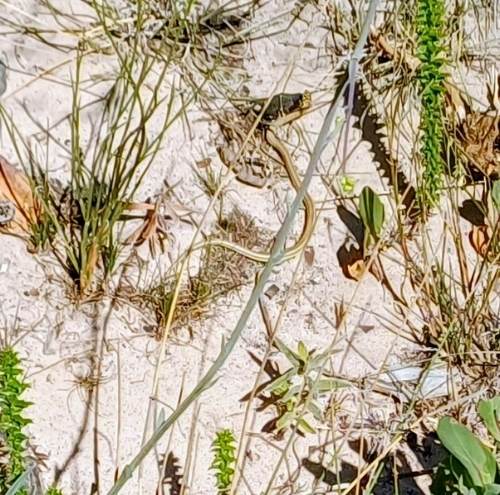 Cross-marked Sand SnakePsammophis crucifer
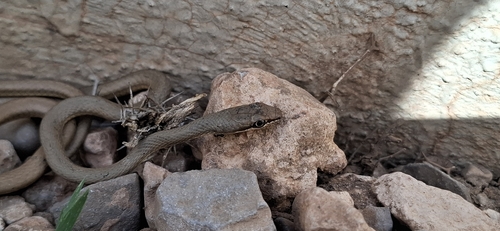 Forskal Sand SnakePsammophis schokari
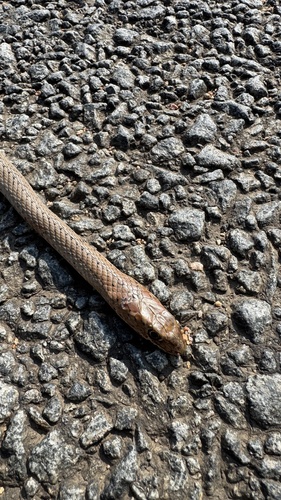 Olive Whip SnakePsammophis mossambicus
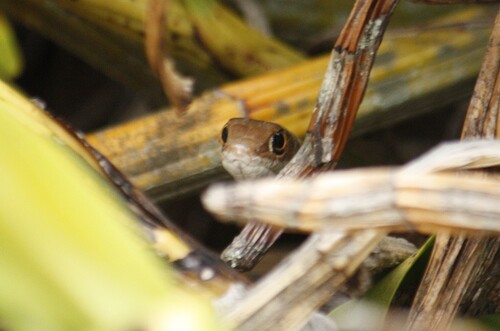 Short-snouted Whip SnakePsammophis brevirostris
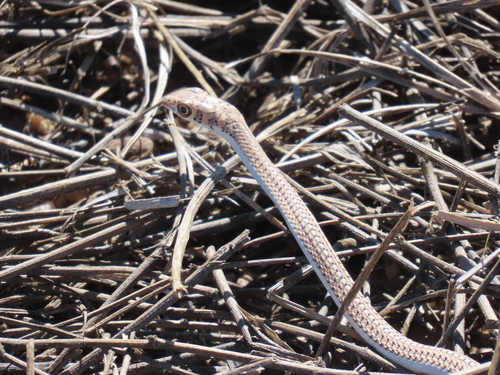 Cape Sand SnakePsammophis leightoni
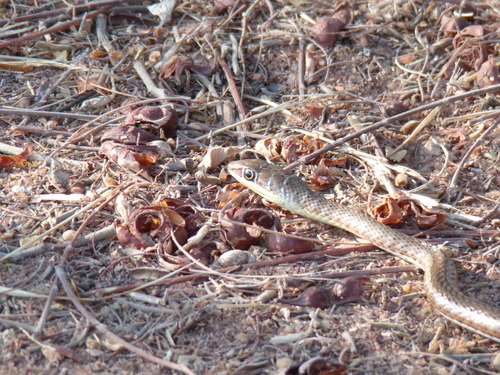 Eastern Stripe-bellied Sand SnakePsammophis orientalis
Classification
How scientists group this snake, from the broadest category down to the exact species. Each step narrows to its closest relatives.
- OrderThe broad group of scaled reptiles: all snakes and lizards
- Squamata
- FamilyA group of related snakes that share key traits
- Psammophiidae
- GenusA close-knit group of very similar species
- Psammophis
- SpeciesThis exact snake, named in the two-part scientific name
- Psammophis trigrammus
Keep learning
- What to Do If You Find a SnakeFound a snake at home or on a trail? Here is how to stay calm, give it space, identify it safely, and know when to call a professional.
- Venomous vs Nonvenomous: How to Tell the DifferenceThe folk rules for telling venomous snakes apart, where each one fails, and why location-based identification beats guessing by sight.
- What Is a Snake? Anatomy and the BasicsA clear overview of what makes a snake a snake: limbless body plan, anatomy, evolution from lizards, species diversity, and why they are ectothermic.
- How to Keep Snakes Out of Your Yard and HomeA practical guide to keeping snakes out of your yard and home using habitat changes that work, plus what to skip and what to do if one shows up.
Distribution from GBIF & iNaturalist. Venom status per CDC. Background: Wikipedia. Informational only. Never handle a snake to identify it.