
Colubridae
Vellore Bridal Snake
HarmlessLycodon nympha
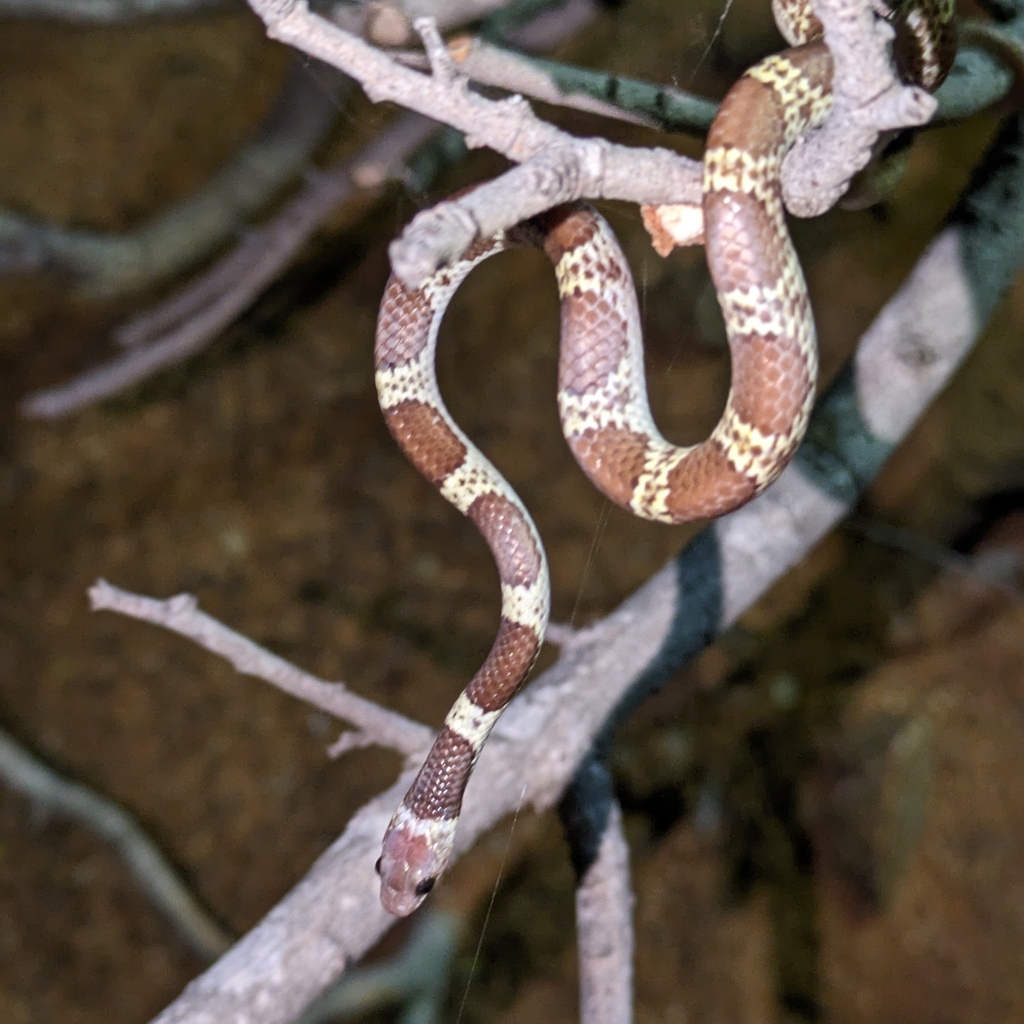
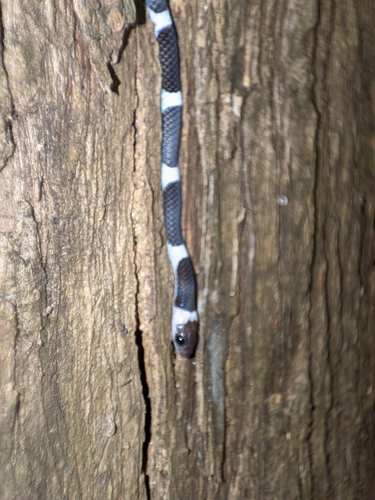
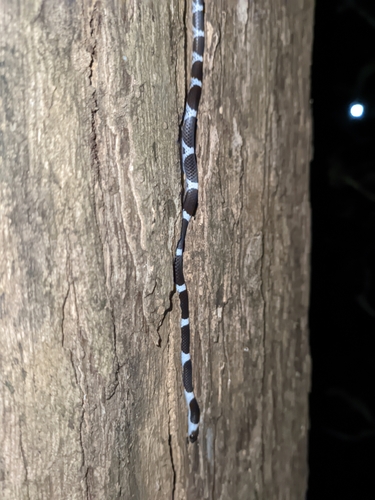
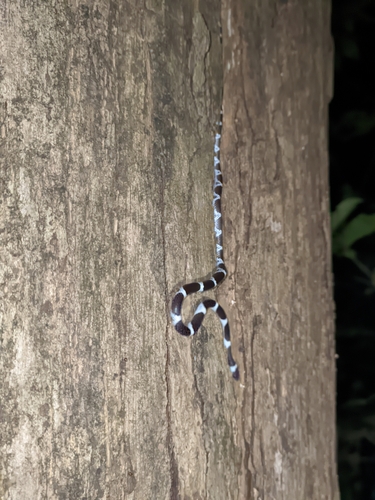
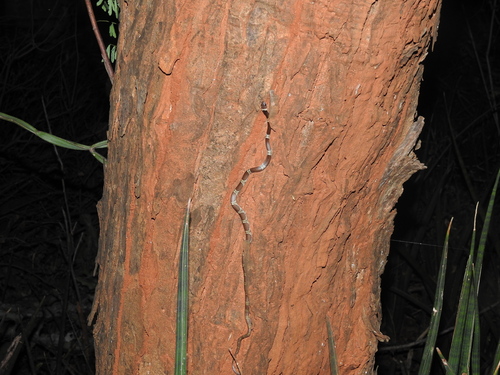
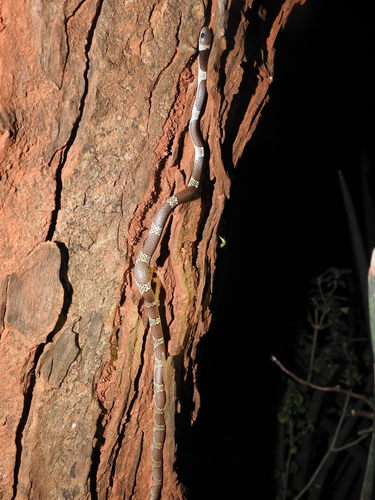
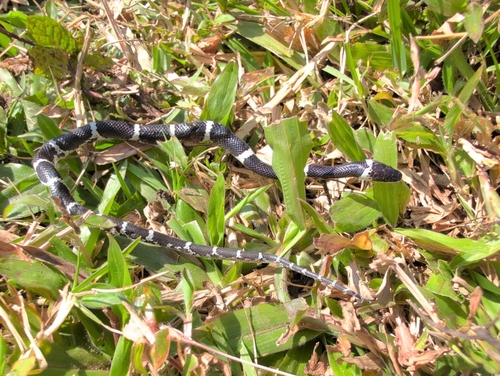
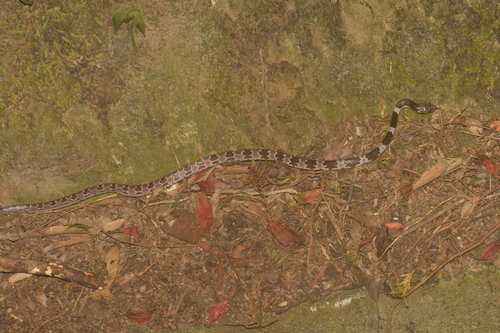
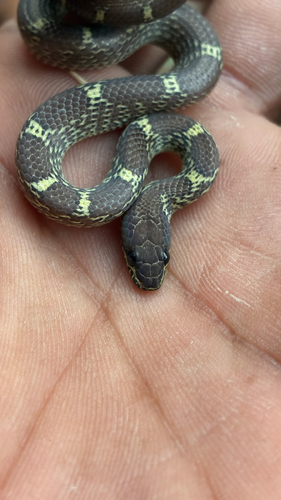
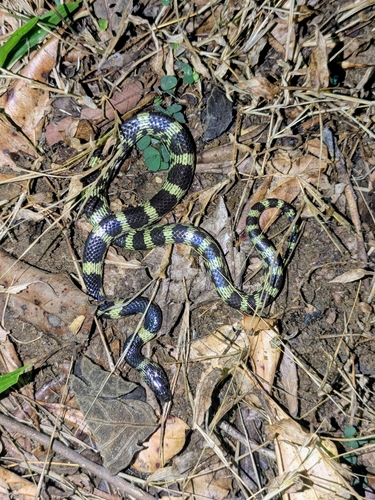
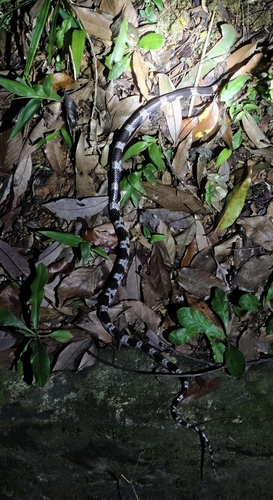
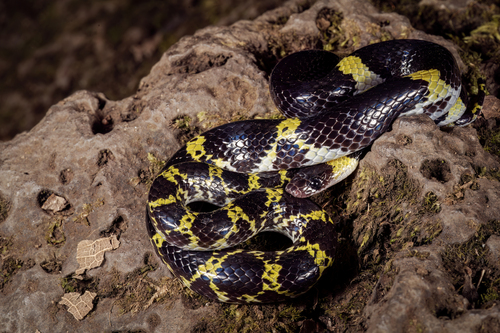
6 photographs of the Vellore Bridal Snake. © Paulmathi Vinod.
The Vellore Bridal Snake (Lycodon nympha) is a non-venomous snake in the Colubridae family, recorded in 3 countries.
- Family
- Colubridae
About the Vellore Bridal Snake
The Vellore bridal snake (Lycodon nympha) is a species of snake found in southern India and Sri Lanka. Bridal snakes are so named because of the characteristic yellow band behind the head, resembling a bridal veil.
Characteristics: A small snake with a glossy black or dark brown colouration. Its colouration may be accompanied by a series of irregular white or grey stripes. Its ventral area is creamy yellow. This snake has considerably large eyes with vertical pupils which are adaptations for its nocturnal lifestyle. It has a rounded snout and an oval shaped flat head.
Behaviour
A nocturnal snake which is very active and timid by nature. If cornered and provoked it will fiercely attack its challenger repeatedly. This snake has a tendency to enter human dwellings in search of prey. It is highly capable of climbing walls but has an equal tendency to fall off, often onto unsuspecting human occupants with catastrophic results.
Feeds mainly on lizards but may consume frogs and other small fauna when the opportunity provides so.
Very little known due to the paucity of specimens. It is assumed to be oviparous.
Little known about its growth rate. The longest specimens seldom exceed 50 cm.
Non venomous
Identification
This snake has 13 rows of costals throughout its body and elongated Loreal shields that touch the eyes.
Rostral: Touches six shields. Frontal: Relatively small.
Supraoculars: Broad and prominent, each shield is nearly as big as the Frontal.
Parietals: Prominent and each shield is twice as bit as the Frontal.
Prefrontals: The combined system is nearly as large as the Frontal.
Nasals: Entire with the nostril situated at the centre. (Rarely may be divided)
Internasals: Span the entire length of the anterior edge of the Prefrontals.
Loreals: Elongated and touch the eyes.
Preoculars: Absent
Postoculars: Divided into two shields.
Temporals: Small and divided into two shields.
Supralabials: Seven pairs (Rarely six or eight) of which the third and fourth pairs touch the eyes.
Mental: Stereotype in form.
Infralabials: Five pairs of which the fifth is the largest.
Sublinguals: Anterior pair larger than the Posterior pair.
Costals: Fall into 13 rows that run throughout the entire length of the body.
Ventrals: 200 to 243
Anal Shield: Divided
Subcaudals: 65 to 88, divided
Dentition:
Maxillary: 9 to 10
Palatine: 8 to 9
Pterygoid: 20 to 21
Mandibular: 19 to 21
Distribution: Southern India and Sri Lanka
The range of this snake appears to extend from Jaffna in the north to Anuradhapura, and includes Trincomalee. This snake is rare throughout its range and has not been recorded in the central hills.
Adapted from Wikipedia, available under CC BY-SA.
Frequently asked: Vellore Bridal Snake
- Is the Vellore Bridal Snake venomous?
- No. The Vellore Bridal Snake (Lycodon nympha) is non-venomous and is not considered dangerous to humans. Like most snakes, it will retreat rather than bite when given the chance.
- Is the Vellore Bridal Snake poisonous?
- Snakes are venomous, not poisonous. "Poisonous" means harmful to eat or touch; "venomous" means injecting toxins through a bite. The Vellore Bridal Snake is neither poisonous nor venomous.
- Is the Vellore Bridal Snake dangerous?
- The Vellore Bridal Snake is not dangerous to humans. It has no medically significant venom and bites only defensively if cornered or handled.
- Where does the Vellore Bridal Snake live?
- The Vellore Bridal Snake has verified records in 3 countries, including India, Sri Lanka, Thailand. See the distribution section below for its full range.
Where it is found
More Colubridae snakes
Classification
How scientists group this snake, from the broadest category down to the exact species. Each step narrows to its closest relatives.
- OrderThe broad group of scaled reptiles: all snakes and lizards
- Squamata
- FamilyA group of related snakes that share key traits
- Colubridae
- GenusA close-knit group of very similar species
- Lycodon
- SpeciesThis exact snake, named in the two-part scientific name
- Lycodon nympha
Keep learning
- What to Do If You Find a SnakeFound a snake at home or on a trail? Here is how to stay calm, give it space, identify it safely, and know when to call a professional.
- Venomous vs Nonvenomous: How to Tell the DifferenceThe folk rules for telling venomous snakes apart, where each one fails, and why location-based identification beats guessing by sight.
- What Is a Snake? Anatomy and the BasicsA clear overview of what makes a snake a snake: limbless body plan, anatomy, evolution from lizards, species diversity, and why they are ectothermic.
- How to Keep Snakes Out of Your Yard and HomeA practical guide to keeping snakes out of your yard and home using habitat changes that work, plus what to skip and what to do if one shows up.
Distribution from GBIF & iNaturalist. Venom status per CDC. Background: Wikipedia. Informational only. Never handle a snake to identify it.