
Colubridae
Sri Lankan Flying Snake
HarmlessChrysopelea taprobanica
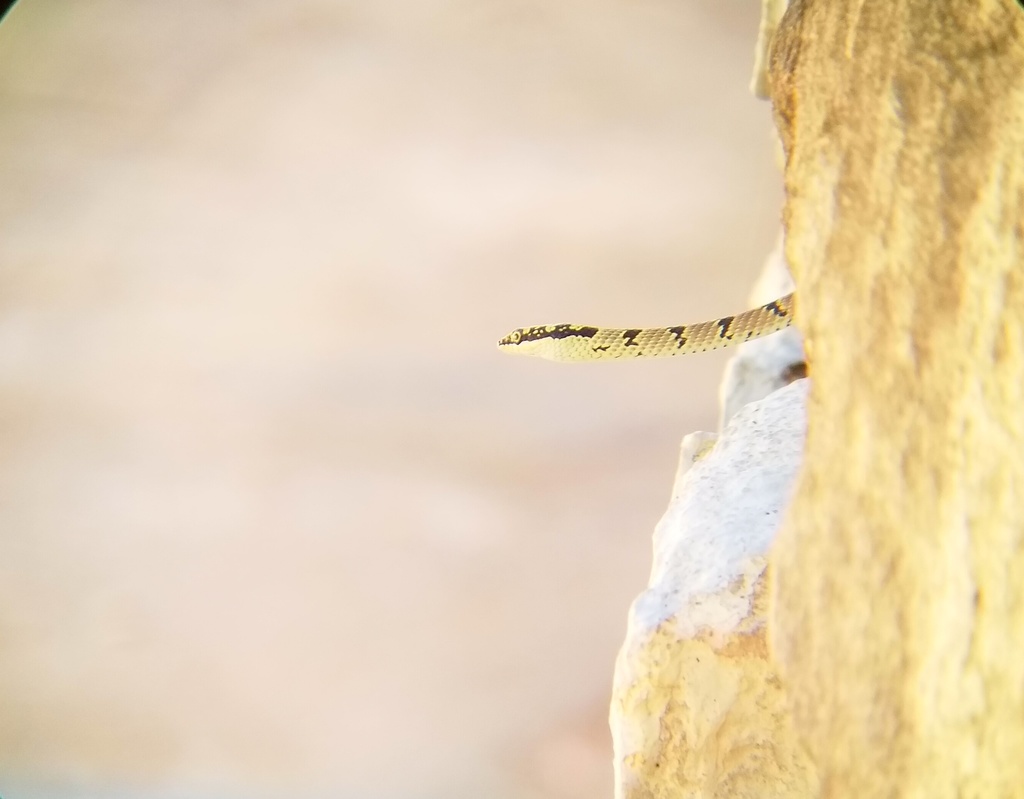
The Sri Lankan Flying Snake (Chrysopelea taprobanica) is a non-venomous snake in the Colubridae family, recorded in 2 countries.
- Family
- Colubridae
About the Sri Lankan Flying Snake
Chrysopelea taprobanica, the Sri Lankan flying snake or Indian flying snake, is a species of gliding colubrid snake distributed in India and Sri Lanka. It can glide, as with all species of its genus Chrysopelea, by stretching the body into a flattened strip using its ribs. The snake is known as "dangara dandaa - දඟරදන්ඩා" in Sinhala, due to its folding postures.
Taxonomy
Chrysopelea taprobanica belongs to the genus Chrysopelea, which contains four other described species.
Chrysopelea is one of five genera belonging to the vine snake subfamily Ahaetuliinae, of which Chrysopelea is most closely related to Dendrelaphis, as shown in the cladogram below:
Distribution
The Sri Lankan flying snake is distributed in Sri Lanka and Peninsular India. population in Sri Lanka can be found in dry zone lowlands and parts of the intermediate climatic zones, including Polonnaruwa, Wilpattu National Park, Sigiriya, Kurunegala, Jaffna, Trincomalee, and Monaragala. This species was believed to be endemic to Sri Lanka until researchers recorded a few specimens from Andhra Pradesh (India) and found old museum specimens collected from India that are now assigned to this species. More recently this species has been sighted in parts of Eastern Ghats in Tamil Nadu.
Description
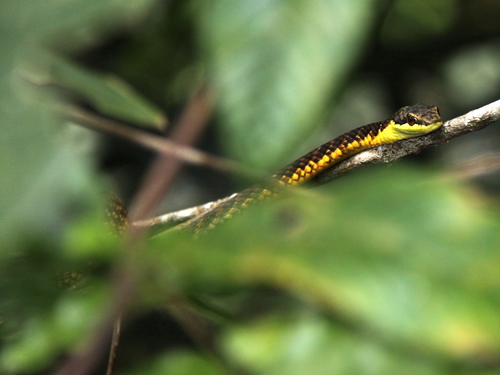
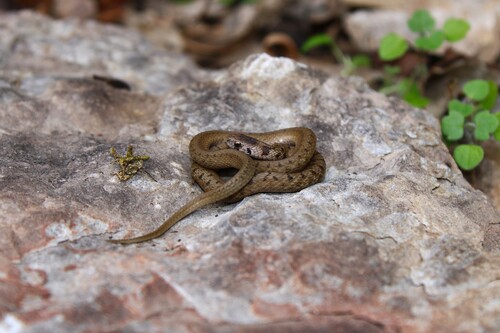
Chrysopelea taprobanica is a medium-sized snake, reaching 60–90 cm (24–35 in) length. The head is depressed. Eyes are large with round pupils. Ventral scales have keels laterally. Vertebral scales are not enlarged. Dorsal scales are smooth or feebly keeled. Dorsal side is greenish yellow or pale green. Orange to red spots can be seen between dark cross bands. Head is black dorsally with yellow and black cross-bars. Ventral side is pale green with a series of black lateral spots on each side.
Scalation
There are 198–214 ventral scales and 107–123 subcaudal scales.
Behavior
Ecology
The snake inhabits old growth trees, as well as secondary vegetation, cultivation, sometimes entering human dwellings. They are diurnal and arboreal.
Diet
Its diet consists mainly of lizards, such as geckos and agamids. Bats, rodents, birds and other small snakes may also be taken.
Reproduction
Chrysopelea taprobanica is oviparous.
Relationship with humans
Because this species is uncommon, arboreal, and prefers forests, it is rarely encountered by humans. One bite has been reliably documented, resulting in mild local effects only.
Adapted from Wikipedia, available under CC BY-SA.
Frequently asked: Sri Lankan Flying Snake
- Is the Sri Lankan Flying Snake venomous?
- No. The Sri Lankan Flying Snake (Chrysopelea taprobanica) is non-venomous and is not considered dangerous to humans. Like most snakes, it will retreat rather than bite when given the chance.
- Is the Sri Lankan Flying Snake poisonous?
- Snakes are venomous, not poisonous. "Poisonous" means harmful to eat or touch; "venomous" means injecting toxins through a bite. The Sri Lankan Flying Snake is neither poisonous nor venomous.
- Is the Sri Lankan Flying Snake dangerous?
- The Sri Lankan Flying Snake is not dangerous to humans. It has no medically significant venom and bites only defensively if cornered or handled.
- Where does the Sri Lankan Flying Snake live?
- The Sri Lankan Flying Snake has verified records in 2 countries, including Sri Lanka, India. See the distribution section below for its full range.
- What does the Sri Lankan Flying Snake eat?
- Its diet consists mainly of lizards, such as geckos and agamids. Bats, rodents, birds and other small snakes may also be taken.
Where it is found
More Colubridae snakes
Classification
How scientists group this snake, from the broadest category down to the exact species. Each step narrows to its closest relatives.
- OrderThe broad group of scaled reptiles: all snakes and lizards
- Squamata
- FamilyA group of related snakes that share key traits
- Colubridae
- GenusA close-knit group of very similar species
- Chrysopelea
- SpeciesThis exact snake, named in the two-part scientific name
- Chrysopelea taprobanica
Keep learning
- What to Do If You Find a SnakeFound a snake at home or on a trail? Here is how to stay calm, give it space, identify it safely, and know when to call a professional.
- Venomous vs Nonvenomous: How to Tell the DifferenceThe folk rules for telling venomous snakes apart, where each one fails, and why location-based identification beats guessing by sight.
- What Is a Snake? Anatomy and the BasicsA clear overview of what makes a snake a snake: limbless body plan, anatomy, evolution from lizards, species diversity, and why they are ectothermic.
- How to Keep Snakes Out of Your Yard and HomeA practical guide to keeping snakes out of your yard and home using habitat changes that work, plus what to skip and what to do if one shows up.
Distribution from GBIF & iNaturalist. Venom status per CDC. Background: Wikipedia. Informational only. Never handle a snake to identify it.