
Genus · Colubridae
Types of flying snakes
5 species make up the genus Chrysopelea, the snakes commonly called flying snakes. None are considered dangerous to humans.
About flying snakes
The gliding snakes of South and Southeast Asia that flatten their bodies and sail between trees.
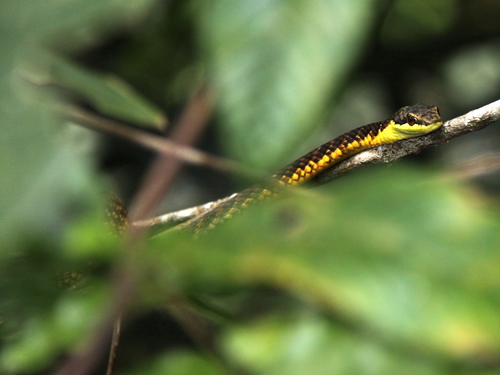
Chrysopelea is a small genus of colubrid snakes, the family Colubridae, famous for gliding. They are the so-called flying snakes. They do not have wings or true flight. Instead, a flying snake launches from a high branch, sucks in its belly, flattens its ribs to turn its round body into a wide, concave ribbon, and undulates through the air to control its descent and steer toward a landing point. This controlled glide is what sets the genus apart from nearly every other snake.
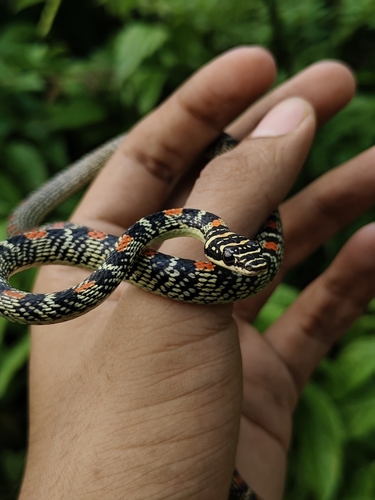
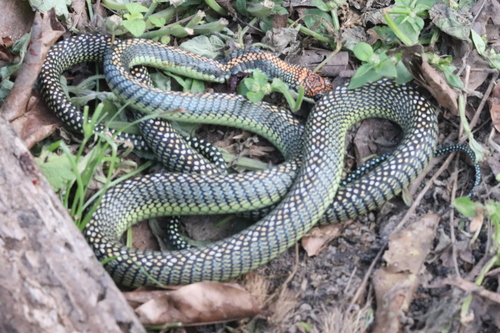
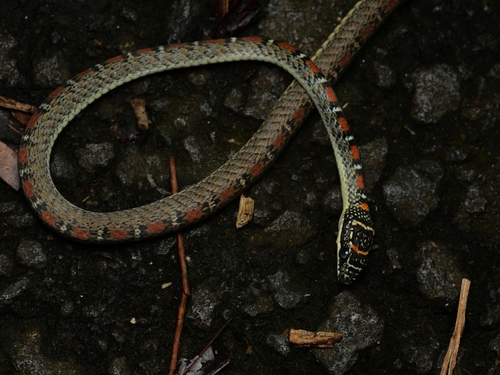
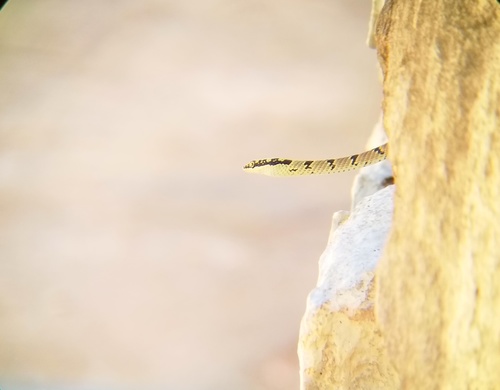
The genus contains roughly five recognized species. Well known members include the Golden Tree Snake, the Paradise Flying Snake, the Banded Flying Snake, and the Sri Lankan Flying Snake. As colubrids, they fit within the largest snake family, a group that holds the majority of the world's living snake species and that ranges enormously in size, color, and habit.
Flying snakes live across South and Southeast Asia, including India, Sri Lanka, southern China, and much of mainland and island Southeast Asia. They are arboreal, meaning tree dwelling, and are at home in forests, plantations, parks, and gardens, often near human settlements. In general terms they are slender, agile, large eyed snakes with bright or boldly patterned scales, frequently green, black, and yellow with red or orange markings, which helps separate them from heavier bodied ground snakes. Exact identification of a specific snake should be left to a qualified herpetologist or local expert.
These snakes are rear-fanged. They carry a mild venom delivered through enlarged teeth set toward the back of the upper jaw, which they use to subdue small prey. They are not considered dangerous to people, and bites are rare and typically cause only minor local effects. Even so, no wild snake should be handled. Misidentification is easy, a bite can still cause infection or a reaction, and you cannot be certain in the field what you are holding. If anyone is bitten by a snake, treat it as a medical matter, stay calm, keep the limb still, and contact emergency services or, in the United States, Poison Control at 1-800-222-1222.
Ecologically, flying snakes are active daytime hunters that prey on lizards, frogs, small birds, bats, and rodents, hunting through the canopy and dropping or gliding between trees to move and to escape threats. Like most colubrids they reproduce by laying eggs. Their gliding ability is unusual among snakes and has made the genus a long running subject of scientific study into how a limbless animal can shape its body to move through the air.
Chrysopelea belongs to the Colubridae family (Colubrids). The largest snake family, and the one most snakes you meet belong to. Typically round pupils, a head only slightly wider than the neck, and no heat-sensing facial pit or rattle. Scales may be smooth and glossy or keeled and matte depending on the species.
Danger: Almost all colubrids are harmless. A small number are rear-fanged with medically significant venom, the boomslang and the twig (vine) snakes of Africa being the dangerous exceptions. Most colubrids will flee or bluff rather than bite.
All species (5)
Keep learning
- What Is a Snake? Anatomy and the BasicsA clear overview of what makes a snake a snake: limbless body plan, anatomy, evolution from lizards, species diversity, and why they are ectothermic.
- How Snakes Move, Hunt, and EatHow snakes move without legs, hunt as ambushers or active foragers, kill by constriction or venom, and swallow prey wider than their head.
- What Do Snakes Eat?All snakes are carnivores. Learn what snakes eat, how diet changes with size and age, how often they feed, and how they hunt and swallow prey.
- Venomous vs Nonvenomous: How to Tell the DifferenceThe folk rules for telling venomous snakes apart, where each one fails, and why location-based identification beats guessing by sight.