
Kingsnake / Milksnake
Short-tailed Snake
HarmlessLampropeltis extenuata
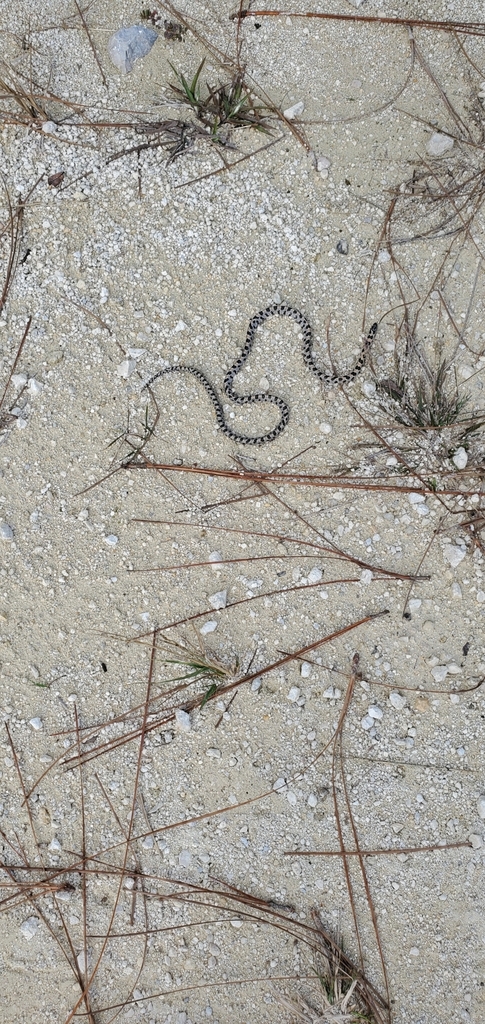
The Short-tailed Snake (Lampropeltis extenuata) is a non-venomous snake in the Colubridae family, recorded in 1 country.
- Also called
- Kingsnake / Milksnake
- Family
- Colubridae
- Size
- 2–5 ft.
- Habitat
- Forests, farmland, grasslands, and suburbs.
- Behavior
- Powerful constrictors that eat other snakes — including venomous ones; gentle but may musk or vibrate the tail.
- Identify
- Smooth, glossy scales with bold bands or chain-like patterns. Milksnakes mimic coral snakes, but red touches black.
About the Short-tailed Snake
The short-tailed snake (Lampropeltis extenuata) is a species of small harmless snake in the family Colubridae. Fossorial and seldom seen, the short-tailed snake is found only in sandy, upland parts of Florida where it is listed as "Threatened" and is protected by state law.
Etymology
The short-tailed snake's tail comprises less than ten percent of the snake's total length, hence the common name. Originally described and named by A. Erwin Brown in 1890 as Stilosoma extenuatum, its generic name was derived from the Greek stylos for "pillar" and soma for "body". This refers to the stiffness of the short-tailed snake's body, which is caused by its wide and inflexible column of unusually short vertebrae. The specific name, extenuata, is Latin for "thin" or "slender".
Description
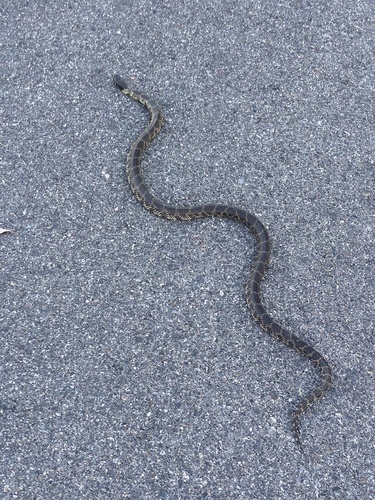
The short-tailed snake is a small serpent averaging 36–51 cm (14–20 in) in total length (tail included), with a record total length measurement of 65.4 cm (25+3⁄4 in), and is perhaps as thin as a pencil. It is gray above with 50 to 80 dark blotches and may or may not have a yellow stripe running down the spine. The underside is white with dark brown blotches. It bears a more-than-superficial resemblance to other kingsnakes, especially the mole kingsnake (Lampropeltis calligaster rhombomaculata), but can be distinguished by its smaller size and much more slender build. Also, Lampropeltis extenuatua has six upper labials, whereas other kingsnakes of the genus Lampropeltis have seven upper labials.
Behavior
The short-tailed snake is as poorly understood as it is seldom-seen, rare and geographically limited. It is a burrowing snake that rarely appears above ground and does so even more rarely during the day. Like other snakes of the tribe Lampropeltini, it vibrates its tail when startled by predators or people but can be distinguished from a rattlesnake by its slender build and lack of a rattle. An excitable snake, it makes a poor captive and is protected against harassment or captivity by Florida law. Despite this, much of what little we know about the short-tailed snake has been based on observations of captive specimens.
Diet
Captive specimens of Lampropeltis extenuata show a keen preference for black-crowned snakes of the genus Tantilla and will often eat them exclusively, rejecting other species of small snake or lizard. It is possible that black-crowned snakes, some of which are themselves small, burrowing snakes endemic to Florida, comprise the entire diet of wild short-tailed snakes. In the wild this species has been known to eat all of the aforementioned species as well as the Florida worm lizard (Rhineura floridana), a fossorial amphisbaenian that is endemic to Florida.
Geographic range
Adapted from Wikipedia, available under CC BY-SA.
Frequently asked: Short-tailed Snake
- Is the Short-tailed Snake venomous?
- No. The Short-tailed Snake (Lampropeltis extenuata) is non-venomous and is not considered dangerous to humans. Like most snakes, it will retreat rather than bite when given the chance.
- Is the Short-tailed Snake poisonous?
- Snakes are venomous, not poisonous. "Poisonous" means harmful to eat or touch; "venomous" means injecting toxins through a bite. The Short-tailed Snake is neither poisonous nor venomous.
- Is the Short-tailed Snake dangerous?
- The Short-tailed Snake is not dangerous to humans. It has no medically significant venom and bites only defensively if cornered or handled.
- Where does the Short-tailed Snake live?
- The Short-tailed Snake has verified records in 1 country, including United States of America. See the distribution section below for its full range.
- How do I identify the Short-tailed Snake?
- Smooth, glossy scales with bold bands or chain-like patterns. Milksnakes mimic coral snakes, but red touches black.
- How big does the Short-tailed Snake get?
- 2–5 ft.
- What does the Short-tailed Snake eat?
- Captive specimens of Lampropeltis extenuata show a keen preference for black-crowned snakes of the genus Tantilla and will often eat them exclusively, rejecting other species of small snake or lizard. It is possible that black-crowned snakes, some of which are themselves small, burrowing snakes endemic to Florida, comprise the entire diet of wild short-tailed snakes. In the wild this species has been known to eat all of the aforementioned species as well as the Florida worm lizard (Rhineura floridana), a fossorial amphisbaenian that is endemic to Florida.
- Why is it called the Short-tailed Snake?
- The short-tailed snake's tail comprises less than ten percent of the snake's total length, hence the common name. Originally described and named by A. Erwin Brown in 1890 as Stilosoma extenuatum, its generic name was derived from the Greek stylos for "pillar" and soma for "body". This refers to the stiffness of the short-tailed snake's body, which is caused by its wide and inflexible column of unusually short vertebrae. The specific name, extenuata, is Latin for "thin" or "slender".
Where it is found
By U.S. state
More Colubridae snakes
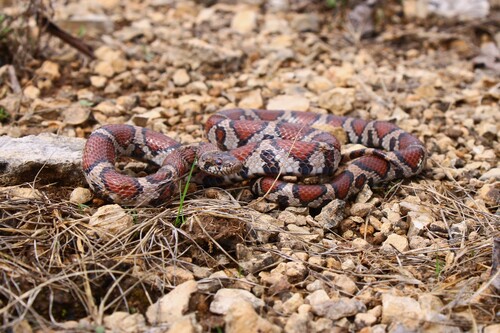 Eastern MilksnakeLampropeltis triangulum
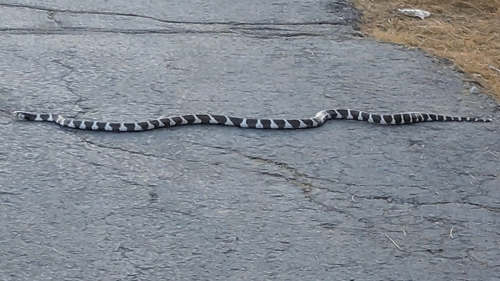 California King SnakeLampropeltis californiae
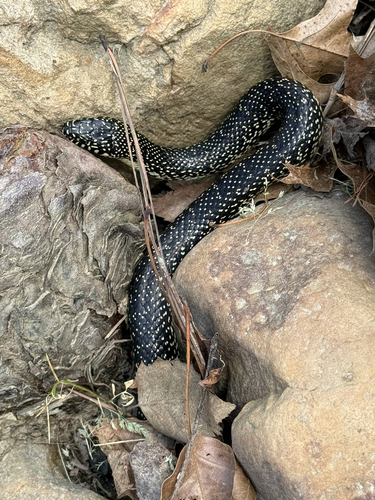 Speckled KingsnakeLampropeltis holbrooki
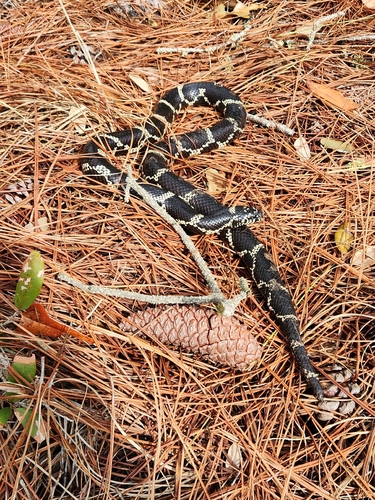 Eastern KingsnakeLampropeltis getula
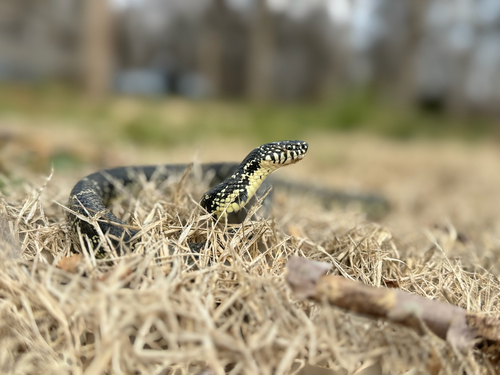 Black KingsnakeLampropeltis nigra
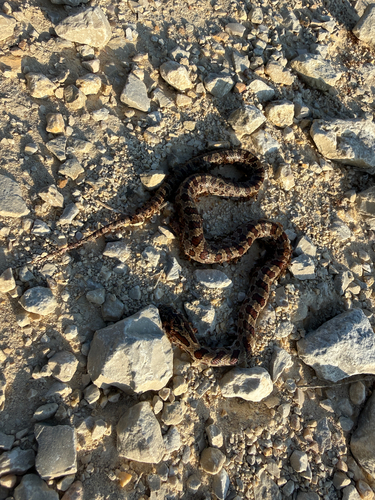 Prairie KingsnakeLampropeltis calligaster
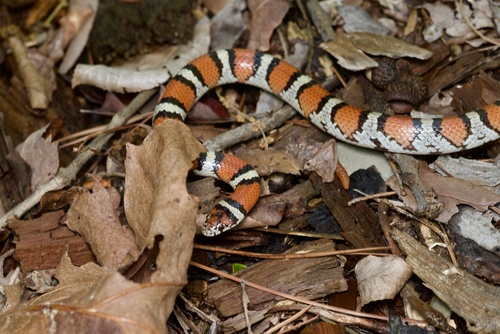 Western MilksnakeLampropeltis gentilis
 Desert KingsnakeLampropeltis splendida
Classification
How scientists group this snake, from the broadest category down to the exact species. Each step narrows to its closest relatives.
- OrderThe broad group of scaled reptiles: all snakes and lizards
- Squamata
- FamilyA group of related snakes that share key traits
- Colubridae
- GenusA close-knit group of very similar species
- Lampropeltis
- SpeciesThis exact snake, named in the two-part scientific name
- Lampropeltis extenuata
Keep learning
- What to Do If You Find a SnakeFound a snake at home or on a trail? Here is how to stay calm, give it space, identify it safely, and know when to call a professional.
- Venomous vs Nonvenomous: How to Tell the DifferenceThe folk rules for telling venomous snakes apart, where each one fails, and why location-based identification beats guessing by sight.
- What Is a Snake? Anatomy and the BasicsA clear overview of what makes a snake a snake: limbless body plan, anatomy, evolution from lizards, species diversity, and why they are ectothermic.
- How to Keep Snakes Out of Your Yard and HomeA practical guide to keeping snakes out of your yard and home using habitat changes that work, plus what to skip and what to do if one shows up.
Distribution from GBIF & iNaturalist. Venom status per CDC. Background: Wikipedia. Informational only. Never handle a snake to identify it.