
Typhlopidae
Schinz's Beaked Blind Snake
HarmlessRhinotyphlops schinzi
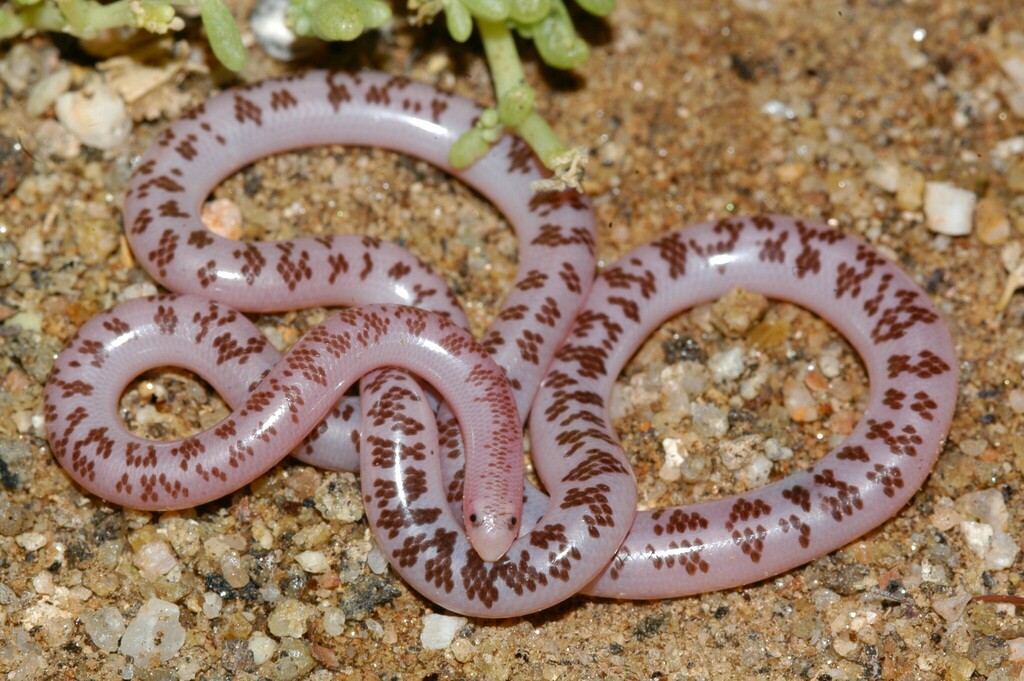
The Schinz's Beaked Blind Snake (Rhinotyphlops schinzi) is a non-venomous snake in the Typhlopidae family, recorded in 5 countries.
- Family
- Typhlopidae
About the Schinz's Beaked Blind Snake
Rhinotyphlops schinzi, commonly known as Schinz's beaked blind snake, is a species of snake in the family Typhlopidae. The species is endemic to southern Africa.
Etymology
The specific name, schinzi, is in honor of "Herr Dr. Hans Schinz", who collected the first specimens in 1884 and 1885 in the Kalahari Desert. He should not be confused with Swiss naturalist Heinrich Rudolf Schinz (1777-1861).
Geographic range
R. schinzi is found from Namibia and neighboring Botswana south to Calvinia and Kenhardt in Northern Cape, South Africa.
Description
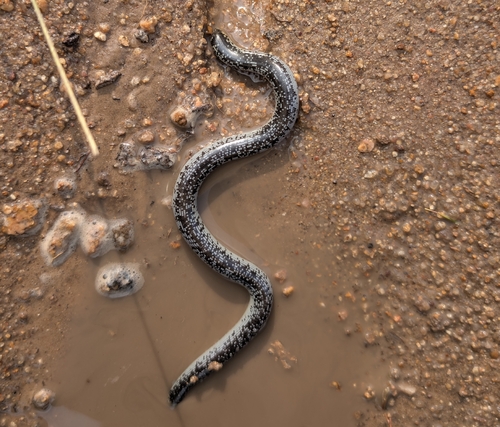
The coloration of R. schinzi varies from yellowish to flesh-colored. The dorsum is marked with blue-black to reddish-brown blotches which may appear as crossbars. The venter and sides of the body are unmarked.
Adults may attain a total length (including tail) of 28 cm (11 inches).
The dorsal scales are arranged in 22-26 rows. There are more than 400 dorsal scales in the vertebral series.
The snout is strongly hooked, with the nostrils located below the sharp cutting edge. The rostral is large, but not extending as far as the eyes. There are four upper labials. The nasal is semidivided, the cleft proceeding from the first upper labial. A preocular is present, which is narrower than the nasal or the ocular, and in contact with the third upper labial. The eyes are distinct. The upper head scales are larger than the body scales. The diameter of body 45 times in the total length. The tail is as long as broad, ending in a spine.
Habitat
The habitat of R. schinzi is arid savannah and semidesert.
Adapted from Wikipedia, available under CC BY-SA.
Frequently asked: Schinz's Beaked Blind Snake
- Is the Schinz's Beaked Blind Snake venomous?
- No. The Schinz's Beaked Blind Snake (Rhinotyphlops schinzi) is non-venomous and is not considered dangerous to humans. Like most snakes, it will retreat rather than bite when given the chance.
- Is the Schinz's Beaked Blind Snake poisonous?
- Snakes are venomous, not poisonous. "Poisonous" means harmful to eat or touch; "venomous" means injecting toxins through a bite. The Schinz's Beaked Blind Snake is neither poisonous nor venomous.
- Is the Schinz's Beaked Blind Snake dangerous?
- The Schinz's Beaked Blind Snake is not dangerous to humans. It has no medically significant venom and bites only defensively if cornered or handled.
- Where does the Schinz's Beaked Blind Snake live?
- The Schinz's Beaked Blind Snake has verified records in 5 countries, including South Africa, Namibia, Zambia. See the distribution section below for its full range.
- Why is it called the Schinz's Beaked Blind Snake?
- The specific name, schinzi, is in honor of "Herr Dr. Hans Schinz", who collected the first specimens in 1884 and 1885 in the Kalahari Desert. He should not be confused with Swiss naturalist Heinrich Rudolf Schinz (1777-1861).
Where it is found
More Typhlopidae snakes
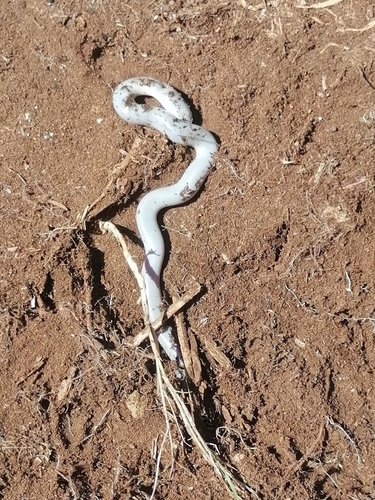 Delalande's Beaked Blind SnakeRhinotyphlops lalandei
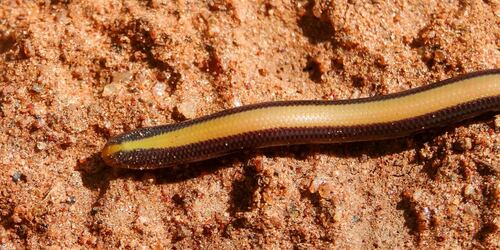 Kenya Beaked SnakeRhinotyphlops unitaeniatus
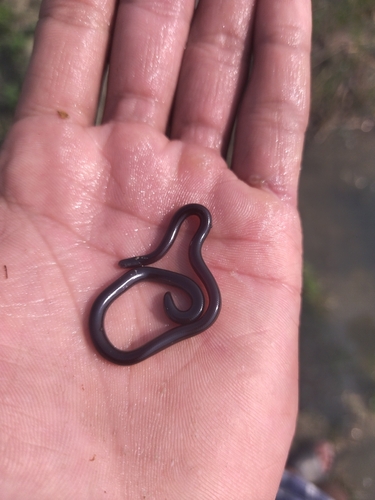 Brahminy BlindsnakeIndotyphlops braminus
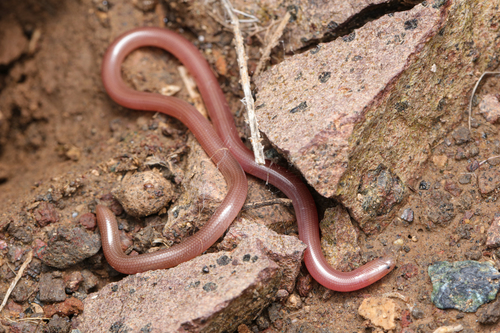 Eurasian Blind SnakeXerotyphlops vermicularis
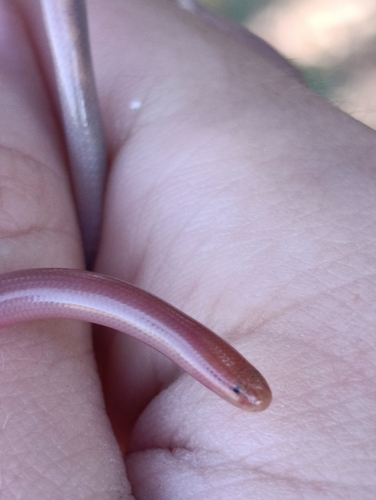 Syrian Blind SnakeXerotyphlops syriacus
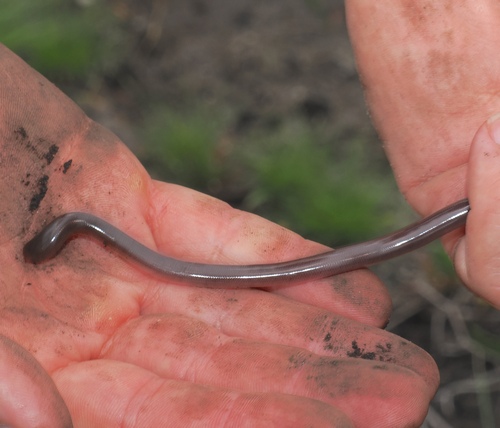 Bibron's Blind SnakeAfrotyphlops bibronii
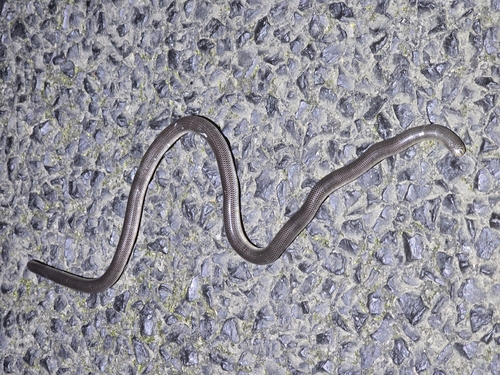 Blackish Blind SnakeAnilios nigrescens
 Schlegel’s Beaked blind snakeAfrotyphlops schlegelii
Classification
How scientists group this snake, from the broadest category down to the exact species. Each step narrows to its closest relatives.
- OrderThe broad group of scaled reptiles: all snakes and lizards
- Squamata
- FamilyA group of related snakes that share key traits
- Typhlopidae
- GenusA close-knit group of very similar species
- Rhinotyphlops
- SpeciesThis exact snake, named in the two-part scientific name
- Rhinotyphlops schinzi
Keep learning
- What to Do If You Find a SnakeFound a snake at home or on a trail? Here is how to stay calm, give it space, identify it safely, and know when to call a professional.
- Venomous vs Nonvenomous: How to Tell the DifferenceThe folk rules for telling venomous snakes apart, where each one fails, and why location-based identification beats guessing by sight.
- What Is a Snake? Anatomy and the BasicsA clear overview of what makes a snake a snake: limbless body plan, anatomy, evolution from lizards, species diversity, and why they are ectothermic.
- How to Keep Snakes Out of Your Yard and HomeA practical guide to keeping snakes out of your yard and home using habitat changes that work, plus what to skip and what to do if one shows up.
Distribution from GBIF & iNaturalist. Venom status per CDC. Background: Wikipedia. Informational only. Never handle a snake to identify it.