
Typhlopidae
Bibron's Blind Snake
HarmlessAfrotyphlops bibronii
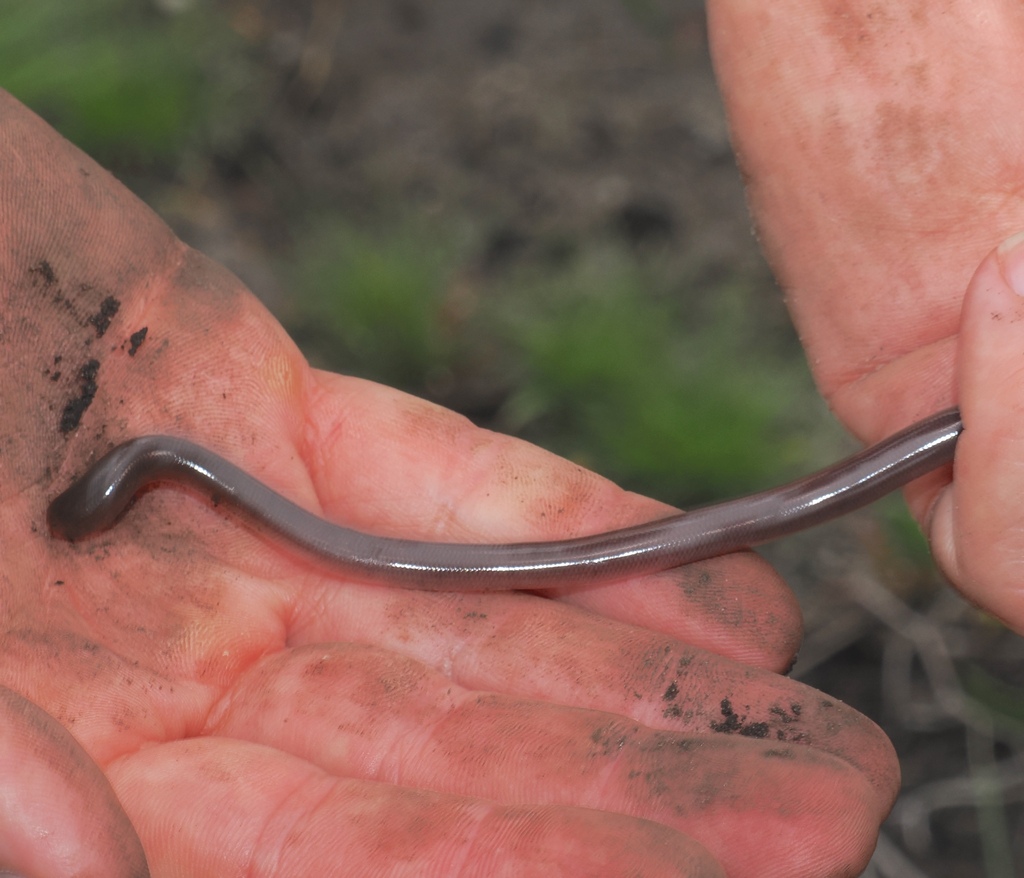
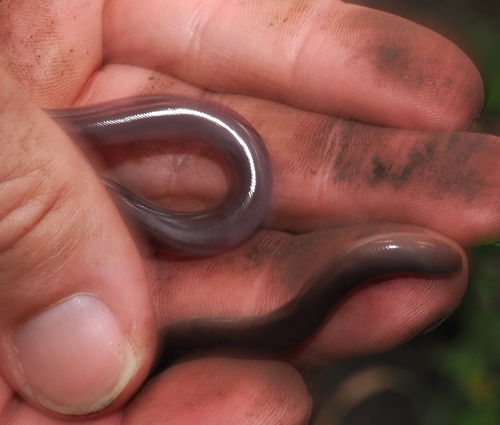
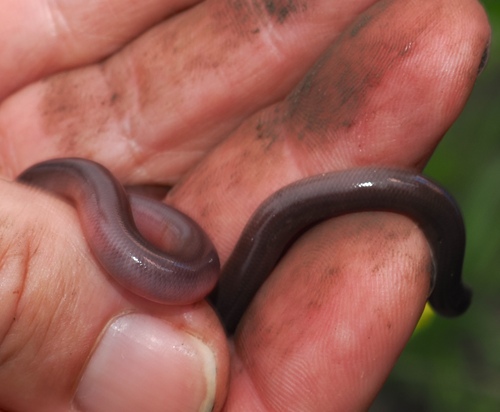
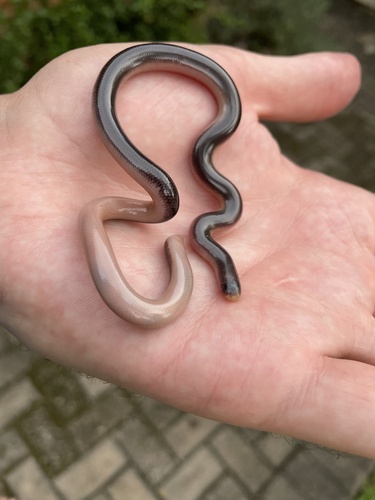
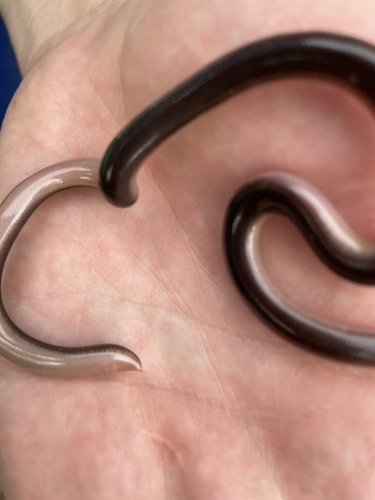
5 photographs of the Bibron's Blind Snake. © desertnaturalist.
The Bibron's Blind Snake (Afrotyphlops bibronii) is a non-venomous snake in the Typhlopidae family, recorded in 5 countries.
- Family
- Typhlopidae
About the Bibron's Blind Snake
Bibron's blind snake (Afrotyphlops bibronii) is a species of snake in the family Typhlopidae. The species is native to southern Africa.
Etymology
The specific name, bibronii, is in honor of French herpetologist Gabriel Bibron.
Geographic range
A. bibronii is found in extreme southeastern Botswana, eastern and northern South Africa, Lesotho, Eswatini, and eastern Zimbabwe, and possibly Mozambique.
Description
A heavy-bodied species of blind snake, A. bibronii is dark olive-brown to brown dorsally, and is paler ventrally. Adults are darker than juveniles. Adults may attain a snout-vent length (SVL) of 29.5 cm (11+5⁄8 in). Its scales are arranged in 30 rows around the body, and there are more than 300 scales in the middorsal row.
The snout is very prominent, with an angular but not sharp edge, below which are located the nostrils. The rostral is very large, extending posteriorly as far as the eyes. The portion of the rostral visible from above is broader than long. The nasals are semidivided, the suture proceeding from the first upper labial. One preocular is present, which is narrower than the nasal or the ocular, and in contact with the second upper labial. There are four upper labials. The eye is distinct, below the suture between the ocular and the preocular. The prefrontal is much larger than the supraoculars and the parietals, which are larger than the body scales. The diameter of the body goes 28 to 36 times into the total length. The tail is short, as broad as long, or broader than long, ending in a spine.
Habitat
The preferred natural habitats of A. bibronii are coastal grasslands and the Highveld, at altitudes from sea level to 2,000 m (6,600 ft).
Behavior
Bibron's blind snake is fossorial, and will burrow into brood chambers of termites and ants. It is protected from the bites of soldier ants by its close-fitting, shiny scales. It is often flushed to the surface of its burrow after heavy rains or flood.
Diet
A. bibronii feeds on larvae and eggs of termites and ants.
Reproduction
A. bibronii is oviparous. Mature females lay eggs from January through March, which is late Summer in southern Africa. Clutch size varies from 5 to 14. Each egg measures about 43 mm × 10 mm (1+11⁄16 in × 3⁄8 in). The embryos within the eggs are well-developed, and the shell walls are thin. The female may remain with the eggs, guarding them until hatching. After only 5–6 days, the hatchlings emerge, with an average total length (including tail) of 11.5 cm (4+1⁄2 in).
Adapted from Wikipedia, available under CC BY-SA.
Frequently asked: Bibron's Blind Snake
- Is the Bibron's Blind Snake venomous?
- No. The Bibron's Blind Snake (Afrotyphlops bibronii) is non-venomous and is not considered dangerous to humans. Like most snakes, it will retreat rather than bite when given the chance.
- Is the Bibron's Blind Snake poisonous?
- Snakes are venomous, not poisonous. "Poisonous" means harmful to eat or touch; "venomous" means injecting toxins through a bite. The Bibron's Blind Snake is neither poisonous nor venomous.
- Is the Bibron's Blind Snake dangerous?
- The Bibron's Blind Snake is not dangerous to humans. It has no medically significant venom and bites only defensively if cornered or handled.
- Where does the Bibron's Blind Snake live?
- The Bibron's Blind Snake has verified records in 5 countries, including South Africa, Zimbabwe, Eswatini. See the distribution section below for its full range.
- What does the Bibron's Blind Snake eat?
- A. bibronii feeds on larvae and eggs of termites and ants.
- Why is it called the Bibron's Blind Snake?
- The specific name, bibronii, is in honor of French herpetologist Gabriel Bibron.
Where it is found
More Typhlopidae snakes
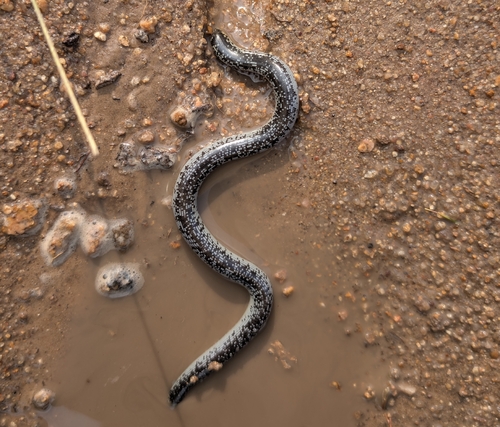 Schlegel’s Beaked blind snakeAfrotyphlops schlegelii
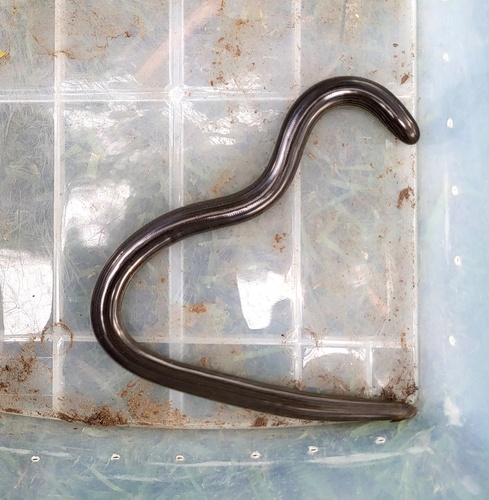 Zambezi Blind SnakeAfrotyphlops dinga
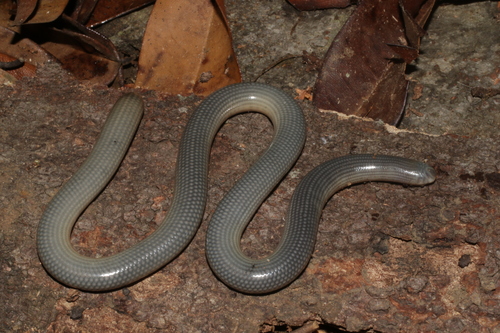 Common Lined Worm SnakeAfrotyphlops lineolatus
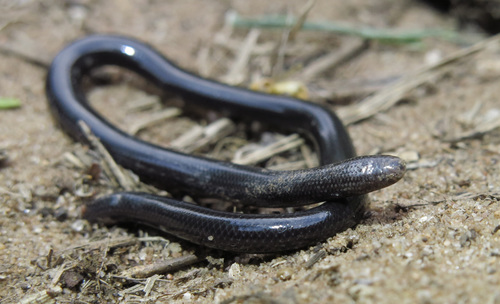 Fornasini's Blind SnakeAfrotyphlops fornasinii
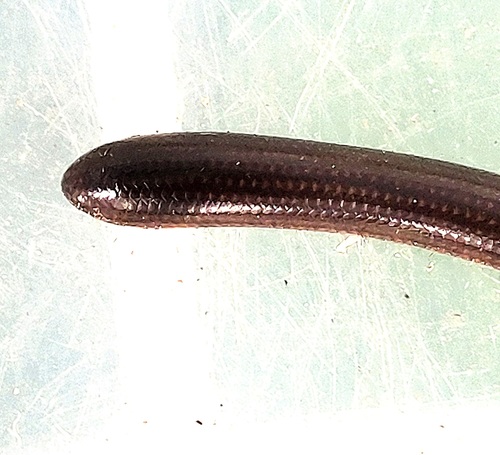 Slender Blind SnakeAfrotyphlops obtusus
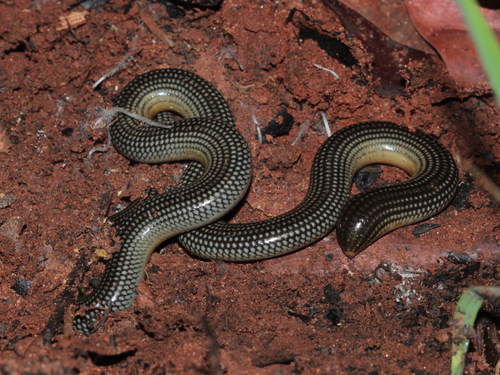 Schmidt’s blind-snakeAfrotyphlops schmidti
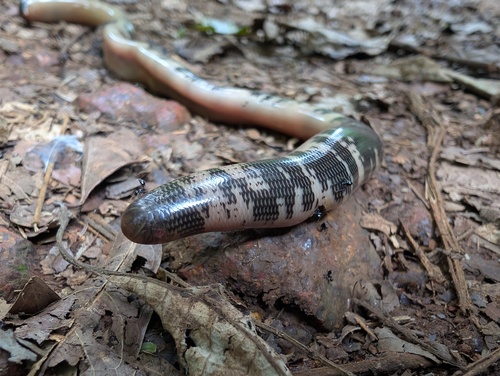 Spotted Blind SnakeAfrotyphlops punctatus
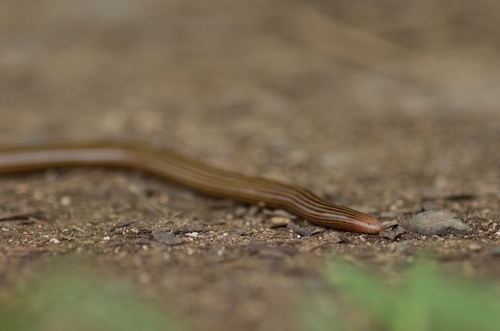 Elegant Worm SnakeAfrotyphlops elegans
Classification
How scientists group this snake, from the broadest category down to the exact species. Each step narrows to its closest relatives.
- OrderThe broad group of scaled reptiles: all snakes and lizards
- Squamata
- FamilyA group of related snakes that share key traits
- Typhlopidae
- GenusA close-knit group of very similar species
- Afrotyphlops
- SpeciesThis exact snake, named in the two-part scientific name
- Afrotyphlops bibronii
Keep learning
- What to Do If You Find a SnakeFound a snake at home or on a trail? Here is how to stay calm, give it space, identify it safely, and know when to call a professional.
- Venomous vs Nonvenomous: How to Tell the DifferenceThe folk rules for telling venomous snakes apart, where each one fails, and why location-based identification beats guessing by sight.
- What Is a Snake? Anatomy and the BasicsA clear overview of what makes a snake a snake: limbless body plan, anatomy, evolution from lizards, species diversity, and why they are ectothermic.
- How to Keep Snakes Out of Your Yard and HomeA practical guide to keeping snakes out of your yard and home using habitat changes that work, plus what to skip and what to do if one shows up.
Distribution from GBIF & iNaturalist. Venom status per CDC. Background: Wikipedia. Informational only. Never handle a snake to identify it.