
Genus · Typhlopidae
Types of blind snakes
3 species make up the genus Rhinotyphlops, the snakes commonly called blind snakes. None are considered dangerous to humans.
About beaked blind snakes
Small burrowing African snakes with a hardened, beak-like snout and eyes reduced to dark spots under the skin.
Rhinotyphlops is a genus in the family Typhlopidae, the typical blind snakes. These are some of the most specialized burrowing snakes in the world. Members spend nearly their entire lives underground, and their bodies show it: a smooth cylindrical shape, tiny vestigial eyes covered by translucent scales, and tight glossy scales of nearly uniform size that let them slide easily through soil. The common name comes from the projecting, often pointed or shovel-like snout that several species use to push through earth.
The genus is African, occurring across sub-Saharan Africa and into parts of the northeast and south of the continent. Typical habitat is loose or sandy soil, leaf litter, termite mounds, and the soft ground around vegetation. Like other blind snakes, they are most often seen at the surface after heavy rain or when soil is disturbed during digging and gardening. Members of this genus include Delalande's Beaked Blind Snake, Schinz's Beaked Blind Snake, and the Kenya Beaked Snake.
Recognizing a Rhinotyphlops in general terms means looking for the classic blind snake build: a small wormlike snake, usually brown, gray, pink, or tan, with no obvious neck, a blunt tail often tipped with a tiny spine, and a head you can barely distinguish from the body except for the hardened beaked snout. The eyes appear only as faint dark spots. Many people mistake these snakes for earthworms, but the dry scaled body and the spine-tipped tail set them apart.
These snakes are completely harmless to people. They are non-venomous, have tiny mouths suited only to small soft prey, and do not bite defensively in any meaningful way. The honest safety framing here is simple: there is nothing dangerous about a blind snake. The main thing to do if you find one is to leave it be or gently return it to soil, since they dry out quickly in the open.
Ecologically, blind snakes are specialist predators of social insects. They feed largely on the eggs, larvae, and pupae of ants and termites, following chemical trails into nests and feeding inside them. Reproduction in the family is typically by laying small clutches of eggs, and some blind snake lineages are known for parthenogenesis, where females reproduce without males. Behavior is secretive and almost entirely subterranean, which is why even common species are rarely seen.
Rhinotyphlops belongs to the Typhlopidae family (Blindsnakes). Tiny, worm-like burrowing snakes that raid ant and termite nests. Looks like a small, glossy earthworm with smooth scales and no obvious neck, eyes, or pattern.
Danger: Harmless. They do not bite people and have no venom.
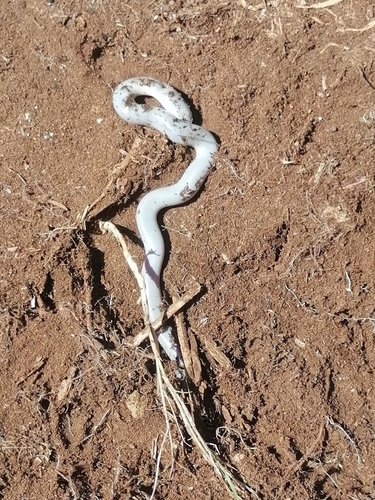
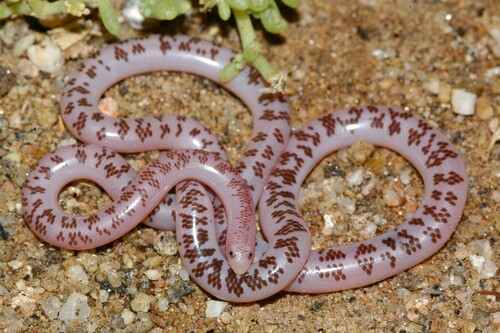
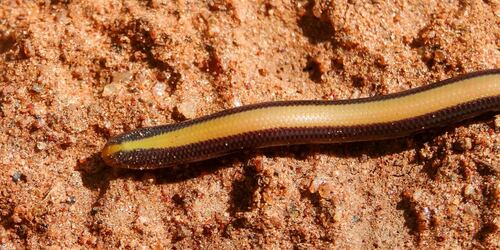
All species (3)
Keep learning
- What Is a Snake? Anatomy and the BasicsA clear overview of what makes a snake a snake: limbless body plan, anatomy, evolution from lizards, species diversity, and why they are ectothermic.
- How Snakes Move, Hunt, and EatHow snakes move without legs, hunt as ambushers or active foragers, kill by constriction or venom, and swallow prey wider than their head.
- What Do Snakes Eat?All snakes are carnivores. Learn what snakes eat, how diet changes with size and age, how often they feed, and how they hunt and swallow prey.
- Venomous vs Nonvenomous: How to Tell the DifferenceThe folk rules for telling venomous snakes apart, where each one fails, and why location-based identification beats guessing by sight.