
Garter / Ribbon snake
Narrowhead Garter Snake
HarmlessThamnophis rufipunctatus
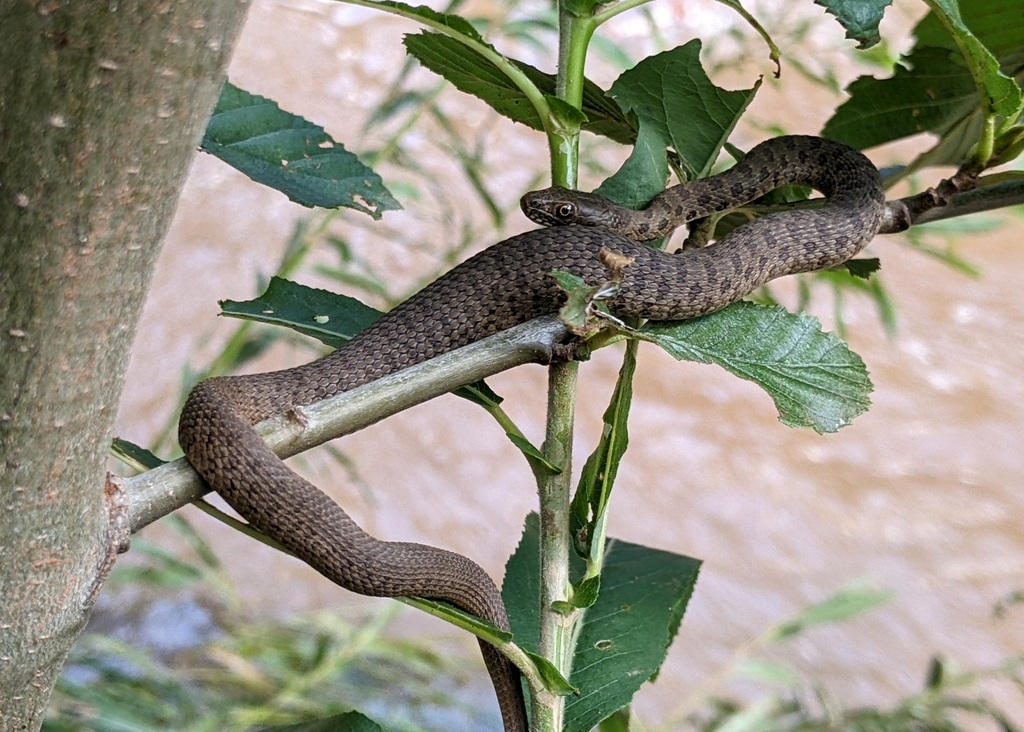
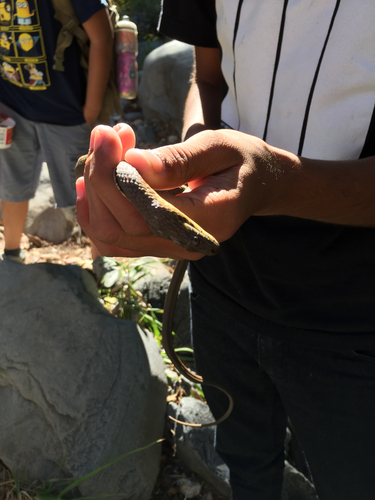
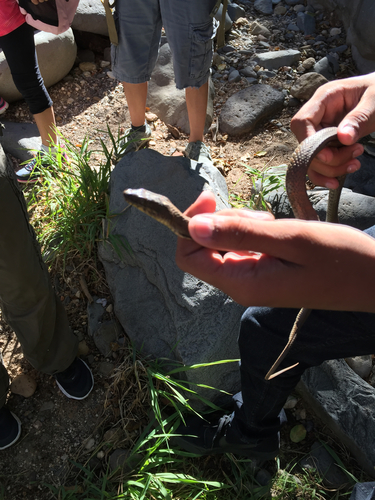
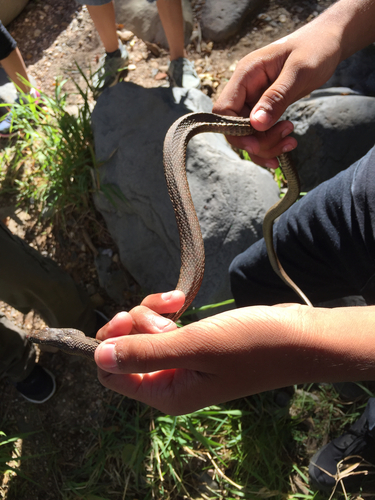
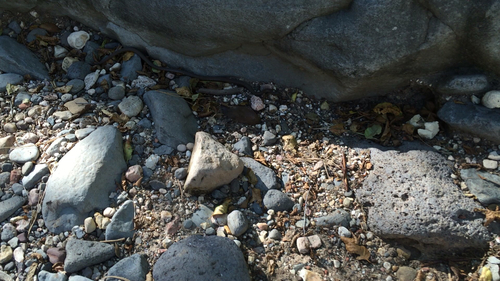
5 photographs of the Narrowhead Garter Snake. © PLAT Vincent.
The Narrowhead Garter Snake (Thamnophis rufipunctatus) is a non-venomous snake in the Colubridae family, recorded in 2 countries.
- Also called
- Garter / Ribbon snake
- Family
- Colubridae
- Size
- Slender, 1.5–3 ft.
- Habitat
- Almost anywhere with moisture — gardens, fields, wetlands, and streamsides.
- Behavior
- Harmless and active by day; may release musk if handled. The most commonly seen snakes across most of the U.S.
- Identify
- Slender body with three light stripes running the length of a darker back.
About the Narrowhead Garter Snake
The narrow-headed garter snake, Thamnophis rufipunctatus, is a species of nonvenomous garter snake that is endemic to the southwestern United States. Its common names also include narrowhead garter snake and narrowhead watersnake.
Taxonomy
Chiasson and Lowe (1989) suggested the species be included in the genus Nerodia (watersnakes) due to its highly aquatic nature, however, this classification was later rejected based on genetic data.
The Madrean narrow-headed garter snake and Southern Durango spotted garter snake were at times considered subspecies of the narrow-headed garter snake, but are now given full species status based on genetic analysis.
Etymology
The scientific name Thamnophis rufipunctatus is a combination of Ancient Greek and New Latin that means "bush snake punctuated with red". The generic name Thamnophis is derived from the Greek "thamnos" (bush) and "ophis" (snake) and the specific name rufipunctatus is derived from the New Latin "rufi-" (red) and "punctatus" (punctuated), referring to the snake's reddish-brown spots.
Geographic range
It is found in Arizona and New Mexico at or near the Mogollon Rim, mainly in canyon-bound headwaters of the Gila and San Francisco rivers and their tributaries.
It is not thought to occur in Mexico. Populations in Mexico that were previously considered subspecies of Thamnophis rufipunctatus are now reclassified as separate species.
Description
The snake is blue-grey to olive-grey, or greenish to brown, and it has brown, orange, or black spots on the back. The total length of adults is 81–112 cm (32–44 in) (about 81–112 cm). Its most notable feature is its long, narrow snout, resulting in a rather triangular-shaped head.
It has eight or 9 upper labial scales, one of which enters the eye, two or three preocular scales, two to four postoculars, and one anterior temporal scale. The keeled dorsal scales are arranged in 21 rows at midbody. Ventrals number 152–177; the anal plate is entire; the subcaudals number 65–87, and are divided.
Habitat and behavior
It is found near river banks or streams at higher elevations (2,300 to 8,000 ft (701 to 2,430 m)), and prefers clear, rocky streams with pool and riffle habitat, though it has also been observed at lake shorelines. It is one of the most aquatic of all garter snakes.
Narrow-headed garter snakes hibernate between October or November to March in rocky outcroppings above the flood line. They are viviparous and give birth to 4-17 young in late July or August. They are sexually mature at around 2 years.
They are often found underwater, and primarily forage on the bottom of streams. They can also be found perched in vegetation near the water, or basking near the water. They are capable of holding their breath for several minutes.
Diet
Adapted from Wikipedia, available under CC BY-SA.
Frequently asked: Narrowhead Garter Snake
- Is the Narrowhead Garter Snake venomous?
- No. The Narrowhead Garter Snake (Thamnophis rufipunctatus) is non-venomous and is not considered dangerous to humans. Like most snakes, it will retreat rather than bite when given the chance.
- Is the Narrowhead Garter Snake poisonous?
- Snakes are venomous, not poisonous. "Poisonous" means harmful to eat or touch; "venomous" means injecting toxins through a bite. The Narrowhead Garter Snake is neither poisonous nor venomous.
- Is the Narrowhead Garter Snake dangerous?
- The Narrowhead Garter Snake is not dangerous to humans. It has no medically significant venom and bites only defensively if cornered or handled.
- Where does the Narrowhead Garter Snake live?
- The Narrowhead Garter Snake has verified records in 2 countries, including Mexico, United States of America. See the distribution section below for its full range.
- How do I identify the Narrowhead Garter Snake?
- Slender body with three light stripes running the length of a darker back.
- How big does the Narrowhead Garter Snake get?
- Slender, 1.5–3 ft.
- What does the Narrowhead Garter Snake eat?
- These snakes are piscivorous, meaning they primarily eat fish. Their diet includes dace, chub, sucker, and both native and introduced trout. They have been reported to eat tadpoles and salamanders, but these are based on historical captive reports and not likely a common part of their diet. Unlike other garter snakes, they are ambush predators, and will sit and wait for prey to approach. Due to their unique mass, the specific gravity of the snake in water is 1, meaning they neither sink nor float and can maintain their position in the water.
- Why is it called the Narrowhead Garter Snake?
- The scientific name Thamnophis rufipunctatus is a combination of Ancient Greek and New Latin that means "bush snake punctuated with red". The generic name Thamnophis is derived from the Greek "thamnos" (bush) and "ophis" (snake) and the specific name rufipunctatus is derived from the New Latin "rufi-" (red) and "punctatus" (punctuated), referring to the snake's reddish-brown spots.
Where it is found
By U.S. state
More Colubridae snakes
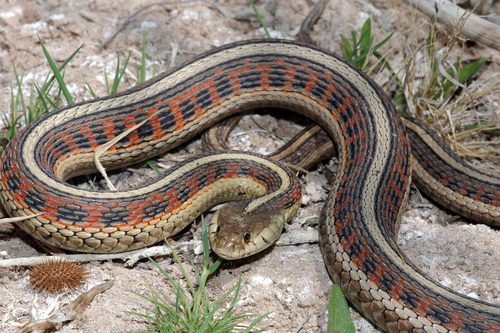 Common Garter SnakeThamnophis sirtalis
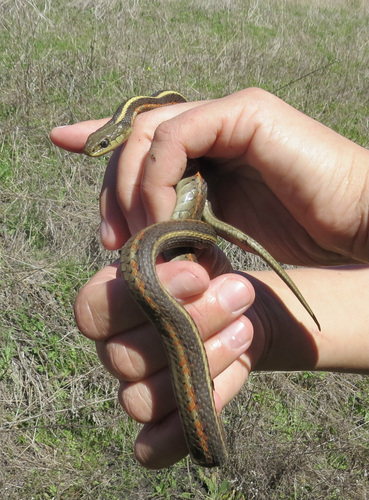 Western Terrestrial Garter SnakeThamnophis elegans
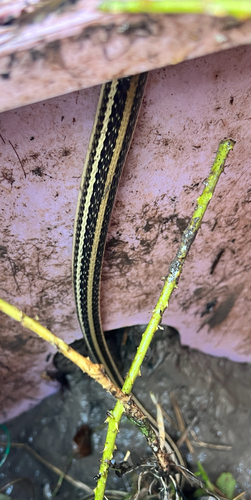 Western Ribbon SnakeThamnophis proximus
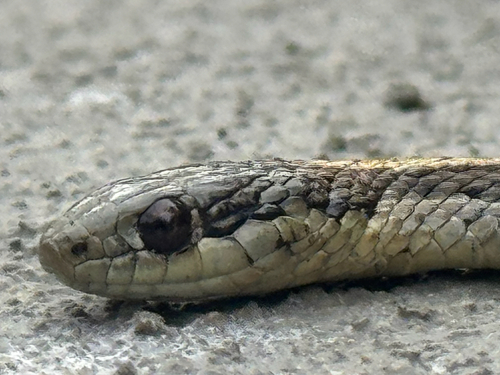 Northwestern Garter SnakeThamnophis ordinoides
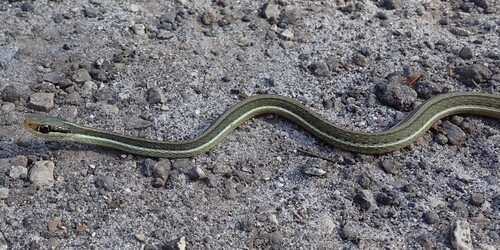 Common Ribbon SnakeThamnophis saurita
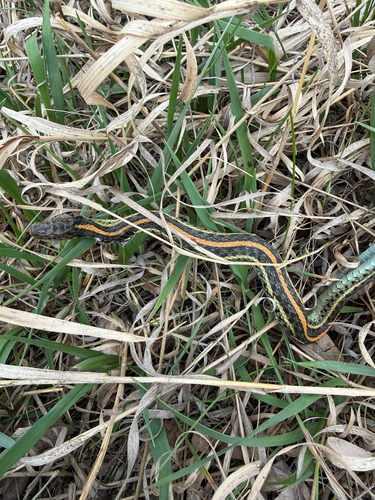 Plains Garter SnakeThamnophis radix
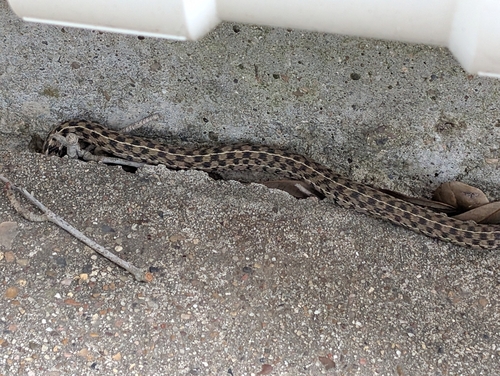 Checkered Garter SnakeThamnophis marcianus
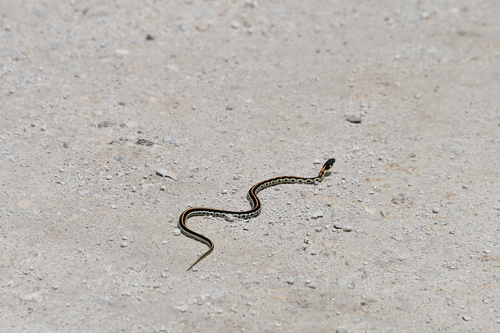 Black-necked Garter SnakeThamnophis cyrtopsis
Classification
How scientists group this snake, from the broadest category down to the exact species. Each step narrows to its closest relatives.
- OrderThe broad group of scaled reptiles: all snakes and lizards
- Squamata
- FamilyA group of related snakes that share key traits
- Colubridae
- GenusA close-knit group of very similar species
- Thamnophis
- SpeciesThis exact snake, named in the two-part scientific name
- Thamnophis rufipunctatus
Keep learning
- What to Do If You Find a SnakeFound a snake at home or on a trail? Here is how to stay calm, give it space, identify it safely, and know when to call a professional.
- Venomous vs Nonvenomous: How to Tell the DifferenceThe folk rules for telling venomous snakes apart, where each one fails, and why location-based identification beats guessing by sight.
- What Is a Snake? Anatomy and the BasicsA clear overview of what makes a snake a snake: limbless body plan, anatomy, evolution from lizards, species diversity, and why they are ectothermic.
- How to Keep Snakes Out of Your Yard and HomeA practical guide to keeping snakes out of your yard and home using habitat changes that work, plus what to skip and what to do if one shows up.
Distribution from GBIF & iNaturalist. Venom status per CDC. Background: Wikipedia. Informational only. Never handle a snake to identify it.