
Garter / Ribbon snake
Butler's Garter Snake
HarmlessThamnophis butleri
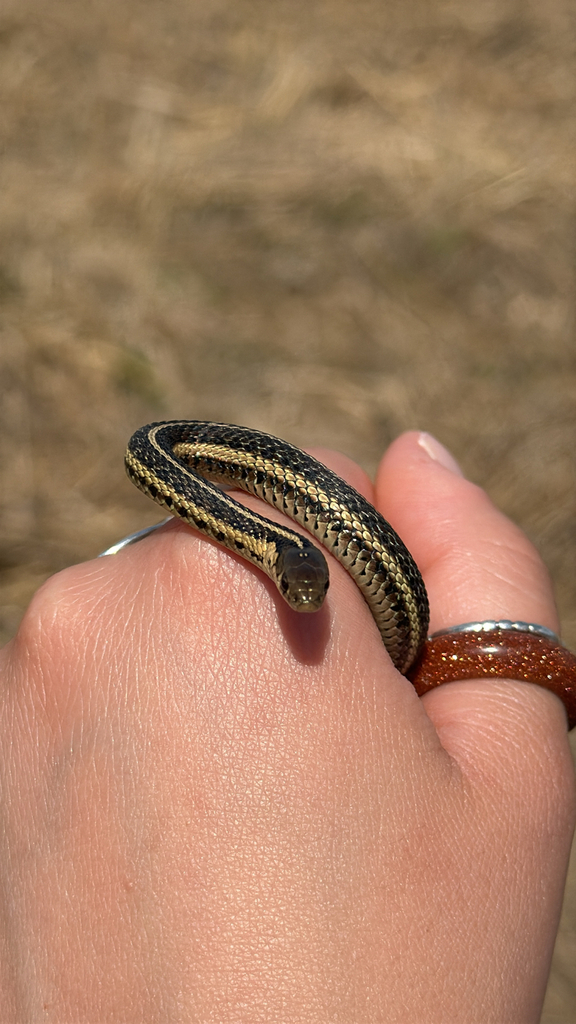
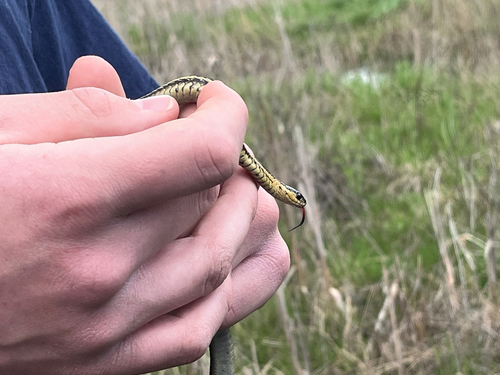
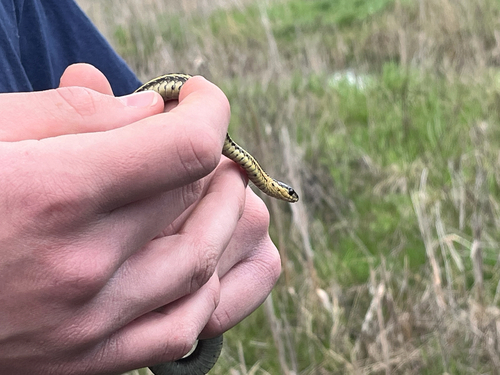
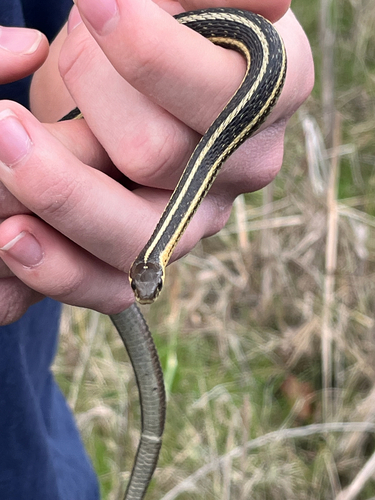
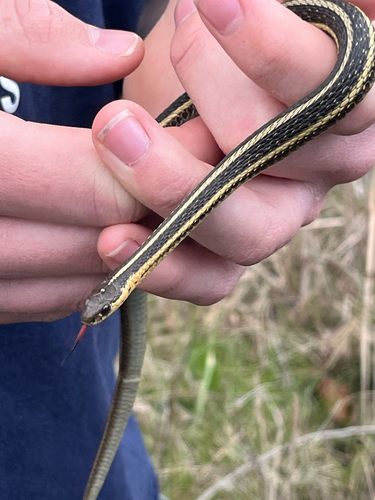
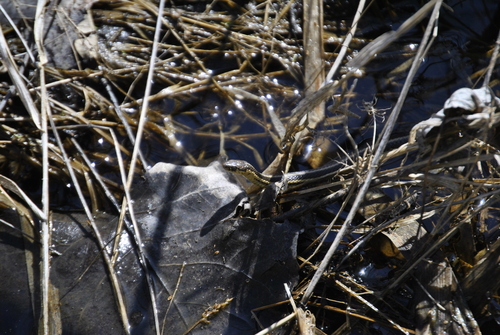
6 photographs of the Butler's Garter Snake. © Jude Kesl.
The Butler's Garter Snake (Thamnophis butleri) is a non-venomous snake in the Colubridae family, recorded in 2 countries.
- Also called
- Garter / Ribbon snake
- Family
- Colubridae
- Size
- Slender, 1.5–3 ft.
- Habitat
- Almost anywhere with moisture — gardens, fields, wetlands, and streamsides.
- Behavior
- Harmless and active by day; may release musk if handled. The most commonly seen snakes across most of the U.S.
- Identify
- Slender body with three light stripes running the length of a darker back.
About the Butler's Garter Snake
Butler's garter snake (Thamnophis butleri) is a species of snake in the subfamily Natricinae of the family Colubridae. The species is endemic to North America.
Etymology
The specific name butleri is in honor of ornithologist Amos Butler (1860–1937) of Brookville, Indiana.
Geographic range
Thamnophis butleri is found in northwestern Ohio, northeastern Indiana, the eastern portion of the Lower Peninsula of Michigan, and the adjacent extreme southern tip of Ontario, Canada. Also, a disjunct population is found in southeastern Wisconsin.
Description and identification
Thamnophis butleri is a small, slender snake, averaging 38–51 cm (15–20 in) in total length (tail included), with three yellow to orange stripes along the length of its body. The background color can range from olive-brown to black, and it may also be possible to discern two rows of dark spots between the side and back stripes. These features do little to distinguish it from most other garter snakes species, but the placement of the lateral, or side, stripes is unique to this species. In Butler's garter snake the lateral stripes are centered on the third scale row up from the ventral scales, and they also overlap the adjacent second and fourth scale rows. This contrasts with the lateral stripe placement of other garter snake species.
For those hoping to avoid getting close enough to inspect the position of the lateral stripe, other features may help in their identification. The head is unusually small for a garter snake, and, when excited, the effort this snake expends to escape seems to go more towards thrashing in place than to getting away.
Ecology
Butler's garter snake inhabits moist, grassy, open canopy areas, such as meadows, wet prairies, marshes, savannas, and grasslands. Like Kirtland's snake, it may also be found in grassy vacant lots in suburban and residential areas. The species can often be found under rocks, logs, trash, and boards. It subsists on a diet of mainly earthworms, but it may also eat leeches, salamanders, and frogs. The species hibernates communally, often with other garter snake species. Butler's garter snake is a relatively short-lived species, and it reaches sexual maturity in its second spring.
Reproduction
Thamnophis butleri is ovoviviparous. Mating takes place in late March and early April. The young are born in June or July, in broods of four to 14. The newborns are 13–18 cm (5.1–7.1 in) long.
Conservation status
In Indiana, Butler's garter snake is listed as an endangered species. In Ontario, the species is also listed as endangered. In Wisconsin, Butler's garter snake is listed as a species of special concern.
Adapted from Wikipedia, available under CC BY-SA.
Frequently asked: Butler's Garter Snake
- Is the Butler's Garter Snake venomous?
- No. The Butler's Garter Snake (Thamnophis butleri) is non-venomous and is not considered dangerous to humans. Like most snakes, it will retreat rather than bite when given the chance.
- Is the Butler's Garter Snake poisonous?
- Snakes are venomous, not poisonous. "Poisonous" means harmful to eat or touch; "venomous" means injecting toxins through a bite. The Butler's Garter Snake is neither poisonous nor venomous.
- Is the Butler's Garter Snake dangerous?
- The Butler's Garter Snake is not dangerous to humans. It has no medically significant venom and bites only defensively if cornered or handled.
- Where does the Butler's Garter Snake live?
- The Butler's Garter Snake has verified records in 2 countries, including United States of America, Canada. See the distribution section below for its full range.
- How do I identify the Butler's Garter Snake?
- Slender body with three light stripes running the length of a darker back.
- How big does the Butler's Garter Snake get?
- Slender, 1.5–3 ft.
- Why is it called the Butler's Garter Snake?
- The specific name butleri is in honor of ornithologist Amos Butler (1860–1937) of Brookville, Indiana.
Where it is found
More Colubridae snakes
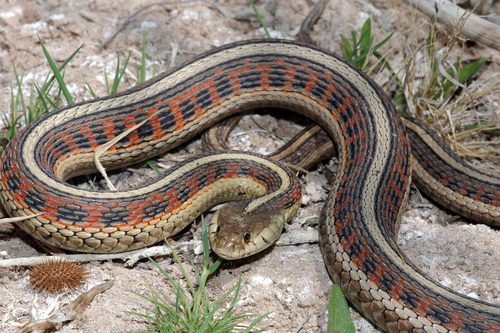 Common Garter SnakeThamnophis sirtalis
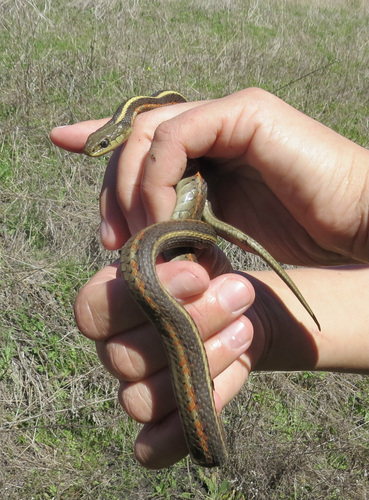 Western Terrestrial Garter SnakeThamnophis elegans
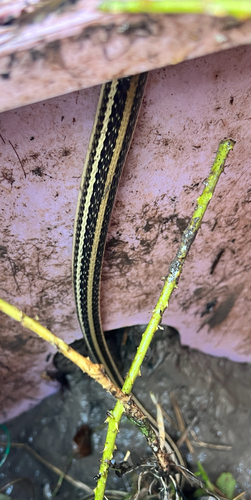 Western Ribbon SnakeThamnophis proximus
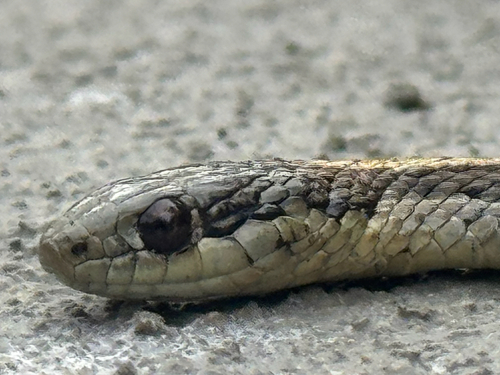 Northwestern Garter SnakeThamnophis ordinoides
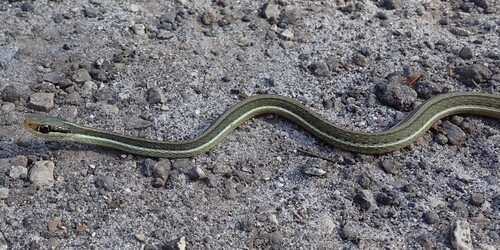 Common Ribbon SnakeThamnophis saurita
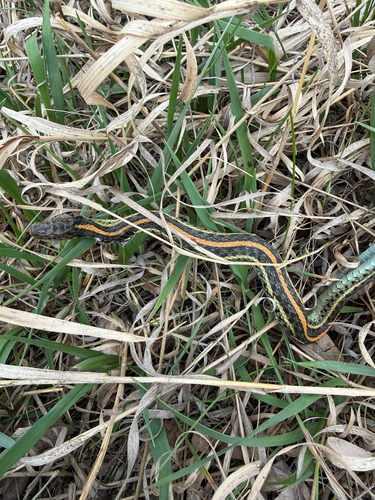 Plains Garter SnakeThamnophis radix
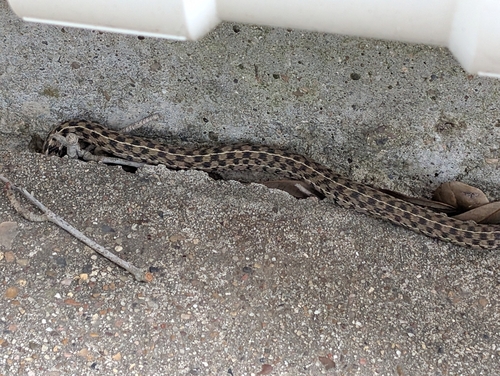 Checkered Garter SnakeThamnophis marcianus
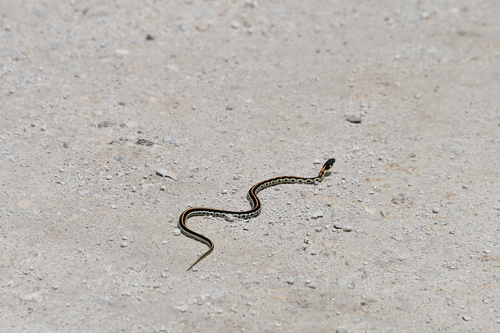 Black-necked Garter SnakeThamnophis cyrtopsis
Classification
How scientists group this snake, from the broadest category down to the exact species. Each step narrows to its closest relatives.
- OrderThe broad group of scaled reptiles: all snakes and lizards
- Squamata
- FamilyA group of related snakes that share key traits
- Colubridae
- GenusA close-knit group of very similar species
- Thamnophis
- SpeciesThis exact snake, named in the two-part scientific name
- Thamnophis butleri
Keep learning
- What to Do If You Find a SnakeFound a snake at home or on a trail? Here is how to stay calm, give it space, identify it safely, and know when to call a professional.
- Venomous vs Nonvenomous: How to Tell the DifferenceThe folk rules for telling venomous snakes apart, where each one fails, and why location-based identification beats guessing by sight.
- What Is a Snake? Anatomy and the BasicsA clear overview of what makes a snake a snake: limbless body plan, anatomy, evolution from lizards, species diversity, and why they are ectothermic.
- How to Keep Snakes Out of Your Yard and HomeA practical guide to keeping snakes out of your yard and home using habitat changes that work, plus what to skip and what to do if one shows up.
Distribution from GBIF & iNaturalist. Venom status per CDC. Background: Wikipedia. Informational only. Never handle a snake to identify it.