
Regional field guide
Snakes in Alabama
40+ snake species have verified records in Alabama, including 7 venomous. Pick your county below to see exactly which snakes live near you.
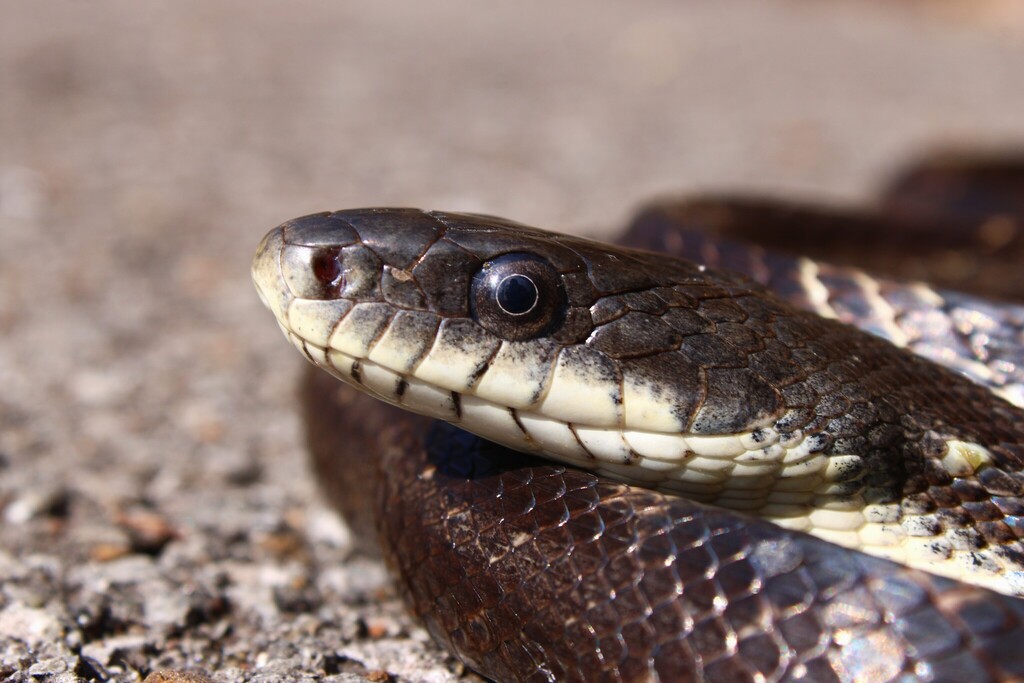
Snakes of Alabama
Alabama supports about 50+ snake species, of which only 7 are venomous. So while the state has a deep snake fauna, the great majority of what you find is harmless. Alabama sits at a crossroads of southeastern habitats, and that mix is what gives it such a long species list relative to its size.
The diversity follows the land. The Appalachian foothills and Piedmont in the north hold forest and rocky-slope species, while the broad coastal plain to the south is full of pine flatwoods, longleaf uplands, and sandy soils. The Mobile-Tensaw delta, river bottoms, swamps, and Gulf coastal marshes provide the wet habitats that watersnakes and cottonmouths need. Few states pack this much variation, from mountain forest to coastal swamp, into one north-to-south line.
Alabama's venomous snakes break into clear categories. The Eastern Copperhead and the cottonmouths (Northern and Florida) are pit vipers of the woods and waterways, with cottonmouths tied closely to swamps, sloughs, and river edges. The rattlesnakes are the Eastern Diamondback of the southern pinelands, the forest-dwelling Timber Rattlesnake, and the small Pygmy Rattlesnake. The Eastern Coralsnake is a secretive banded elapid that spends its life in leaf litter and burrows and is seldom seen. The well-known color rhymes only loosely apply in the US and are not a reliable way to identify a snake.
Most snakes Alabamians see are harmless. Black racers move fast across open ground, rat snakes climb barns and trees, and kingsnakes are prized because they hunt and eat other snakes, venomous ones included. Garter snakes show up in gardens, and several watersnakes share the same waters as cottonmouths and are routinely mistaken for them. For safety, the honest fact is that most bites happen when people try to handle or kill a snake, and deaths are very rare thanks to antivenom and medical care. Never handle a wild snake, and if someone is bitten, call Poison Control at 1-800-222-1222 or 911.
Venomous snakes in Alabama
- Northern CottonmouthAgkistrodon piscivorus Venomous
- Timber RattlesnakeCrotalus horridus Venomous
- Eastern CopperheadAgkistrodon contortrix Venomous
- Eastern Diamondback RattlesnakeCrotalus adamanteus Venomous
- Pygmy RattlesnakeSistrurus miliarius Venomous
- Florida CottonmouthAgkistrodon conanti Venomous
- Eastern CoralsnakeMicrurus fulvius Venomous
Most commonly seen
- Gray RatsnakeCommonly seen
- Common WatersnakeCommonly seen
- Northern CottonmouthCommonly seen
- North American RacerCommonly seen
- Timber RattlesnakeCommonly seen
- DeKay's BrownsnakeCommonly seen
- Ring-necked SnakeCommonly seen
- Common Garter SnakeCommonly seen
- Eastern CopperheadCommonly seen
- Plain-bellied WatersnakeCommonly seen
- Black KingsnakeCommonly seen
- Rough GreensnakeCommonly seen
Counties in Alabama
67 listed- Autauga18
- Baldwin36
- Barbour20
- Bibb19
- Blount13
- Bullock17
- Butler15
- Calhoun24
- Chambers17
- Cherokee19
- Chilton17
- Choctaw8
- Clarke12
- Clay21
- Cleburne21
- Coffee12
- Colbert20
- Conecuh11
- Coosa15
- Covington35
- Crenshaw8
- Cullman10
- Dale13
- Dallas17
- De Kalb21
- Elmore23
- Escambia23
- Etowah16
- Fayette6
- Franklin10
- Geneva15
- Greene12
- Hale12
- Henry16
- Houston22
- Jackson23
- Jefferson21
- Lamar1
- Lauderdale15
- Lawrence18
- Lee29
- Limestone16
- Lowndes11
- Macon28
- Madison21
- Marengo11
- Marion11
- Marshall15
- Mobile32
- Monroe15
- Montgomery19
- Morgan20
- Perry19
- Pickens4
- Pike21
- Randolph13
- Russell26
- Saint Clair18
- Shelby23
- Sumter17
- Talladega15
- Tallapoosa21
- Tuscaloosa22
- Walker11
- Washington19
- Wilcox14
- Winston20
Snakes in Alabama: FAQ
- Are there venomous snakes in Alabama?
- Yes. 7 venomous snake species have verified records in Alabama, including Northern Cottonmouth, Timber Rattlesnake, Eastern Copperhead, Eastern Diamondback Rattlesnake. Most snakes in Alabama, however, are harmless.
- How many snake species live in Alabama?
- 40+ snake species have verified records in Alabama, of which 7 are venomous.
- What is the most commonly seen snake in Alabama?
- The Gray Ratsnake is the most frequently reported snake in Alabama, based on verified wildlife observations.
- What should I do if I see a venomous snake in Alabama?
- Keep your distance and do not try to catch or kill it. Most bites happen when people handle or corner a snake. If someone is bitten, contact local emergency services or poison control immediately.