
Garter / Ribbon snake
Short-headed Garter Snake
HarmlessThamnophis brachystoma
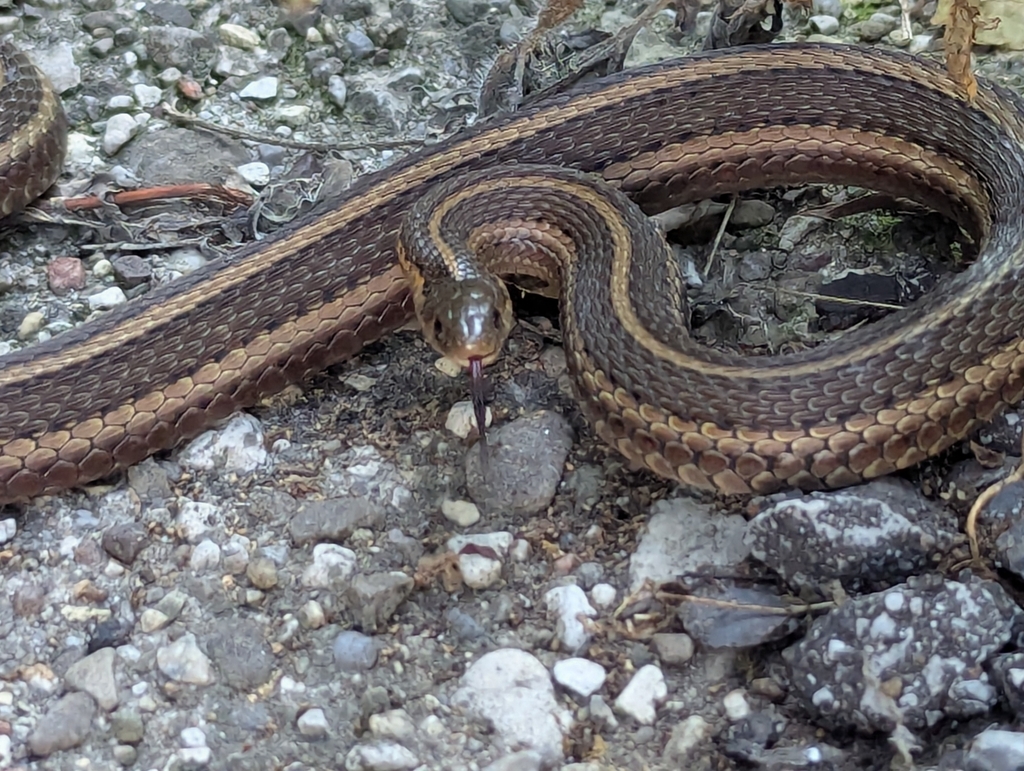
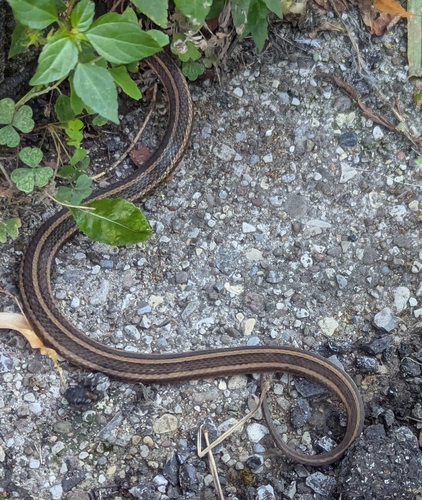
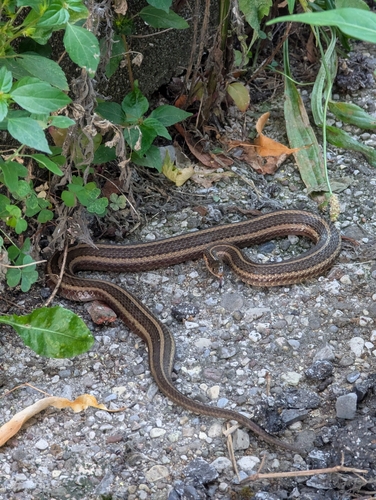
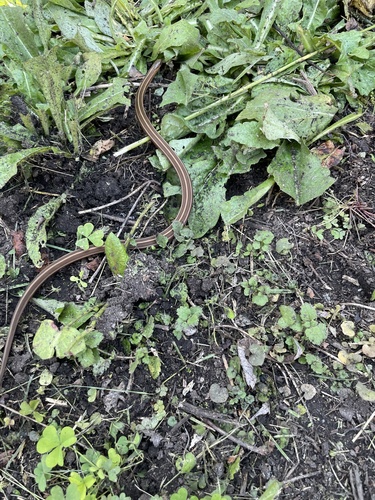
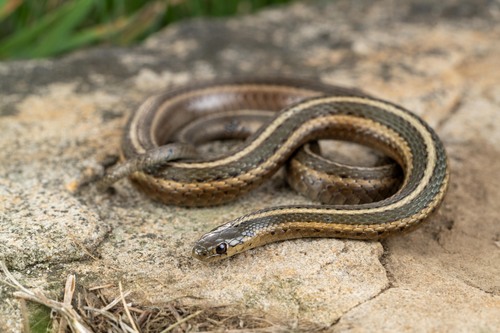
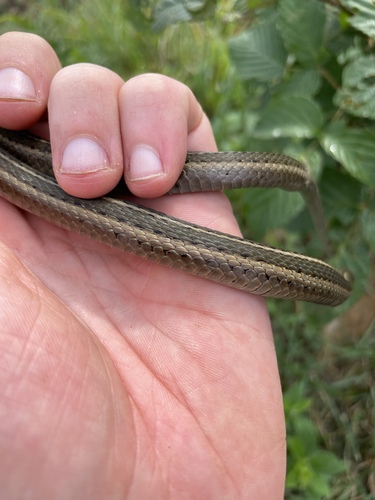
6 photographs of the Short-headed Garter Snake. © Julie.
The Short-headed Garter Snake (Thamnophis brachystoma) is a non-venomous snake in the Colubridae family, recorded in 1 country.
- Also called
- Garter / Ribbon snake
- Family
- Colubridae
- Size
- Slender, 1.5–3 ft.
- Habitat
- Almost anywhere with moisture — gardens, fields, wetlands, and streamsides.
- Behavior
- Harmless and active by day; may release musk if handled. The most commonly seen snakes across most of the U.S.
- Identify
- Slender body with three light stripes running the length of a darker back.
About the Short-headed Garter Snake
Thamnophis brachystoma, commonly known as the shorthead garter snake or short-headed gartersnake, is a small species of snake in the subfamily Natricinae of the family Colubridae. The species is native to the northeastern United States.
Etymology
The specific name brachystoma comes from the Greek words brachy, meaning short, and stoma, meaning mouth.
Description
Thamnophis brachystoma is a small species of snake, with a total length (including tail) of 254–559 mm (10.0–22.0 in). There is no apparent distinction between the body and head. Unlike Thamnophis sirtalis, there are no black spots between stripes in T. brachystoma. Dorsal coloration tends to be olive or olive-green with three (1 dorsal, 2 lateral) beige to yellow stripes running the length of the body. There is a distinct sexual dimorphism in this species with females being larger than males.
Distribution and habitat
Thamnophis brachystoma is found in small pockets in northwestern Pennsylvania and southwestern New York. Outside of its natural range, there is an introduced population in Pittsburgh in southwestern Pennsylvania, as well as Youngstown, Mahoning County, Ohio.
The shorthead garter snake is commonly found in old fields and meadows, but can occasionally be found in wooded areas. It is almost always found within several hundred meters of a field. It is believed that on sunny days it will be openly basking; however, when a population study was conducted, it was almost invariably found under objects such as wood and rocks. Individuals were only encountered in the open on cloudy days.
Ecology and behavior
Thamnophis brachystoma is slow to bite would be handlers, but will readily expel musk and feces from the cloaca. Shorthead garter snakes can commonly be found near one another under cover objects, with no apparent correlation to seasonality or breeding cycles.
Diet
In the wild, T. brachystoma feeds exclusively on earthworms. However, in captivity shorthead garter snakes may consume other food items such as leeches, salamanders, frogs, and fish. Prior to the introduction of non-native earthworms to North America, T. brachystoma would have primarily fed on native earthworms that were restricted to the unglaciated Allegheny Plateau.
Reproduction
Reproduction in T. brachystoma occurs in spring shortly after emerging from the hibernacula. Females generally emerge with ovarian follicles already well developed. Females in New York breed every other year while females in Pennsylvania breed annually. Males use stored sperm for breeding. The testes are small after emergence, reaching full size by midsummer. After this point, sperm will be stored for later use in the spring. T. brachystoma is believed to be viviparous, with experiments showing a transfer of amino acids between mother and offspring.
Adapted from Wikipedia, available under CC BY-SA.
Frequently asked: Short-headed Garter Snake
- Is the Short-headed Garter Snake venomous?
- No. The Short-headed Garter Snake (Thamnophis brachystoma) is non-venomous and is not considered dangerous to humans. Like most snakes, it will retreat rather than bite when given the chance.
- Is the Short-headed Garter Snake poisonous?
- Snakes are venomous, not poisonous. "Poisonous" means harmful to eat or touch; "venomous" means injecting toxins through a bite. The Short-headed Garter Snake is neither poisonous nor venomous.
- Is the Short-headed Garter Snake dangerous?
- The Short-headed Garter Snake is not dangerous to humans. It has no medically significant venom and bites only defensively if cornered or handled.
- Where does the Short-headed Garter Snake live?
- The Short-headed Garter Snake has verified records in 1 country, including United States of America. See the distribution section below for its full range.
- How do I identify the Short-headed Garter Snake?
- Slender body with three light stripes running the length of a darker back.
- How big does the Short-headed Garter Snake get?
- Slender, 1.5–3 ft.
- What does the Short-headed Garter Snake eat?
- In the wild, T. brachystoma feeds exclusively on earthworms. However, in captivity shorthead garter snakes may consume other food items such as leeches, salamanders, frogs, and fish. Prior to the introduction of non-native earthworms to North America, T. brachystoma would have primarily fed on native earthworms that were restricted to the unglaciated Allegheny Plateau.
- Why is it called the Short-headed Garter Snake?
- The specific name brachystoma comes from the Greek words brachy, meaning short, and stoma, meaning mouth.
Where it is found
By U.S. state
More Colubridae snakes
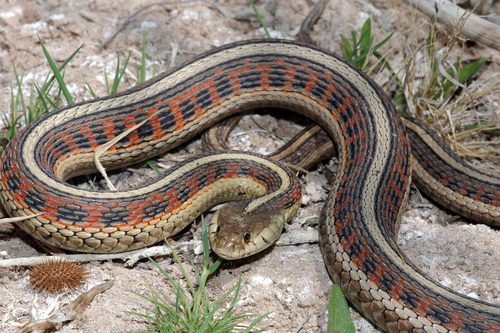 Common Garter SnakeThamnophis sirtalis
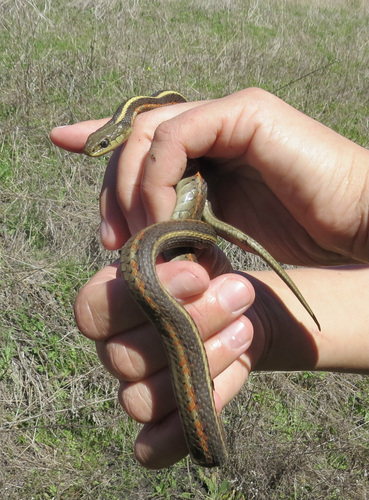 Western Terrestrial Garter SnakeThamnophis elegans
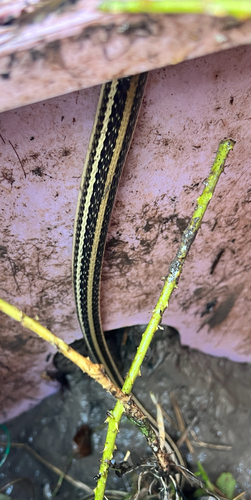 Western Ribbon SnakeThamnophis proximus
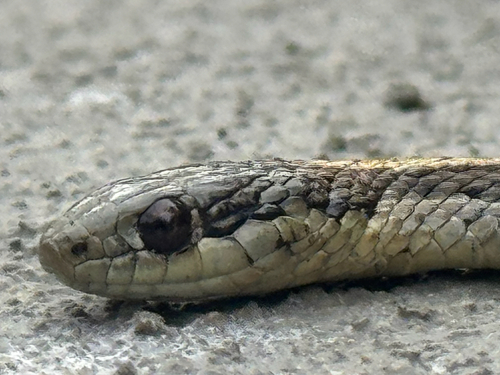 Northwestern Garter SnakeThamnophis ordinoides
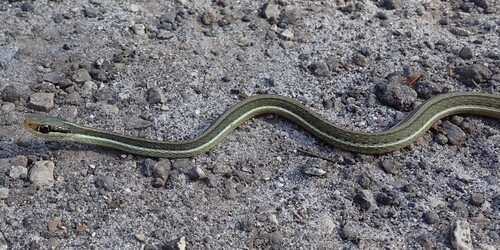 Common Ribbon SnakeThamnophis saurita
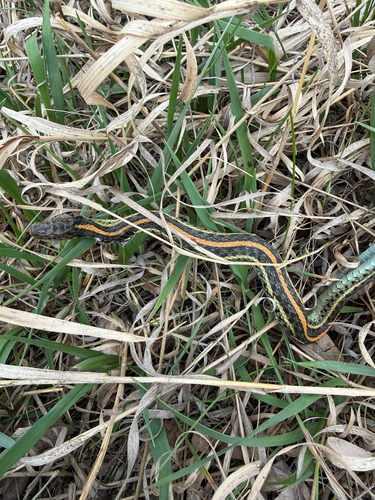 Plains Garter SnakeThamnophis radix
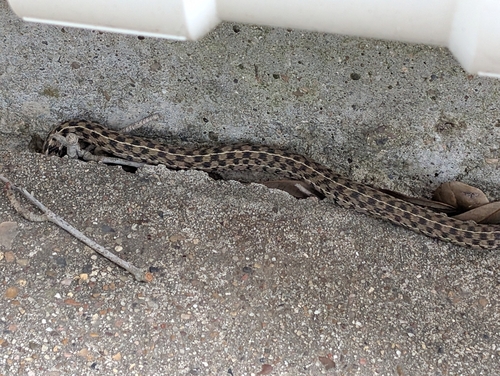 Checkered Garter SnakeThamnophis marcianus
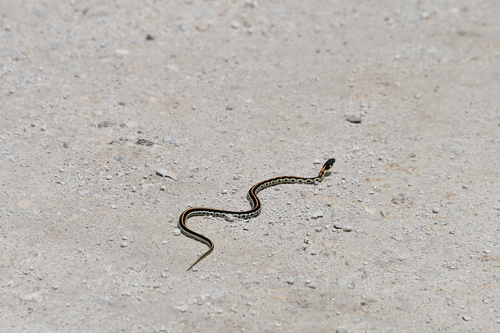 Black-necked Garter SnakeThamnophis cyrtopsis
Classification
How scientists group this snake, from the broadest category down to the exact species. Each step narrows to its closest relatives.
- OrderThe broad group of scaled reptiles: all snakes and lizards
- Squamata
- FamilyA group of related snakes that share key traits
- Colubridae
- GenusA close-knit group of very similar species
- Thamnophis
- SpeciesThis exact snake, named in the two-part scientific name
- Thamnophis brachystoma
Keep learning
- What to Do If You Find a SnakeFound a snake at home or on a trail? Here is how to stay calm, give it space, identify it safely, and know when to call a professional.
- Venomous vs Nonvenomous: How to Tell the DifferenceThe folk rules for telling venomous snakes apart, where each one fails, and why location-based identification beats guessing by sight.
- What Is a Snake? Anatomy and the BasicsA clear overview of what makes a snake a snake: limbless body plan, anatomy, evolution from lizards, species diversity, and why they are ectothermic.
- How to Keep Snakes Out of Your Yard and HomeA practical guide to keeping snakes out of your yard and home using habitat changes that work, plus what to skip and what to do if one shows up.
Distribution from GBIF & iNaturalist. Venom status per CDC. Background: Wikipedia. Informational only. Never handle a snake to identify it.