
Elapidae
Inland Taipan
VenomousOxyuranus microlepidotus
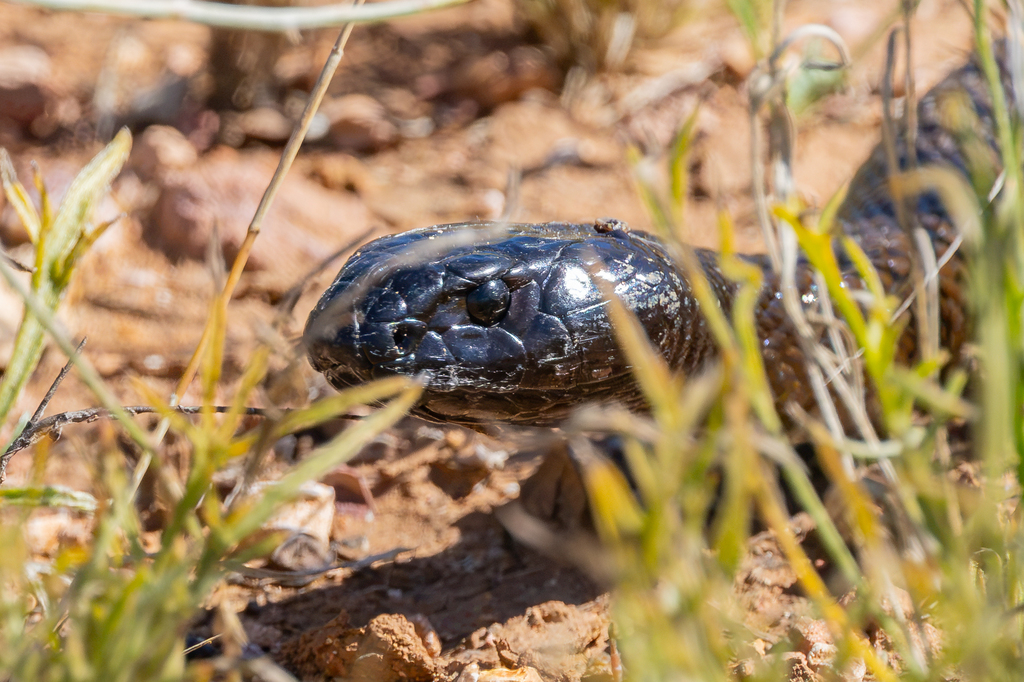
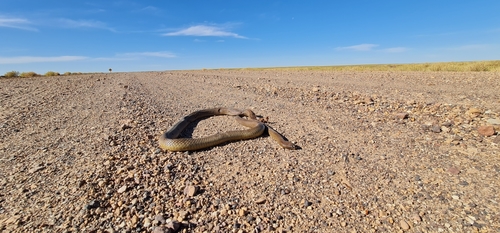
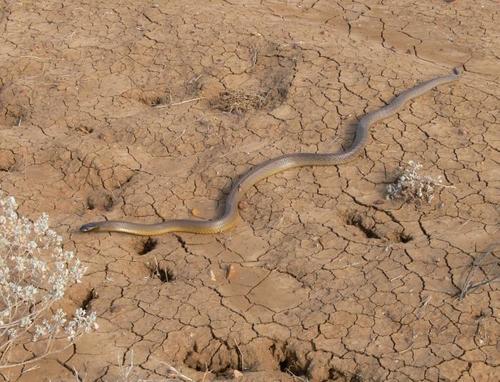
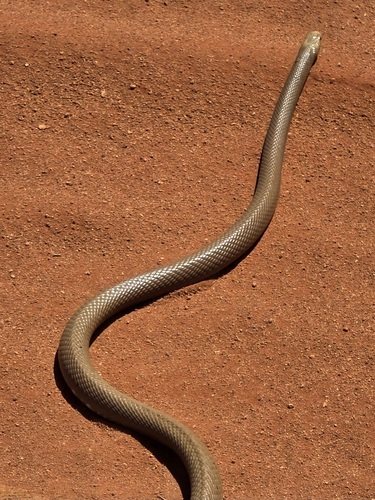
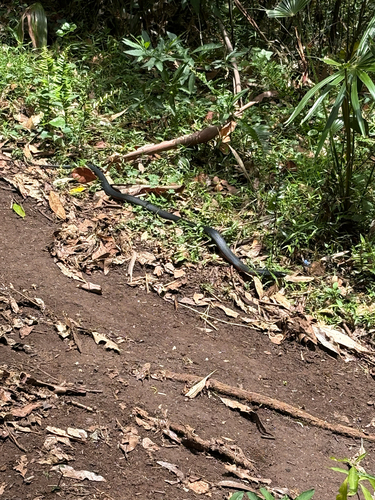
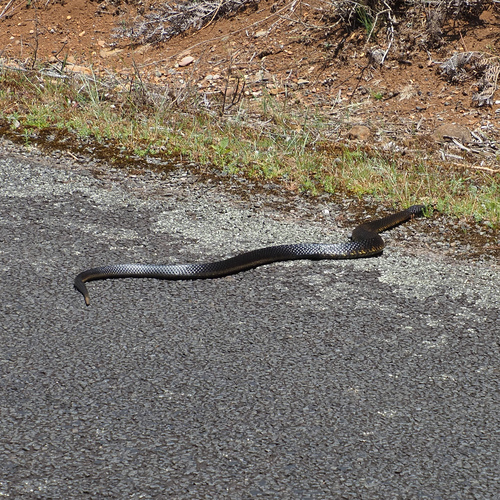
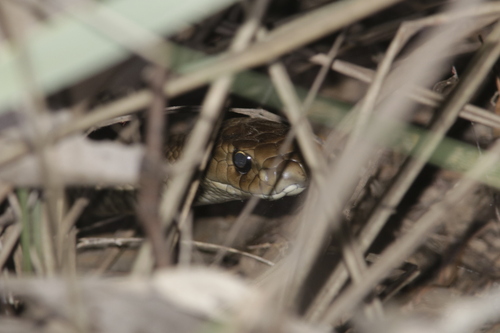
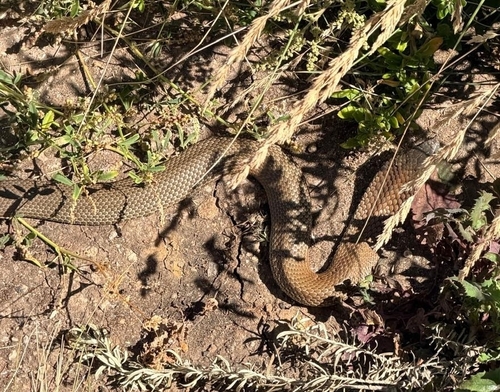
3 photographs of the Inland Taipan. (c) Ramit Singal, some rights reserved (CC BY).
The Inland Taipan (Oxyuranus microlepidotus) is a venomous snake in the Elapidae family, recorded in 1 country.
If you are bitten
This is a venomous snake. Treat any bite as a medical emergency: stay calm, keep the bitten limb still and roughly level with the heart, remove rings and tight clothing, and get to emergency care immediately. Do not apply a tourniquet, cut the wound, apply ice, or try to suck out venom. Call your local emergency number or poison center.
- Family
- Elapidae
- Danger
- high
About the Inland Taipan
The inland taipan (Oxyuranus microlepidotus), also commonly known as the western taipan, small-scaled snake, or fierce snake, is a species of extremely venomous snake in the family Elapidae. It is endemic to semiarid regions of central‑eastern Australia. Aboriginal Australians living in areas where Karnic languages are spoken refer to this species as dandarabilla.
The species was formally described by Frederick McCoy in 1879 and William John Macleay in 1882, but for almost 90 years it remained poorly known to science: no additional specimens were collected and virtually nothing was added to knowledge of its biology until the species was rediscovered in 1972.
Based on the median lethal dose (LD50) of its venom in laboratory mice, the inland taipan is widely regarded as the most venomous snake in the world; its venom is substantially more toxic, drop for drop, than that of any tested sea snake. It is also considered to possess the most toxic venom of any reptile when tested on human heart cell cultures. The inland taipan is a specialised predator of mammals, and its venom is particularly adapted to killing warm-blooded prey. A single bite has been estimated to contain sufficient venom to kill more than 100 adult humans.
Despite this extreme potency, the inland taipan is usually shy and reclusive, with a generally placid disposition, and it rarely comes into contact with people because it inhabits remote areas. By contrast, the coastal taipan (Oxyuranus scutellatus) is often considered the more dangerous species in practice, largely because of its behaviour when it encounters humans and its proximity to populated coastal regions. The word "fierce" in one of the inland taipan's common names refers to the strength of its venom rather than its temperament.
Taxonomy
Among the Aboriginal people from the area now known as Goyder Lagoon in north‑eastern South Australia, the inland taipan was traditionally known as dandarabilla.
The inland taipan was first described scientifically in 1879, when two specimens were collected at the junction of the Murray and Darling Rivers in north‑western Victoria. Frederick McCoy described these as Diemenia microlepidota, the "small‑scaled brown snake". In 1882 a third specimen was collected near Bourke, New South Wales, and William John Macleay described it as Diemenia ferox, believing it to be a different species. No further material was collected until the 1970s.
In 1896 George Albert Boulenger transferred both taxa to the genus Pseudechis (black snakes), treating them as Pseudechis microlepidotus and P. ferox. In 1956, working solely from the published descriptions and notes, James Roy Kinghorn regarded ferox as a synonym of microlepidotus and proposed the new genus Parademansia for the species.
Adapted from Wikipedia, available under CC BY-SA.
Local and regional names
The Inland Taipan is known by these names across the regions where it lives:
- Arabic
- تايبان الداخلي
- Bengali
- ইনল্যান্ড টাইপ্যান
- Bulgarian
- континентален тайпан
- Chinese
- 內陸太攀蛇
- Croatian
- Kopneni taipan
- Czech
- taipan menší
- English
- Fierce Snake, Small-scaled Snake, Western Taipan
- Finnish
- Aavikkotaipaani
- French
- Taïpan du désert
- German
- Australischer Inlandtaipan, Kleinschuppenschlange, Schreckensotter, Westlicher Taipan, Zornschlange
- Hebrew
- טאיפן פנים-יבשתי
- Hungarian
- Kispikkelyű tajpán
- Indonesian
- Taipan pedalaman
- Italian
- Taipan dell'interno
- Japanese
- ナイリクタイパン
- Korean
- 내륙타이판
- Malayalam
- ഇൻലാൻഡ് തായ്പാൻ
- Polish
- Tajpan pustynny
- Russian
- Тайпан Маккоя
- Spanish
- Taipan del interior
- Swedish
- Inlandstaipan
- Tamil
- உள்நாட்டு தைப்பன்
- Thai
- งูไทปันโพ้นทะเล
- Ukrainian
- Тайпан континентальний
- Vietnamese
- Rắn Taipan nội địa
Frequently asked: Inland Taipan
- Is the Inland Taipan venomous?
- Yes. The Inland Taipan (Oxyuranus microlepidotus) is venomous and belongs to the Elapidae family (cobra, mamba, coral or sea snake). Its bite is considered high risk to people. Treat any bite as a medical emergency.
- Is the Inland Taipan poisonous?
- Snakes are venomous, not poisonous. "Poisonous" means harmful to eat or touch; "venomous" means injecting toxins through a bite. The Inland Taipan is venomous, delivering venom through a bite.
- Is the Inland Taipan dangerous?
- This is a venomous snake. Treat any bite as a medical emergency: stay calm, keep the bitten limb still and roughly level with the heart, remove rings and tight clothing, and get to emergency care immediately. Do not apply a tourniquet, cut the wound, apply ice, or try to suck out venom. Call your local emergency number or poison center.
- Where does the Inland Taipan live?
- The Inland Taipan has verified records in 1 country, including Australia. See the distribution section below for its full range.
If you are bitten by the Inland Taipan
Do
- Get away from the snake and stay calm. Most bites worsen when people panic or try again to handle the snake.
- Call 911 or Poison Control (1-800-222-1222) right away. Antivenom works best when given early.
- Note the time of the bite and, from a safe distance, the snake's color and pattern, a phone photo is enough. Do not chase it.
- Keep the bitten limb still and at roughly heart level. Sit or lie down and limit movement.
- Remove rings, watches, and tight clothing near the bite before swelling starts.
- Gently wash the bite with soap and water and cover it with a clean, dry dressing.
Do not
- Do not cut the wound or try to suck out the venom.
- Do not apply a tourniquet or ice.
- Do not drink alcohol or caffeine.
- Do not take aspirin or ibuprofen, they can worsen bleeding. Acetaminophen is safer for pain.
- Do not try to catch or kill the snake. A dead snake can still bite by reflex.
First-aid guidance adapted from the U.S. Centers for Disease Control and Prevention (CDC NIOSH), Venomous Snakes. Educational only; always follow the instructions of emergency responders.
Where it is found
More Elapidae snakes
Classification
How scientists group this snake, from the broadest category down to the exact species. Each step narrows to its closest relatives.
Keep learning
- Are Snakes Dangerous? The Real Risk, in PerspectiveMost snakes are harmless and avoid people. Here is the honest picture of snakebite risk worldwide and how to lower your own.
- Snakebite First Aid: What to Do (and What Never to Do)A clear, CDC-based guide to snakebite first aid: the steps that help, the popular myths that hurt, and how to tell a serious bite from a minor one.
- Venomous vs Nonvenomous: How to Tell the DifferenceThe folk rules for telling venomous snakes apart, where each one fails, and why location-based identification beats guessing by sight.
- What to Do If You Find a SnakeFound a snake at home or on a trail? Here is how to stay calm, give it space, identify it safely, and know when to call a professional.
Distribution from GBIF & iNaturalist. Venom status per CDC. Background: Wikipedia. Informational only. Never handle a snake to identify it.